
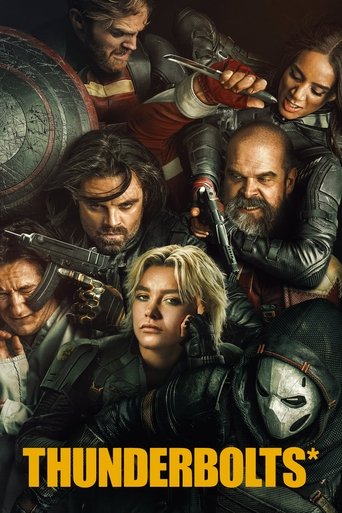
With general interest in the MCU clearly on the decline, Thunderbolts* tries to bring things back to basics, focusing on more grounded characters and the team dynamics that once defined the early Avengers films. It also aims higher thematically, tackling issues like depression, loneliness, and mental health. For some, the mere presence of these themes is enough to elevate it above the studio’s recent output, with a few even calling it the best MCU film since Endgame. But once you move past the novelty of “look, a serious topic in a Marvel movie” and focus on how those ideas are actually handled (not just that they’re there), you’ll find there isn’t much that truly sets Thunderbolts* apart.
That’s not to say the film doesn’t have bright spots. In fact, it has one very bright spot: Florence Pugh. One of the most consistent actors of her generation, Pugh has a way of elevating even the most mediocre material, sometimes to the point of convincing you the movie around her is better than it actually is (Don’t Worry Darling, We Live In Time). She was already the standout in her previous MCU appearances (Black Widow, Hawkeye) and is once again here. Her character’s arc isn’t particularly complex on paper, but Pugh brings it to life with a kind of hollow-eyed sadness that feels lived-in. She’s funny when needed and makes the ensemble click more than the script ever allows. And she does it all without seeming like she’s trying. Her performance here might be one of the best the MCU has seen.
It’s frustrating, then, that outside her efforts, the film doesn’t fully come together. Like many recent Marvel entries, plot developments feel dictated more by franchise planning than by character logic. A late-film team announcement, in particular, feels especially forced. And while I liked how the central emotional conflict wraps up, the journey there feels rushed and inconsistent.
The concept of “inner darkness,” mostly embodied by the character Bob (aka Sentry), played well by Lewis Pullman, isn’t explored any more deeply than what the ill-fated The New Mutants attempted back in 2020, or even the hallucination sequences in Age of Ultron. Truthfully, even lesser-known animated films like Spellbound and Onion and the Dark handle depression with more insight. The marketing certainly doesn’t help, framing this as an “A24-style MCU movie,” which only sets it up for comparison with films like Everything Everywhere All at Once, which it doesn’t come remotely close to. While the metaphor isn’t used to its full potential, the imagery of people turning into shadows is visually striking and arguably the film’s most memorable idea.
As for the rest, the action is fine but never suspenseful. The character dynamics offer a few laughs, but many of the players feel unnecessary. Julia Louis-Dreyfus is clearly enjoying herself as a character you love to hate, but her subplot on a congressional hearing drags on too long. Even Bucky, whom I usually like, doesn’t add much here.
In the end, Thunderbolts* is another serviceable Marvel outing. Casual audiences may appreciate its more grounded tone after the bloated chaos of Quantumania or The Marvels. But even with Florence Pugh carrying much of the emotional weight, this doesn’t feel like the triumphant return to form some fans are hoping for. It’s fine. It’s watchable. It’s yet another two-hour episode in a very long-running series. Nothing more.
- 1Sentimental Value
- 2Hamnet
- 3One Battle After Another
- 4Ne Zha 2
- 5Blue Moon
- 172Thunderbolts*#172 of 256
- Where to watch
 Disney+
- Where to watch
- Disney+
 Play trailer


- Original title
- Thunderbolts*
- Director
- Jake Schreier
- Genre
- Action, Science Fiction, Adventure
- Cast
- Florence Pugh, Sebastian Stan, Julia Louis-Dreyfus, Lewis Pullman, David Harbour, Wyatt Russell, Hannah John-Kamen, Olga Kurylenko
- Rated
- PG
- Screenwriter
- Phil Langone, Anthony Winn, David Krentz, Eric Pearson, Joanna Calo, Coral D'Alessandro, Federico D'Alessandro, Vinny Delay, Mark Sexton, Anthony Liberatore
- Composer
- Ryan Lott, Rafiq Bhatia, Ian Chang
- Cinematography
- Andrew Droz Palermo, Paul Hughen
- Editor
- Harry Yoon, Angela M. Catanzaro
- Country

- Language
- English
- Budget
- $180 million
- Box office
- $382.437 million