
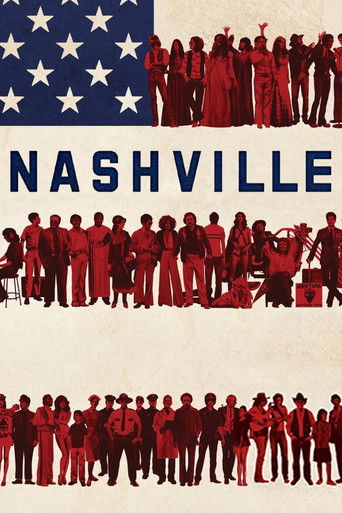
Former US president Barack Obama once remarked, “Our culture is the most successful export in human history,” and American movies play a major role in that export. Hollywood has long shaped global perceptions of American life, often presenting culture as an incidental backdrop to the plot. In Nashville, however, Robert Altman flips this dynamic. Instead of hiding culture within the narrative, he places it front and center, putting it under a microscope. Altman dissects it with sharp precision, exposing its contradictions and magnetic appeal. Set against the backdrop of Nashville’s country music scene, the film not only captures the city’s essence but critiques the myths, ambitions, and flaws that shape both the city and the larger American identity.
Nashville is a sprawling 2-hour and 40-minute epic, sprawling not just in terms of its runtime but also in the vast web of interconnected characters. It takes place over five days, with 24 storylines weaving in and out of focus. This grand structure is a puzzle, particularly in the first hour when it’s challenging to keep track of who is who. It’s a film that invites multiple viewings, as you’ll likely catch new connections and subtle details with each watch. Every scene feels like a piece of art that could stand alone, but together they create a richly textured portrait of the city. While there’s a lot to unpack, first-time viewers will be hooked by the film’s sharp commentary and its fascinating character dynamics.
What makes Nashville stand out is its ability to juggle an ensemble cast and still give each character room to feel fully realized. Altman uses his vast ensemble to explore larger themes like commerce, art, and the American Dream, with each character serving as a reflection of these ideals, often at odds with the reality they face in a world driven by spectacle and image. While Altman never spends too long on any one character, he’s able to provide just enough depth in their brief moments of screen time to make them resonate. The film balances humor, heartbreak, and politics with remarkable ease, using its characters as vessels to explore these larger themes.
The satire in Nashville is both biting and smart, offering a nuanced critique of the entertainment industry, power dynamics, and the commercialization of art. Altman’s commentary on the exploitation of women in the industry is unmistakable, as characters like Sueleen Gay are forced into compromising situations for fame, a direct jab at the systemic abuse of power. But Altman also delves into more subtle themes, like the political corruption that ties business and politics together, distorting the American Dream and often prioritizing image over real human struggles. In this way, the satire in Nashville offers a complex commentary on power, media, and the commercialization of art. These critiques are all woven into the larger picture of American life, highlighting how a culture driven by image and spectacle often ignores the real struggles beneath the surface, such as the apathy toward genuine human suffering.
The cast of Nashville is superb, with Lily Tomlin delivering a standout performance in a rare dramatic role. Her portrayal of Linnea, a gospel singer and mother of two deaf children, is a highlight, especially during Carradine’s unforgettable performance of the Oscar-winning song “I’m Easy.” Tomlin conveys so much with just a glance, capturing the complexity of her character in a single, powerful moment. While her performance is the clear standout, the entire ensemble shines. Altman’s brilliance lies in his ability to cast every actor perfectly, ensuring that each one leaves a lasting impression, even in fleeting scenes.
What’s most impressive about Nashville is its ability to convey so much without resorting to artificial shortcuts. In many films with multiple storylines, there’s often a sense of rushed development or forced connections between characters. But Altman makes it look effortless. Each moment feels earned, and though the film is long, it never overstays its welcome. Nashville is a perfect example of how to balance an ensemble cast, complex themes, and a sprawling narrative, creating a film that’s as entertaining as it is thought-provoking.
- 1One Flew Over the Cuckoo's Nest
- 2Dersu Uzala
- 3Jaws
- 4Nashville#4 of 51
- 5Manila in the Claws of Light
- Where to watch
- Rent or buy at Apple TV Store, Google Play Movies, YouTube, Amazon Video
- Where to watch
- Not available for streaming
 Play trailer


- Original title
- Nashville
- Director
- Robert Altman
- Cast
- David Arkin, Barbara Baxley, Ned Beatty, Karen Black, Ronee Blakley, Timothy Brown, Keith Carradine, Geraldine Chaplin
- Rated
- R
- Screenwriter
- Joan Tewkesbury
- Composer
- Arlene Barnett, Jonnie Barnett, Karen Black, Ronee Blakley, Gary Busey, Juan Grizzle, Allan F. Nicholls, Dave Peel, Joe Raposo
- Cinematography
- Paul Lohmann
- Editor
- Sidney Levin, Dennis M. Hill
- Country

- Language
- English
- Budget
- $2.2 million
- Box office
- $9.996 million