
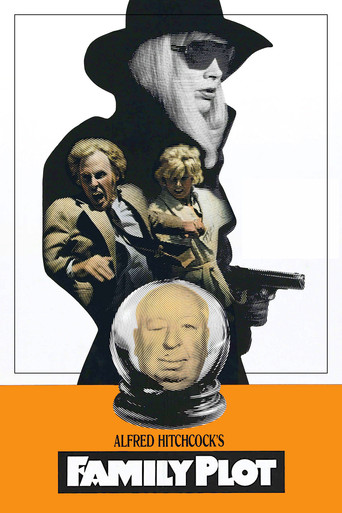

Family Plot marks the 53rd and final film of legendary director Alfred Hitchcock. The master of suspense had notably slowed down in his final decade, directing just two films in the 1970s compared to 11 in the 1950s. Watching it as part of my 1976 journey feels like witnessing the end of an era. Hitchcock built his career on a polished, studio-controlled style, and even his best films have a theatrical quality to them. He famously said, “Drama is life with the dull bits cut out.” So, how would the director approach the 1970s, a decade dominated by filmmakers like Francis Ford Coppola, Martin Scorsese, and Robert Altman, who emphasized realism, moral ambiguity, and experimentation?
In Family Plot, you can see hints of these trends: the main characters are morally gray, the stakes are smaller, and the performances are slightly more natural than you might expect from a Hitchcock film. That said, Barbara Harris still delivers an exaggerated and deliberately silly voice whenever her medium character is “possessed,” which reminds you of the theatricality Hitchcock never abandoned. Ultimately, this is still a Hitchcock film through and through, with his unmistakable visual grammar, suspense sequences, and flair for the dramatic. Watching this right after Marathon Man(another 1976 film featuring William Devane as an antagonist), it’s striking how much Family Plot feels like it’s from an entirely different decade.
Another fascinating element of the film is its score by John Williams. At this point in his career, Williams was on the cusp of becoming Hollywood’s most famous composer, Jaws had catapulted him to fame the year before, and Star Warswould cement his legacy just a year later. Here, you can hear traces of the sound that would define the 1980s, but still rooted in the jazzy orchestration that marked much of his early work. It feels like another way the film exists at a crossroads.
So, how does it work as a Hitchcock film? It’s a decent one. The film has its moments, like the initial theft of the diamond and the tension when the antagonists realize why the main couple has been pursuing them. Throughout, Hitchcock maintains a breezy tone that makes the film an enjoyable watch, with occasional flourishes like the lingering focus on the diamond in the chandelier.
What holds it back, though, is the lack of compelling protagonists. The characters, while intentionally unlikable, aren’t quite engaging enough to make us want to spend time with them. Bruce Dern’s character, in particular, can feel a bit too whiny.
In the end, Family Plot works as a fitting farewell for Hitchcock. It captures much of what he was known for, even if it doesn’t adapt significantly to the stylistic changes of the 1970s. Instead, it’s a fun and breezy swan song for one of cinema’s greatest directors.
- 1Rocky
- 2Taxi Driver
- 3Assault on Precinct 13
- 4Kings of the Road
- 5All the President's Men
- 31Family Plot#31 of 51
- Where to watch
- Rent or buy at Apple TV Store, YouTube, Amazon Video
- Where to watch
- Not available for streaming
 Play trailer


- Original title
- Family Plot
- Director
- Alfred Hitchcock
- Cast
- Barbara Harris, Bruce Dern, Karen Black, William Devane, Ed Lauter, Cathleen Nesbitt, Katherine Helmond, Warren J. Kemmerling
- Rated
- PG
- Screenwriter
- Ernest Lehman
- Composer
- John Williams
- Cinematography
- Leonard J. South
- Editor
- J. Terry Williams
- Country

- Language
- English
- Budget
- $4.5 million
- Box office
- $13.2 million