
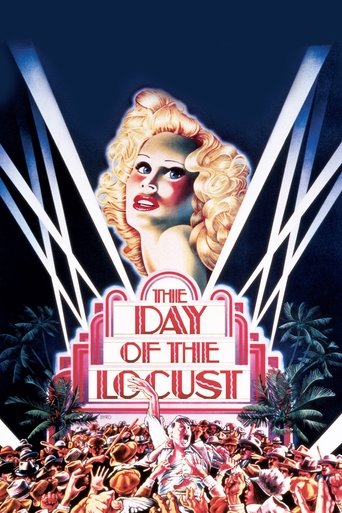
Directed by John Schlesinger and featuring a notable cast including Donald Sutherland and Karen Black, The Day of the Locust provides a vivid portrayal of Hollywood’s superficial allure and harsh realities just before World War II. The film follows Tod Hackett (William Atherton), an aspiring artist who arrives in Hollywood to work as a production designer, only to become entangled with a group of individuals whose dreams are overshadowed by the industry’s ruthlessness.
The film tackles intriguing themes, Hollywood’s pre-World War II glamour and the destructive nature of ambition, offering rich material to explore. It is unfortunate that despite having plenty to work with, the script’s decides to infuse Tod and Faye with traits that extend beyond these themes, particularly Tod’s unsettling behavior towards Faye. This deviation from the central issues contributes to a bloated and uneven experience, leaving the film feeling overextended and unfocused at its 144-minute runtime. There are moments when the film could benefit from more subtlety, as certain images, such as the rose in the wall, come across as overly blunt and on-the-nose.
The performances in the film are strong overall. Burgess Meredith, who earned an Oscar nomination for Best Supporting Actor, brings genuine depth to his role, especially in a scene which he reflects on his past. Donald Sutherland’s portrayal of a character ironically called Homer Simpson (years before that series), a repressed man struggling with his religious beliefs, is notably sensitive and compelling. His performance is so effective that it nearly single-handedly makes the film’s tragic final act resonate.
The film’s technical elements, particularly its production design and cinematography, masterfully capture Hollywood’s blend of grandeur and disillusionment. The city is portrayed as a realm of unending sunshine and opulence, with its striking visuals sharply contrasting the dark themes explored. While John Barry’s score enhances the atmosphere, it occasionally distracts with its overly comedic tones and lack of the required melancholy. The film’s exploration of Hollywood’s dark side, such as the unsettling cockfighting scene, effectively highlights the town’s corruption and are nice detours. Despite these interesting moments and themes, The Day of the Locust is hampered by a disjointed narrative and uneven character development, leaving viewers with a sense of missed potential despite its technical achievements.
Still courtesy of Paramount Pictures
- 1One Flew Over the Cuckoo's Nest
- 2Dersu Uzala
- 3Jaws
- 4Nashville
- 5Manila in the Claws of Light
- 36The Day of the Locust#36 of 51
- Where to watch
- Rent or buy at Apple TV Store, Google Play Movies, YouTube, Amazon Video
- Where to watch
- Not available for streaming
 Play trailer


- Original title
- The Day of the Locust
- Director
- John Schlesinger
- Genre
- Drama
- Cast
- Donald Sutherland, Karen Black, Burgess Meredith, William Atherton, Geraldine Page, Richard Dysart, Bo Hopkins, Pepe Serna
- Rated
- R
- Screenwriter
- Waldo Salt
- Composer
- John Barry
- Cinematography
- Conrad Hall
- Editor
- Jim Clark
- Country

- Language
- English
- Distributor (CA)
- Paramount Pictures