
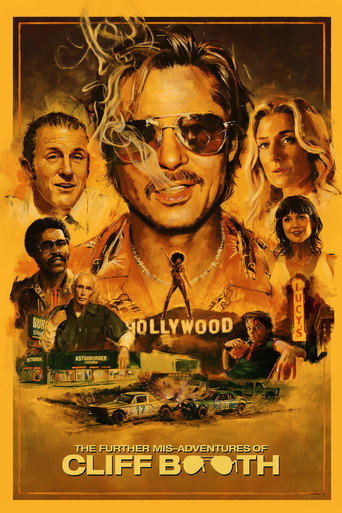
Overview
If Once Upon a Time… in Hollywood looked at the heart of the American film industry on the verge of its downfall with wide-eyed enthusiasm and nostalgia, filling its streets with color and life and ultimately imagining an alternative reality in which that downfall would never happen, The Further Mis-Adventures of Cliff Booth takes us to a time when it has already happened, with its characters now living amid the decay of the once glamorous city.
This time, we follow only Cliff Booth (Brad Pitt), with Rick Dalton nowhere to be seen. Having largely retired from stunt work, Cliff now makes a living juggling several occupations, most notably as a Hollywood fixer, the man people in the industry turn to when they have a problem that needs solving. Much of the film follows his daily routine and various misadventures before the main plot kicks in, when talent agent Karen Crosby (Elizabeth Debicki) approaches him on behalf of television star Charlie Peters (Scott Caan), who has managed to piss off a pair of Filipino hitmen.
Background
Following the success of Once Upon a Time… in Hollywood, Quentin Tarantino began developing what was supposed to be his tenth and final film, The Movie Critic, set in 1977 Los Angeles and following a film critic writing for a pornographic magazine. Originally conceived as a television series, the project was abandoned in April 2024, partly because Tarantino felt that recreating another period of Hollywood history no longer presented much of a creative challenge to him. He remained interested in the period, however, and wrote another screenplay set in 1977, this time revisiting Cliff Booth, whose backstory he had already expanded upon in his 2021 novelization of Once Upon a Time… in Hollywood. Although pleased with the screenplay, Tarantino had little interest in revisiting the same characters for his final film, and with Tarantino’s blessing, Brad Pitt approached David Fincher, with whom he had collaborated three times before.
Still under an exclusive contract with Netflix, Fincher enthusiastically accepted, particularly excited by the opportunity to make something quite different from his previous films. While shooting, he trimmed Tarantino’s original 230-page screenplay to about 170 pages and brought several regular collaborators, including cinematographer Erik Messerschmidt, editor Kirk Baxter, and composers Trent Reznor and Atticus Ross. The film received an unprecedented wide IMAX release, one month ahead of its streaming debut.

The Review
Visually and tonally, there is very little of Once Upon a Time… in Hollywood that carries over into The Further Mis-Adventures of Cliff Booth, which feels more as if Fincher is making his own version of a ’70s noir film than trying to emulate Tarantino’s style. As expected with Fincher, the film is dour and depressing, which fits what the script is going for. Instead of blood gushing and body parts flying, we have truly upsetting cold murders, two of which might make you sick to your stomach. Where the world surrounding Rick and Cliff in the original film felt so full of life, here it feels as if everyone has grown cynical and hopeless, and much of the glamour of working in the industry seems to have worn off.
That’s not to say that all the fun is lost, with this easily being one of Fincher’s most downright entertaining films, although it is far less flashy and zippy than the script suggests. Scenes like the date in which Cliff takes Karen to watch him compete in a figure-eight race could have used a little more energy, and the drab colors and overly digital look of Erik Messerschmidt’s cinematography rob the film of some of its spark. But the moments when Fincher allows himself to loosen up, such as the opening five minutes (the film’s best scene) or when Charlie Peters loads his gun with real bullets on a movie set, are fantastic.
Equally effective are the sequences that feel distinctly Fincher’s. The two scenes where we see the hitmen in action are easily among the year’s tensest, with the director making great use of shadows and uncomfortable silences that instantly recall Zodiac. Thematically, the film also touches on some of the director’s recurring interests, particularly institutional corruption and the isolation of men who seemingly have everything under control. The score by his regular collaborators Trent Reznor and Atticus Ross has a few lovely moments of noir melancholy and generally complements the film’s tone well, except when the composers jarringly bring in modern electronics. Also distracting is Fincher’s admitted use of generative AI in postproduction, especially in a quick montage going over Charlie’s career.
As is often the case with a Tarantino script, the film has its pacing issues, something Fincher couldn’t entirely fix even after considerably trimming the screenplay. This is most apparent in the film’s awkwardly rushed conclusion, but throughout there is always the feeling that a few scenes run for too long while others deserved a little more attention. It is especially indulgent with lengthy exchanges that add little to the narrative or themes of the film. One of them has Tarantino sharing his views on film criticism through a long monologue delivered by Karen, with an arrogance that feels much more characteristic of Tarantino himself than of Karen. For a good two minutes, she essentially reduces film criticism to someone describing how much they liked their hamburger. It’s a rather dismissive view of a profession that can help audiences appreciate and better understand the very art form Tarantino cares so much about, and a somewhat hypocritical one coming from a filmmaker who has never been particularly shy about sharing his own (often condescending) opinions on other people’s films.
Yet there are many moments where the usual Tarantino excellence comes through in his script, especially when it comes to the dynamics between characters. Cliff Booth remains a character largely defined by how he reacts to those around him, and it is particularly entertaining to see how little patience he has for the two thugs at the start and, later, for Charlie’s predicament. What makes him a little more interesting this time around is how increasingly lonely his life has become. Even his relationship with his father (wonderfully played by Peter Weller), whom Cliff perhaps sees as his last truly meaningful connection, seems to be just as transactional from his father’s perspective as most of Cliff’s other relationships. There is a hint of regret in the way Cliff looks at Toni, now married, yet he finds himself entering another seemingly temporary relationship with Debicki’s Karen, who doesn’t always seem to have things nearly as figured out as she would like to think. There is a growing sense of melancholy to Cliff, a man who possesses so many of the qualities other men envy and yet finds himself increasingly alone as the years go by.
Still, Pitt hasn’t lost any of the effortless charisma that made Cliff so captivating in the first place, and the character remains enormously entertaining to watch. The prospect of Tarantino retiring from directing but continuing to write stories set in this universe, while collaborating with other major filmmakers, is an extremely exciting one. The next stop would presumably be the ’80s, so how about a Tarantino and Spielberg collaboration?
Final Thoughts
The Further Mis-Adventures of Cliff Booth is a fascinating combination of Fincher and Tarantino’s sensibilities, expanding the world of Once Upon a Time… in Hollywood in interesting directions while standing on its own as a smart and entertaining crime noir. Smaller and more inconsequential than its predecessor, and hampered by uneven pacing and disappointingly bland cinematography, it never quite shakes that ‘direct-to-streaming’ feeling, even in IMAX, but delivers some fantastic sequences whenever Tarantino’s strengths as a writer and Fincher’s precision as a director join forces.
Still courtesy of Netflix
- Original title
- THE FURTHER MIS-ADVENTURES OF CLIFF BOOTH
- Director
- David Fincher
- Where to watch
- New In Theaters
- Where to watch
- Coming soonDec 23, 2026
- Cast
- Brad Pitt, Elizabeth Debicki, Scott Caan, Carla Gugino, Yahya Abdul-Mateen II, Peter Weller, Matt Groove, JB Tadena
- Rated
- R
Crew and more details
- Screenwriter
- Quentin Tarantino
- Composer
- Trent Reznor, Atticus Ross
- Cinematography
- Erik Messerschmidt
- Editor
- Kirk Baxter
- Country

- Language
- English
- Budget
- $200 million
- Distributor (CA)
- Netflix
 Play trailer
- 1Everytime
- 2Hadestown: The Musical
- 3Minotaur
- 4You Can See Everything
- 5Hope
- 46THE FURTHER MIS-ADVENTURES OF CLIFF BOOTH#46 of 236


