
The Coen brothers were always one of the best examples of directorial collaboration, showing how two opposing but complementary instincts could push each other as far as possible. With one disciplined and the other loose, the wackiest comedies became, under their surface, carefully structured with grim undertones (A Serious Man, Burn After Reading), while the heaviest dramas still carried a strange and unique sense of humor (the opening of No Country for Old Men). Since their break, each has followed their own instincts more strongly, and without the balance of the other, those instincts have become their films’ greatest weakness. Joel’s The Tragedy of Macbeth was so grim and ultra-serious it suffocated every scene. Ethan’s Drive-Away Dolls, and now Honey Don’t!, swing the other way, unruly, disjointed, and badly out of touch.
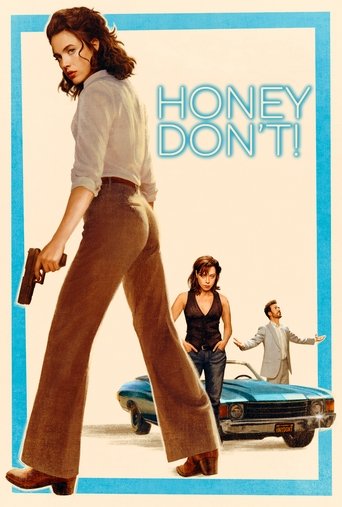
In Honey Don’t!, the second in Ethan’s so-called trilogy of “Lesbian B-Movies” (is there a more degrading way to sell your franchise?), Margaret Qualley plays a detective drawn into a chain of noir setups involving murders, shady cops, and a cultish reverend. The film mixes comedy and mystery, noir and screwball, a combination the Coens once mastered but which now works against itself at every turn.
Compared to Drive-Away Dolls, one of the worst misses by a major filmmaker in recent memory, Honey Don’t! at least has some redeeming features and shows flashes of Ethan’s sensibility and technical craft. Its greatest strength is Margaret Qualley, magnetic in a performance that captures the film’s genre-bending better than anything else in the production. She shifts effortlessly between noir cool, intelligence, and comic timing, while also giving the film the heart it needs in its rare moments of focus. She holds together scenes that would collapse with a less committed actress. Ari Wegner’s cinematography captures a sun-drenched, sweltering heat so intense it feels unbearable, with every frame radiating the kind of oppressive summer day no one can stand, giving the film an almost invisible urgency. There are also individual sequences that are undeniably effective, such as a darkly comic parking lot murder, a violent clash after a grandmother’s death, a Lena Hall piano cameo, and a twist involving a stranger at a bus stop. In those moments you glimpse the film that might have been had Joel’s control been there to keep Ethan in check.
But the looseness takes over and the movie goes off the rails. It piles on noir setups for nearly an hour, the opening murder, the parking lot murder, the grandmother murder, all playing like catalysts instead of progression. In noir it is common to have loose threads and red herrings, but when every scene is a setup with no payoff, it becomes hard to care about anything. When you realize that Chris Pine’s much-maligned Poolman shows better control of its tone and story, you start to wonder if Ethan should even finish this trilogy.
Ethan’s biggest misstep is not technical but how out of touch he looks when trying to appeal to modern audiences. The film pushes raunchiness, nudity, and a forced sense of edginess that feels like something left behind twenty years ago. The humor is incredibly off-putting, especially in the repetitive scenes with Chris Evans, who delivers what may be the worst performance of his career. In a run increasingly filled with misfires, the film somehow gives him his most unlikable character yet, smug, grating, and desperately straining for laughs. The word “macaroni” will make you cringe. The film also tries to present itself as inclusive by giving us a lesbian protagonist, but beyond her, women are either exploited through gratuitous nudity and an objectifying gaze, or left as needy and underdeveloped characters.
About twenty percent of Honey Don’t! works. Qualley and a handful of specific scenes prove there is still a spark in Ethan’s chaos, but without Joel’s balance it is wasted, leaving only a pale echo of the Coens’ classic work, scattered and indulgent. You wonder what longtime collaborators like Carter Burwell or Jess Gonchor must think, having gone from No Country for Old Men and Inside Llewyn Davis to the macaroni scene. More than anything, Honey Don’t! is another reminder that when the brothers contrast and complete one another, they create something timeless. It is time they came back together to give us the kind of cinematic magic that only happens when their complementary strengths collide.
Still courtesy of Universal Pictures Canada
- 1Sentimental Value
- 2Hamnet
- 3One Battle After Another
- 4Ne Zha 2
- 5Blue Moon
- 212Honey Don't!#212 of 256
- Where to watch
 Prime Video
- Where to watch
- Prime Video
 Play trailer


- Original title
- Honey Don't!
- Director
- Ethan Coen
- Cast
- Margaret Qualley, Aubrey Plaza, Chris Evans, Lera Abova, Jacnier, Gabby Beans, Talia Ryder, Charlie Day
- Rated
- R
- Screenwriter
- Ethan Coen, Tricia Cooke, J. Todd Anderson
- Composer
- Carter Burwell
- Cinematography
- Ari Wegner
- Editor
- Tricia Cooke, Emily Denker
- Country


- Language
- English
- Budget
- $20 million
- Box office
- $7.445 million
- Distributor (CA)
- Universal Pictures Canada