

Overview
Sucker Punch marked Zack Snyder’s first attempt at an original feature, after a series of adaptations largely focused on masculine violence and heroism. Here, he explores female exploitation and the struggle for autonomy, while retaining the exaggerated action, sexualized imagery, and slow-motion spectacle of his earlier work. Can the two coexist?
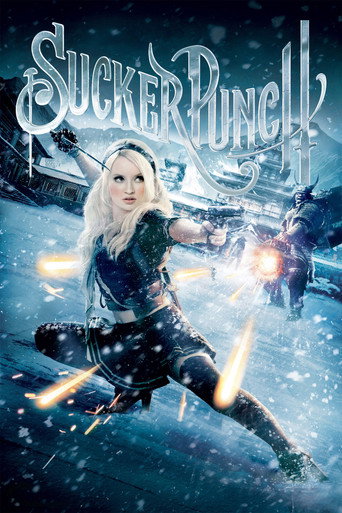
Set in the 1960s, the story follows Babydoll (Emily Browning), a young woman committed to a psychiatric hospital after accidentally killing her younger sister while trying to protect her from their abusive stepfather. With a lobotomy scheduled in five days, she retreats into an imaginary world where the institution becomes a brothel controlled by the cruel Blue Jones (Oscar Isaac). There, she befriends four other young women (Abbie Cornish, Jena Malone, Vanessa Hudgens, and Jamie Chung), and together they devise an escape plan. Whenever Babydoll performs a dance to distract their captors, she enters yet another fantasy, where the women become heavily armed warriors fighting giant samurai, zombie soldiers, dragons, and robots.
Background
The idea for Sucker Punch originated in an early screenplay Zack Snyder wrote before becoming a feature film director, starting with the simple premise of a young woman who escapes the humiliation of performing for men by imagining herself in an entirely different world. Snyder later expanded the concept with Steve Shibuya, developing the screenplay after Watchmen (2009) and drawing inspiration from films such as Brazil (1985), Frances (1982), and All That Jazz (1979). Amanda Seyfried was initially cast as Babydoll but withdrew due to scheduling conflicts, with Emily Browning taking the role. Filming took place in Vancouver in 2009 and early 2010, combining extensive visual effects with elaborate stunt choreography. The film received largely negative reviews and underperformed at the box office, but developed a cult following in the years that followed (particularly among Snyder’s devoted fans, many of whom seem to spend half their days on social media campaigning for his return to the DC universe). A 127-minute Extended Cut was subsequently released on Blu-ray, although Snyder has repeatedly expressed interest in releasing his original, more elaborate director’s cut. Release the Snyder Cut, goddammit!
The Review
The Extended Cut might make Snyder’s intentions a little clearer, and who knows, perhaps his still-unreleased director’s cut will prove revelatory, but as it stands, whatever noble intentions the director might have had with his script are completely undermined by its atrocious and misguided execution. As a narrative, it is overly simplistic, poorly developed, and downright infantile. As a satire, it is hardly any more sophisticated. On both fronts, Snyder seems convinced that what he is delivering is far more interesting and meaningful than it actually is.
After an admittedly engaging opening, where we witness the tragedy that places Babydoll in the asylum, we are taken into her imaginary world, and later, into a fantasy within that fantasy. Until the final minutes, the connections between these different layers remain so thin that much of the film consists of watching events unfold with little reason to care about their consequences. There is barely any momentum in the girls’ quest to collect the objects they need to escape, and the plan itself is remarkably elementary. Even worse are the video-game levels they are transported to, consisting of several minutes of occasionally beautiful but completely weightless action sequences.
Snyder gets to indulge (a lot) in these sequences, whether creating his own version of The Lord of the Rings, revisiting the zombie genre, or playing with samurai cinema and World War I battles. Yet despite their different settings, they share the same drab, digitally created aesthetic, and between the rock soundtrack, excessive slow motion, and repetitive camera movements, they quickly become interchangeable. The girls have practically no personality during these adventures, simply going through the motions as they fight one computer-generated enemy after another. Never has so much visual excess felt quite so dull.
As for the satire itself, there is the elephant in the room: Snyder making a critique of the exploitation of young and beautiful women while seemingly exploiting those same women himself (Browning was 20 at the time). True, the highly sexualized dances are never shown, but filming young actresses in revealing costumes, accompanied by occasional suggestive moans during the action, with the camera frequently lingering on their thighs and bellies, is more than a little suggestive.
Even more frustrating is how little actual agency Snyder’s script gives these women. They want to escape, but to do what? What do they want from life beyond leaving the institution? Why does their escape eventually require a sacrifice, and why does a betrayal need to be thrown into the mix? Their relationships are barely explored, and their individual personalities are so poorly defined that even their deaths struggle to have much emotional impact. The script even wastes the few intriguing ideas it raises, such as the suggestion that Carla Gugino’s character might have been subjected to similar mistreatment herself. Snyder’s understanding of these women seems limited to the fact that they are oppressed, want to escape, and must work together to do so, with little interest in who they are beyond those circumstances. Simply declaring that you’re telling a feminist story and having female protagonists fighting against oppressive men is nowhere near enough.
Final Thoughts
Sucker Punch has a few aesthetically beautiful moments, but its paper-thin characters and exhausting action sequences make for an empty and remarkably suspense-free experience. Zack Snyder has an interesting idea about exploitation and spectacle, but seems far more interested in indulging in the latter than meaningfully exploring the former.
- Original title
- Sucker Punch
- Director
- Zack Snyder
- Where to watch
- Rent or buy at Apple TV Store, YouTube, Amazon Video
- Where to watch
 Netflix
 Max
- Cast
- Emily Browning, Abbie Cornish, Jena Malone, Vanessa Hudgens, Jamie Chung, Carla Gugino, Oscar Isaac, Jon Hamm
- Rated
- PG-13
Crew and more details
- Screenwriter
- Zack Snyder, Steve Shibuya
- Composer
- Marius de Vries, Tyler Bates
- Cinematography
- Larry Fong
- Editor
- William Hoy
- Country

- Language
- English
- Budget
- $82 million
- Box office
- $89.793 million
 Play trailer


