OVERVIEW
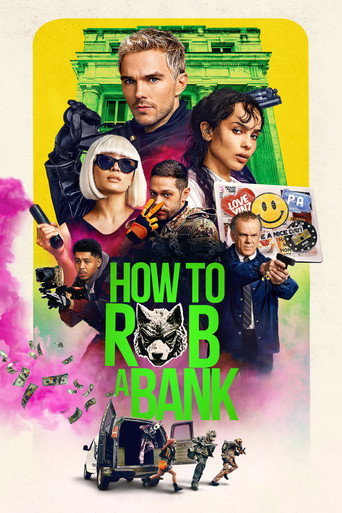
Robin Hood would probably have done quite well on YouTube, at least judging by the success of the four masked robbers at the center of David Leitch’s How to Rob a Bank. Ryan (Nicholas Hoult), his wife Emi (Anna Sawai), Army veteran Vince (Pete Davidson), and their tech-savvy friend Hugo (Rhenzy Feliz) have come up with an unusual way to promote their YouTube channel: they film themselves robbing banks while ranting about the system (we all know how well the latter goes over on YouTube). Not a fan of their channel is FBI agent West (John C. Reilly), who enlists the help of a programmer under house arrest (Zoë Kravitz) to find out who those masked robbers are. It’s an ultra-modern take on the heist film, although once you look past all the visual stimulation, it tells a story you’ve seen quite a few times before.
BACKGROUND
Inspired by an online video of thieves stealing an ATM, Mark Bianculli’s screenplay spent years in development before landing with David Leitch and his producing partner, Kelly McCormick, for whom a heist film seemed like a fairly safe bet after the box-office disappointment of The Fall Guy. The project found a home at Amazon MGM, which was looking to expand its theatrical slate and would release another bank heist film, Crime 101, earlier that year. Leitch wanted to pay homage to 1970s crime films like Dog Day Afternoon while embracing the headache-inducing flash of modern YouTube videos. Curiously, getting YouTube’s logo into the film took some negotiation, with Leitch himself admitting that the crew probably wouldn’t get away with posting those videos on the platform. Amazon originally scheduled the film for Labor Day weekend before moving it to mid-November, reportedly hoping that strong early test screenings with younger viewers would translate into a bigger audience over Thanksgiving.

THE REVIEW
Despite its ultra-modern exterior, How to Rob a Bank remains a very conventional bank robbery film, going through all the tropes you’ve seen countless times before. There’s the FBI agent nearing retirement, the gang with the noblest of causes, a high-speed chase, and a final heist. Crime 101 proved that a well-executed version of all this can still be entertaining, as long as we come to care about the characters and the thrills themselves are well constructed. How to Rob a Bank may earn a few points for trying to bring the premise up to date, but unfortunately, it struggles to get the basics right.
Much of the conflict revolves around the morality of its protagonists and of Agent West, the man pursuing them. West is very much a victim of the system himself, determined to catch the thieves both to protect such system, but more importantly, because not catching them would tarnish the reputation he’s spent years building at the FBI. Meanwhile, Ryan and his gang are angry. Tired of being exploited by capitalism and the banks, they go on and on about how they’re the Robin Hoods of modern times, stealing from the rich, who will hardly miss the money, and giving it to the poor, whose lives could be transformed by a handful of bills.
The message is about as complex as that of any Robin Hood adaptation and delivered with the same bluntness you’ll find in plenty of YouTube rants. At one point, Zoë Kravitz’s character spells out how unfairly someone with student loans is treated compared to a company in debt, while most of the gang have suffered through the banks’ merciless tactics themselves. Banks suck. What’s new again?
Outside of the self-indulgent, heavy-handed message, you get subpar thrills along with some underwhelming characters. The film starts much better than it goes on, with the first robberies and chases featuring the same overabundance of style Leitch brought to Bullet Train. The first act admittedly sets the pieces in place well enough. We learn the gang’s tactics, and Reagan and West are established as worthy foes. Their first move against the gang comes far earlier than expected, and after that, the film grows largely uninteresting and repetitive. If the idea was to make a modern Dog Day Afternoon, the result feels a lot closer to the Now You See Me and Fast & Furious movies.
The actors do their best, but they’re all ultimately sabotaged by a script that sees them more as ideas than as actual people. Hoult, Sawai, and Kravitz suffer the most. Hoult plays a good-guy variant of his character from The Order, while also showing that he wouldn’t make a very good influencer. Sawai, coming off the huge success of Shōgun, is playing such an underwritten character that her attempts at showing emotion come across as forced and out of place. Kravitz gets a few funny lines and situations, mostly involving her cravings for junk food, but nothing more. The character has so little agency that when West checks back in on her a few days after she’s done her part in the case, she’s literally doing nothing and perks up simply because she has something to do again. Doesn’t she have any other ambitions or hobbies? John C. Reilly is always good, but the surprising highlight is a now-fit Pete Davidson, who plays the most genuine character and gets the film’s one emotional scene. It’s a performance and a character arc that could have landed far better in a stronger and perhaps more serious film, and Davidson could and should be chasing more roles like it. Beyond how thinly everyone is written, the plan itself doesn’t make much sense either. Was their whole elaborate effort to build a following really necessary for the outcome? It’s hard to gain followers nowadays, but you can’t help thinking they could have saved themselves a lot of trouble by jumping straight to the last act.
Despite the characters failing to stick and the film’s limited thematic ambition, there’s a bit of fun to be had with Leitch’s style. He and cinematographer Jonathan Sela do a good job shifting between the 35mm scenes of the characters’ personal lives and the digital footage they shoot for their channel, and their TikTok mimicry is often amusing. The usual high-speed chase is a bit too short but thrilling enough, while the shootouts fall short of the genre’s standards. Dominic Lewis’s score is both melodically cool and tonally obnoxious, much like his work on Bullet Train, though this time it leans more toward the latter. Occasionally, an impressive camera movement catches your attention, like the long take that follows Hugo through his community. Ultimately, though, the film feels like watching hours of YouTube videos. It passes the time but leaves you with very little to hold on to.
FINAL THOUGHTS
Despite its ultra-modern exterior, How to Rob a Bank is a formulaic and flimsy heist film. There’s some fun to be had with David Leitch’s flashy style, particularly during the early robberies, but once the action grows repetitive, we’re left with tiresome characters who go on and on about their grievances. Well, at least it gets YouTube right!
Still courtesy of Amazon MGM
- 1Everytime
- 2Hadestown: The Musical
- 3Minotaur
- 4You Can See Everything
- 5Hope
- 176How to Rob a Bank#176 of 230
- Where to watch
- Coming soonNov 13, 2026
- Where to watch
- Coming soonNov 12, 2026
 Play trailer


- Original title
- How to Rob a Bank
- Director
- David Leitch
- Cast
- Nicholas Hoult, Zoë Kravitz, Anna Sawai, Rhenzy Feliz, Pete Davidson, John C. Reilly, Christian Slater, Tati Gabrielle
- Rated
- R
- Screenwriter
- Mark Bianculli
- Composer
- Dominic Lewis
- Cinematography
- Jonathan Sela
- Editor
- Elísabet Ronaldsdóttir
- Country

- Language
- English
- Distributor (CA)
- Amazon MGM