
OVERVIEW
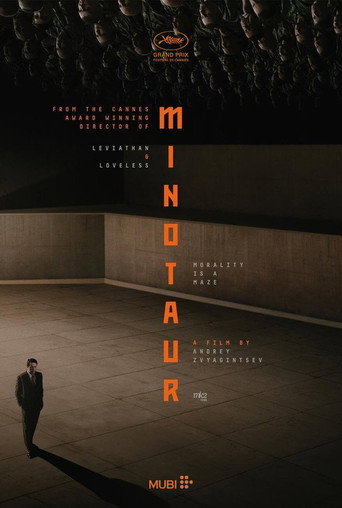
In Krasnoborsk, a fictional Russian city in 2022, Gleb (Dmitriy Mazurov), CEO of a shipping company, is pressured to send fourteen men to the front for the Russian draft. At the same time, he begins suspecting that his wife, Galina (Iris Lebedeva), might be having an affair, and rather than confront her, starts to follow her around the city, slowly building a case in silence.
BACKGROUND
It’s been nine years since Zvyagintsev’s Loveless, which won the Cannes Jury Prize in 2017, and those years were incredibly eventful and difficult for the Russian director. He almost died from COVID complications in 2021, and later moved his family from Moscow to Paris in 2022, having not returned to Russia since, partly because going back would risk being labeled a foreign agent at this point. On the professional side, Zvyagintsev has also been struggling to get his next project, Jupiter, off the ground due to a lack of financing. Originally a parallel project, Zvyagintsev shot Minotaur in Riga over the autumn of 2025, with the hope of returning to Jupiter next. It arrived in the festival as one of the most anticipated titles.

THE REVIEW
Unlike the festival’s other three most anticipated returns, All of a Sudden, Fatherland, and Fjord, each of which revisits familiar thematic territory with diminishing returns, Minotaur is the entry where a director most clearly sharpens his earlier preoccupations into what arguably stands as his finest work. Although admittedly smaller than his previous films in scope, and featuring a more basic premise (it is an adaptation, after all), the resulting work feels as immaculately mounted and precise in its execution as we’ve come to expect, and yet its handling of the themes is his most elegant and assured yet.
It is undoubtedly a bleak film, and one that, unlike All of a Sudden, leaves you with a little less hope for humankind. As he did in Leviathan and Loveless, Zvyagintsev treats the family as a working model of the state. The monstrosity, the corruption, and, as always, the complacency that happens in that storyline are simply the same machinery that operates in Russia, observed at a smaller scale.
At its center is Galina’s possible affair, which follows a classical structure, and on its own, it might go the way you’d expect. A few things of note elevate it. One is how Zvyagintsev builds Gleb outright as the one suffering unfairly (despite his wife mentioning that he himself had many affairs, the direction is still very much on his side, making you feel empathy even as his own issues grow larger and larger as the movie goes on). Similarly, Zvyagintsev and Lebedeva are fantastic in subtly hinting at Galina’s side of the events. A very attractive woman, it is not hard to imagine how forced she was into the relationship and how much she had gone through before the film started. As that storyline progresses, Zvyagintsev also throws in some dark humor that works extremely well while never taking viewers out of the movie.
Still, what truly enriches that storyline is its parallel to what Gleb must do, an action that, like the mythology that names the film (always deeply symbolic titles!), requires an inhuman sacrifice that only truly monstrous people can do. The film moves well until it reaches the point where Gleb must take a few actions, and the surprising aftermath of those actions is as cold and gut-wrenching as anything seen at Cannes in 2026.
The film also features deliberate cinematography by Mikhail Krichman, which consistently separates Gleb and Galina while making the whole world oppressive with a constant palette of grays. There is a single moment of warmth in the film, where the camera moves freely and creates a spark in contrast to the methodical surroundings, but of course, it doesn’t last long. The film is technically accomplished, masterfully conducted by Zvyagintsev, yet disheartening in its themes. It closes with a memorable final shot that wraps all of the film’s storylines and themes, and will undoubtedly stand as one of 2026’s most devastating images.
FINAL THOUGHTS
Minotaur finds Zvyagintsev operating at the top of his game. It builds on his earlier work, once again using a central family as a microcosm of Russia. Appropriately dark yet unexpectedly funny, it is engaging in its storyline and rich in its ideas. The result is not only a statement on where Russia is and what it costs to live there, but also on the corruption and complacency beneath the surface that keep it that way.
Still courtesy of MUBI
- 1Everytime
- 2Hadestown: The Musical
- 3Tuner
- 4Minotaur#4 of 219
- 5You Can See Everything
- 1Minotaur#1 of 52
- 2Wild Horse Nine
- 3The Man I Love
- 4The Unknown
- 5La Gradiva
- 1Minotaur#1 of 34
- 2Hope
- 3The Man I Love
- 4The Unknown
- 5La Gradiva
- Where to watch
- Coming soonNov 20, 2026
- Where to watch
- Coming soonDec 3, 2026
 Play trailer


- Original title
- Minotaure
- Director
- Andrey Zvyagintsev
- Cast
- Dmitriy Mazurov, Iris Lebedeva, Varvara Shmykova, Juris Žagars, Anatoliy Belyy, Vladimir Friedman, Anastasia Mischenko, Yurii Zavalnyuk
- Screenwriter
- Simon Lyashenko, Andrey Zvyagintsev, Claude Chabrol
- Composer
- Evgueni Galperine, Sacha Galperine
- Cinematography
- Mikhail Krichman
- Editor
- Andrey Zvyagintsev
- Country




- Language
- French
- Distributor (CA)
- MUBI