
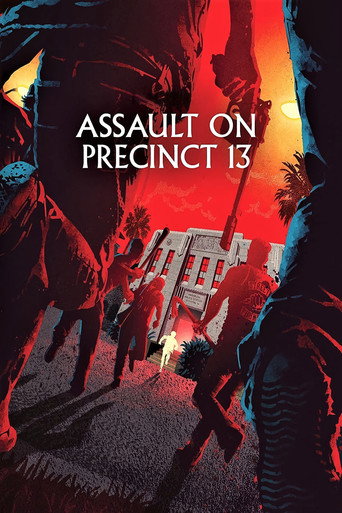

Two years before defining the slasher genre with Halloween, John Carpenter arguably delivered an even tighter, more well-rounded film with Assault on Precinct 13, and on an even smaller budget. His status as a master of horror is undeniable, but beyond that, he excels at doing more with less. Indie filmmakers could learn a lot from both this and Halloween.
Made for just $100,000 and shot in 20 days, the film never feels cheap. Carpenter’s use of widescreen cinematography (2.35:1 Panavision), long takes, and precise shot composition creates an immersive experience far beyond its budget. The cast and crew were mostly friends, and he cut, composed, and edited the now-iconic synth score himself, an approach he’d revisit in Halloween. He also smartly uses sound, with silenced gunfire adding to the eerie atmosphere while serving its narrative purpose, enhancing the film’s sense of scale and tension.
But as striking as the film looks and sounds, Assault on Precinct 13 is an even greater showcase of Carpenter’s storytelling. His economical pacing, tight structure, and ability to build tension with minimal exposition are on full display. He introduces characters efficiently, making them engaging and memorable from their first scene despite the film’s stripped-down dialogue. The brief exchange between a father and daughter rehearsing what she will say to convince her grandmother to leave the neighborhood makes later events hit harder, while Napoleon Wilson’s introduction, where his treatment alone tells us plenty about him, immediately establishes his character. These first 30 minutes seamlessly weave multiple plot threads that converge at a nearly abandoned police precinct under siege by a ruthless gang. It reminded me of Mad Max: Fury Road (2015), where action itself drives the narrative, making the entire film feel like one extended setpiece.
Carpenter’s love for Westerns is evident, this is essentially a modern-day Rio Bravo (1959), where a sheriff and a small group defend a jail from an incoming siege. The brutal opening execution scene immediately sets the film’s tone, and Carpenter subverts expectations by killing off the presumed main villain early, making the gang’s attack feel even more unpredictable. As in Halloween, he understands that mystery makes villains more terrifying.
The siege is expertly paced, balancing stretches of quiet tension with sudden bursts of violence. The characters are outnumbered and running out of bullets, keeping the stakes high. While the ice cream truck scene and final corridor shootout are standout moments, Carpenter sustains the intensity across the entire siege, making it consistently gripping.
It’s easy to call Halloween Carpenter’s defining film, but Assault on Precinct 13 is the one that truly proves his genius. Watching it today, it’s remarkable how much suspense and excitement he wrings out of such a simple premise. Few directors can do so much with so little. With its relentless tension, iconic score, striking visual style, and masterful use of sound, it stands as one of the best siege films ever made, one that continues to influence action and horror filmmakers today.
- Where to watch
 Prime Video
- Where to watch
- Not available for streaming
 Play trailer


- Original title
- Assault on Precinct 13
- Director
- John Carpenter
- Cast
- Austin Stoker, Darwin Joston, Laurie Zimmer, Martin West, Tony Burton, Charles Cyphers, Nancy Kyes, Peter Bruni
- Rated
- R
- Screenwriter
- John Carpenter
- Composer
- John Carpenter
- Cinematography
- Douglas Knapp
- Editor
- John Carpenter
- Country

- Language
- English
- Budget
- 150000
- Box office
- $35.294 million