

OVERVIEW
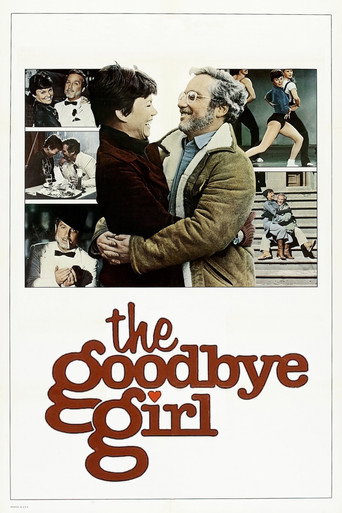
From the series “How could this film possibly have been considered for an Oscar, let alone won one?” comes The Goodbye Girl, a perfectly fine and pleasing romantic comedy that was an enormous success in 1977 and somehow earned five Oscar nominations, with Richard Dreyfuss winning Best Actor. The story follows Paula (Marsha Mason), a former dancer and single mother whose boyfriend abandons her just as she is ready to move to California with him. To make matters worse, she discovers that, that same night, he has sublet their New York apartment to Elliot (Dreyfuss), an eccentric aspiring actor. With neither willing nor able to leave, Paula, her ten-year-old daughter Lucy (Quinn Cummings), and Elliot are forced to share the apartment. Predictably, their initial hostility gradually becomes affection, although Paula’s history with unreliable men makes her reluctant to trust another actor entering her life.
BACKGROUND
The film was written by Neil Simon, then at the height of his popularity, fresh off The Sunshine Boys (1975) and Murder by Death (1976). The project actually originated with Bogart Slept Here, another Simon screenplay that would have starred his wife, Marsha Mason, alongside Robert De Niro, with Mike Nichols directing. Production began in 1975 but collapsed after just one week of filming, and Richard Dreyfuss was brought in as a possible replacement for De Niro. His chemistry with Mason convinced Simon to write an entirely new story for the two actors, this time with Herbert Ross directing. It was an eventful year for both Ross and Dreyfuss, the former also directing The Turning Point, which received eleven Oscar nominations, and the latter appearing in Steven Spielberg’s Close Encounters of the Third Kind. The film later received a Broadway musical adaptation in 1993, which revised its dated portrayal of homosexuality following protests, and was ranked by AFI in 2002 among the 100 greatest American screen romances.
THE REVIEW
Looking back, it’s interesting to compare the film’s success with that of Annie Hall, the other major romantic comedy of 1977, which eventually won Best Picture. In many ways, Annie Hall is the definitive romantic comedy of the 1970s, reinventing the genre at a time when American filmmakers were experimenting with new ways of telling stories. Woody Allen embraced the decade’s creative freedom, playing with narrative structure, breaking the fourth wall, and challenging the conventions of romantic relationships. The Goodbye Girl, on the other hand, takes a much more traditional approach, with familiar characters, predictable developments, and the reassurance that everything will eventually turn out okay. Even as increasingly cynical and unconventional films were gaining the spotlight, Neil Simon proved that audiences were still craving the comfort of an old-fashioned romantic comedy, one that presented itself as contemporary while offering little more than familiar romantic fantasies. The Goodbye Girl has its amusing moments, but while Allen’s film still entertains and influences filmmakers almost 50 years later, Ross’s feels dated and forgettable.
Marsha Mason’s Paula is a typical Hollywood portrayal of a strong woman: unafraid to speak her mind and set boundaries, but ultimately dependent on a man to find her happy ending. In that sense, it’s hard to see why someone like Elliot would fall in love with her, given her many unlikable traits. Is he simply the savior of the universe, whose mission in life is to rescue a poor woman whose heart has been broken far too many times before? It hardly seems like a fair deal. He puts up with all her yelling and grievances, while she agrees to see the terrible play he’s starring in. For free! Of course, she also has to tolerate his unusual habits of sleeping in the nude and meditating first thing in the morning. The things one does for a roof over one’s head in New York City!
Mason tries hard to sell her character’s pain, hoping that, like Elliot, we will sympathize with her because of the tragedy of her situation. She yells and cries, but the screenplay seems determined to make us overlook the fact that she begins the film living in the apartment of a married boyfriend who supports her financially. When he abandons her, she has to return to work, and we’re expected to see every inconvenience as another tragedy. We watch as she struggles to return to dancing and eventually convinces herself that she’s becoming stronger and more independent, even while continuing to live in an apartment that isn’t hers.
At least Paula gets some backstory, which is more than we can say for Dreyfuss’s Elliot, whose past relationships and sacrifices we learn very little about. Elliot is humiliated when his director forces him to portray a homosexual caricature of Richard III, resulting in scathing reviews and what initially looks like the end of his acting career. Yet, conveniently, other opportunities eventually come his way. You really can’t think too hard about the plot or why things happen the way they do. Just enjoy watching him repeatedly return to his annoying roommate!
In that sense, the film is quite successful at keeping audiences entertained without asking too much of them. Simon’s dialogue is often amusing, and Dreyfuss brings his bubbling personality and excellent comic timing, even if his performance sometimes feels exaggerated beyond what the material requires. Quinn Cummings is also good as Lucy, although hardly Oscar material, and her growing affection for Elliot provides some of the film’s most convincing moments. Their relationship is genuinely sweet, and there are enough laughs and funny situations to make the film a pleasant experience. By the time the expected happy ending arrives, it’s easy to understand why audiences left the theatre smiling, even if those five Oscar nominations remain difficult to explain.
FINAL THOUGHTS
The Goodbye Girl offers enough laughs and sweet moments to make for a pleasant, if forgettable, romantic comedy. Its predictable story and frustrating characters have hardly aged well, making its enormous success in 1977 much easier to understand than its five Oscar nominations.
- Where to watch
- Rent or buy at Apple TV Store, YouTube
- Where to watch
- Rent or buy at Amazon Video
 Play trailer


- Original title
- The Goodbye Girl
- Director
- Herbert Ross
- Cast
- Richard Dreyfuss, Marsha Mason, Quinn Cummings, Paul Benedict, Barbara Rhoades, Theresa Merritt, Michael Shawn, Patricia Pearcy
- Rated
- PG
- Screenwriter
- Neil Simon
- Composer
- Dave Grusin
- Cinematography
- David M. Walsh
- Editor
- John F. Burnett
- Country

- Language
- English
- Box office
- $102 million