

OVERVIEW
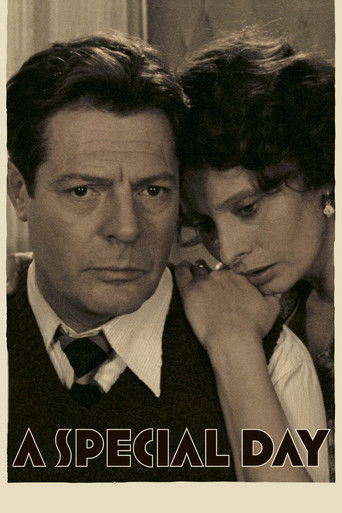
On the day Adolf Hitler visits Benito Mussolini in Rome, a working-class apartment building empties out for the parade. Only two residents remain: a dutiful mother of six, invisible to her own family (Sophia Loren), and a cultured broadcaster marked for deportation (Marcello Mastroianni). Over the course of a single afternoon, their accidental meeting peels back the roles that fascism has assigned them, revealing what each has been forced to hide.
BACKGROUND
By 1977, Italian cinema’s golden age was winding down. Its defining directors, Fellini, Pasolini, Visconti, Petri, and Risi, were aging out with no clear successors, and the industry was losing money, audiences, and international reach. Scola was part of that generation but, despite winning Best Director at Cannes the year before, hadn’t achieved the same recognition outside Italy. A Special Day went on to change that. On paper, it looked like another vehicle for the country’s most bankable screen pairing, but Scola had other plans. He cast Mastroianni, the international prototype of the Italian Latin lover, as a closeted gay man, while stripping Loren of her makeup team entirely and denying her request to have the character change costumes (both of which had upset the glamorous actress considerably). Based on the real story of broadcaster Nunzio Filogamo, who was forced to carry a certificate stating he was not homosexual under the fascist regime, the film had Scola drawing from his own childhood memory, especially interested in exploring history through the millions who had no part in the choices of their country’s leaders but had to live with the consequences. The film competed for the Palme d’Or at Cannes but lost. It went on to win the Golden Globe and a César, and received two Oscar nominations.
THE REVIEW
Scola doesn’t waste time establishing his characters as prisoners of their circumstances and the suffocation of their surroundings. The world is presented in a washed-out, near-sepia palette that renders the film almost black-and-white, yet not quite, with occasional glimpses of color amid the dour, flat surroundings. Tight frames, walls, doors, and narrow corridors oppress the two main characters, who feel like walking corpses, compressed by the regime that demands they conform. And even when the building empties, the regime never fully leaves: the parade’s radio broadcast plays constantly in the background at an obtrusive volume, a masterful choice by Scola to represent a system that drowns out everything around it.
When we first see Antonietta, it is minutes before 6 am. She’s awake and active for a while, making coffee, setting the table, and now strategically waking her family up to go to the parade: “You first, as you take the longest time,” she says to the oldest daughter. Her husband angrily shouts at her for letting him sleep so long, despite it being her third attempt to do so, as she walks around the house, making sure that all of her six children have everything they need. Once the family leaves for the parade, along with everyone else in the apartment complex, emptying the lobbies in a matter of minutes, she stays behind to keep cleaning: dishes, laundry, tidying the apartment. All tasks she will have to repeat the next day and the day after, while hearing her husband’s remarks about how she stayed home, resting all day.
Gabriele’s introduction is equally telling. He stamps a few letters, dressed elegantly while looking tempted by a gun sitting on his table. We come to learn that he was once a radio announcer who got sacked for his, as the regime put it, “depraved tendencies,” despite having a woman friend who would pose with him as his partner, and has now been relegated to anonymously addressing letters, a job a friend got him as a favor. A man who once spoke to the nation now copies names in silence. His house is tidy but equally oppressive, the home of someone forced into solitary life who would much rather have company, something the production design highlights with the huge stacks of books and the small single bed he keeps immaculate.
Antonietta’s pet bird escapes, which becomes the catalyst for their meeting. It doesn’t take long before the two of them are talking and getting to know each other, developing a connection that both clearly crave. Their reciprocal interest in continuing the conversation has them going back and forth between momentary goodbyes and hellos again while shifting apartments, going to the roof, having a little rumba session, changing topics, and being interrupted by the nosy concierge.
The concierge, played with gusto by Françoise Berd, takes on an interesting role in the film, representing the far subtler but more effective form of control that comes with fascism. She’s the eyes and ears of conformity, always watching, enforcing social norms without any official authority. She becomes a self-appointed enforcer for the regime, turning up the radio to a loud volume when realizing that both have forgotten what that day should be about. She doesn’t have formal authority; her presence and inquisitiveness are enough to prompt both to consider conforming to the status quo and to interrupt their interaction. In a fascist system, you don’t need secret police when your neighbors do the job for free.
One of the most interesting threads that develops during their conversation is seeing Gabriele slowly open Antonietta’s eyes. Early on, she described a brief encounter with Mussolini, in which the simplest glance she assumed was directed at her was enough to make her faint and treat the event as the highlight of her life. When Gabriele subtly challenges her ideology, reading from a photo album that states only men can be genius, she cannot even fathom how that is not true (“Aren’t the history books always full of men?”). Gabriele, who himself is hinted to have once believed in the system (“I am not against fascism. If anything, fascism is anti me”), is left disappointed, upset by how efficiently the regime has turned the population into people who won’t question anything, but instead defend it unreasonably and incorrectly.
The turning point comes after she makes an advance on Gabriele, who gets rightfully angry at her for assuming his engagement with her topics and her life is merely flirtation and lust, and then reveals his secret. Deep down, she probably knew it, and what makes it tragic for him is noticing that their interactions so far had been built on her physical interest in him. Antonietta, undesired by a husband whose neglect is made worse by persistent infidelity, wants to feel embraced and seen for the first time in years, maybe ever, while for him, he is in desperate need of someone to treat him as a real person. The two move past the occurrence and are able to provide that to each other.
Both Loren and Mastroianni are in top form here, the latter nominated for a Best Actor Oscar, the former unfairly overlooked. Having two stars deglamorize themselves to portray these roles heightens the impact Scola is aiming for, and the way they blend into ordinary people is essential to the project. Both are equally effective in portraying their characters’ gradual unburdening, two people who slowly open up to each other and, for one afternoon, seem to breathe freely for the first time.
Complemented by De Santis’s cinematography and Scola’s disciplined restraint, avoiding non-diegetic score until the film’s final minutes and steering clear of melodrama, the film never reaches for more than the moment warrants, and the melancholy is present with the characters even at their brightest point. Another film would have let color seep back in, opened up the space, and made their temporary liberation feel triumphant. Scola keeps it all grounded and fleeting.
By nightfall, they sink deeper into their fascist prison. Gabriele literally, as guards arrive to deport him. Antonietta, now with an unlocked view of the world, once again framed small against narrow doors. She remains a prisoner of her thankless, invisible obligations as a housewife, even as she hears that her husband wants a seventh child named Adolf. She looks across to Gabriele’s apartment, and he looks back as their special day comes to an end.
FINAL THOUGHTS
I like to think that we are far removed from the reality of A Special Day, a reality in which people are persecuted for who they are, silenced for who they love, and reduced to invisible labor by the roles they’re assigned. And while meaningful progress has been made in the decades since, unfortunately, I don’t think we are as far from it as we’d like to believe. A Special Day captures how a fascist system forces its rules, turning the world into a lifeless, desaturated, and oppressed place, and how genuine human connection can defy even the most oppressive systems and become small acts of resistance. It helps that the technical choices are this precise, from De Santis’s washed-out cinematography to Ricceri’s suffocating production design to Loren and Mastroianni’s devastating performances, but especially Scola’s meticulous direction, a masterclass in making a film with a limited setting feel dynamic. That the film lost the Best Foreign Film Oscar to the far safer Madame Rosa, in which Loren would years later star in a remake, is one of the many overlooked injustices the Academy has committed. An essential watch that resonates and remains relevant almost 50 years later.
- 1Sorcerer
- 2Annie Hall
- 3The Ascent
- 4Star Wars
- 5Close Encounters of the Third Kind
- 6A Special Day#6 of 40
- Where to watch
- Rent or buy at Apple TV Store, Google Play Movies, YouTube
- Where to watch
- Not available for streaming
 Play trailer


- Original title
- Una giornata particolare
- Director
- Ettore Scola
- Cast
- Sophia Loren, Marcello Mastroianni, John Vernon, Françoise Berd, Patrizia Basso, Tiziano De Persio, Maurizio Di Paolantonio, Antonio Garibaldi
- Rated
- NR
- Screenwriter
- Ruggero Maccari, Ettore Scola, Maurizio Costanzo
- Composer
- Armando Trovajoli
- Cinematography
- Pasqualino De Santis
- Editor
- Raimondo Crociani
- Country


- Language
- Italian