

OVERVIEW
Spielberg’s first science fiction film approaches alien contact as an extraordinary discovery. For those who are called to experience it, the unknown becomes an obsession, powerful enough to disrupt ordinary life and leave no room for anything else.
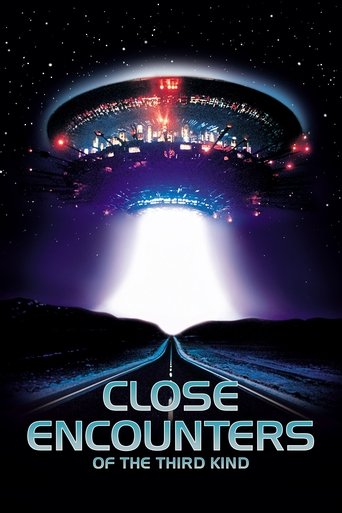
Across the American heartland, strange lights appear over power lines, rural roads, and suburban homes. An Indiana lineman (Richard Dreyfuss) and a young mother (Melinda Dillon) have separate encounters with the source of these lights. In the days that follow, compulsive visions of a mountain consume him as his marriage fractures; she searches for a son taken in the night. Elsewhere, a French scientist (François Truffaut) races to decode signals that may confirm humanity is not alone.
BACKGROUND
A long-gestating project for young Spielberg, fresh from the monumental success of Jaws two years prior, Close Encounters proved an even greater challenge for the director, who still considers getting the climax right one of the most difficult experiences of his career. Columbia Pictures, nearing bankruptcy after consecutive years of massive losses, effectively gambled its future on the film after Spielberg initially pitched a budget of $2.7 million that would eventually balloon to $19.4 million. He attempted to collaborate with several writers but remained dissatisfied with their drafts, eventually taking over the screenplay himself. It remains the only film for which Spielberg received sole screenwriting credit.
The project grew from his childhood fascination with space and the amateur science fiction films he made as a teenager, some of which provided blueprints for entire sequences in Close Encounters. More personally, Roy’s decision to leave his family behind in pursuit of the unknown reflected Spielberg’s own conflicted ideas about ambition, fatherhood, and domestic life. Spielberg later expressed deep regret over the ending, admitting that after becoming a father himself, he could no longer imagine writing Roy’s decision the same way. His relationship with the film continued to evolve after its release, leading him to revisit it twice, first with the controversial 1980 Special Edition and later with his preferred 1998 Director’s Cut.
THE REVIEW
Close Encounters is a movie that becomes richer and deeper as you go through Spielberg’s filmography. In a way, it is the film that ties it all together. Beyond the absent father figure that would become one of his most recurrent themes, and that The Fabelmans would retroactively make sense of decades later, it also establishes Spielberg’s hopeful view of humanity and his fascination with life beyond our own. These are ideas he would revisit time and time again, reshaping them for the period in which each film was made, most recently in Disclosure Day.
As a film of the seventies, it has its fair share of government mistrust and conspiracy, particularly in its questions about who is allowed to know the truth. The government invents a quarantine to evacuate an entire area, effectively becoming the villain for much of the film. Yet, contrary to what Spielberg would explore in later films, its actions ultimately seem far more noble, grounded primarily in protecting people from something it does not yet understand. Would they have allowed the truth to spread afterward? Considering the empathy they eventually show Roy and Jillian when they reach Devil’s Tower, I would like to think so.
The conspiracy thriller aspect is certainly fun and engaging, yet far more interesting is how it ties to Spielberg’s own life, becoming almost a myth Spielberg tells himself. Raised mostly by his mother and sisters while his father focused on work, Spielberg uses the alien encounter to process that absence, constructing a story where a calling so extraordinary might justify leaving a family behind. Roy begins by trying to bring his family along, dragging them to the site of his first sighting. After seeing they don’t understand, he becomes detached, and by dinner, he neglects the family for his vision of the mountain captured in the iconic mashed potatoes sculpture. Before long, he has torn the house apart entirely, ripping fencing and plants through the kitchen window to build a mud replica of a mountain in his living room, erasing every trace of home in the process. Jillian offers an unintentional counterpoint: she pursues the same calling, yet her journey begins with searching for a son who was taken from her. Her obsession becomes an act of devotion, and that devotion ultimately leads her to the same place Roy reaches by abandoning his own family. Spielberg would later walk back Roy’s ending, saying in multiple interviews that he deeply regrets having Roy board the spaceship, but it remains fascinating how much the film reveals about where his mind was at the time.
Despite its fascinating subtext, the film is also a showcase for Spielberg as a visual storyteller. His scene-level craftsmanship relies on a careful control of information, often allowing characters and viewers to discover the extraordinary at roughly the same pace. The power outage sequence. Barry opening the door to the light. The trucks chasing the UFOs down the highway. The Indianapolis air traffic control scene as the mysterious blips appear on the radar. Each is practically a self-contained masterclass in visual storytelling, with Spielberg operating at a frequency almost no other filmmaker can match.
Made at a time when audiences had no problem with long establishing sequences where suspense and wonder could slowly creep in, Close Encounters gives itself an enormous amount of setup. The entire film becomes one huge crescendo, building anticipation almost to the point of becoming unbearable. When the encounter finally arrives in the final section, it feels as earned as such a monumental event in human history deserves.
That progression is beautifully reflected in John Williams’ score, which spends much of the film developing atonal sounds, at times approaching horror territory, while gradually hinting at more melodic ideas. The score finally takes center stage as the military forces the evacuation, making it feel propulsive and dangerous while tracking the final leg of Roy and Jillian’s journey. Then, during the encounter, Williams finally unleashes the unashamed melodic grandeur he has spent the entire film withholding. His beautiful main theme is joined by a lovely invocation of Pinocchio’s “When You Wish Upon a Star,” a melody once used to reward a puppet for learning duty and sacrifice; here, it accompanies a man doing the opposite: becoming real by shedding every responsibility he has for his greater calling.
While Williams’s score is impeccable, it is Vilmos Zsigmond’s cinematography that is the true reason the film has aged so gracefully. It won the film’s only competitive Oscar, while Spielberg finally received his first Best Director nomination after his much-discussed omission for Jaws (Close Encounters itself was criminally left out of the five Best Picture nominees, which included far weaker and now much less remembered films such as Julia and The Turning Point). Spielberg deserves much of the credit for the film’s most iconic compositions; an intensely visual director, he obsessively storyboarded entire sequences and regularly arrived with new ideas for Zsigmond. The cinematographer, who described their collaboration as “very rewarding,” embraced those ideas and turned Spielberg’s storyboards into images that still hold up against anything produced digitally since.
The visual effects were remarkable for their time, but much of that durability comes from Zsigmond. To disguise the fact that the aliens in the climax were six-year-old girls in rubber suits, he overexposed the shots until the suits dissolved into pure white light and the figures became luminous silhouettes rather than visible bodies. Zsigmond also brought his signature pre-flashing technique to the film: before shooting, the film negatives were exposed to a small, controlled amount of light in a lab, reducing contrast and lifting the shadows. It lends Close Encounters a dreamlike quality even before the aliens arrive, as if ordinary life was never quite right for Roy.
For as magical and timeless as the film feels, and as masterful as its individual sequences are, the connective tissue between them is not nearly as strong. This is where Spielberg’s limitations as a screenwriter become more apparent, something he himself acknowledged when discussing his dissatisfaction with some of the characters. Roy and Jillian’s relationship, for example, is barely developed, with a vague and unnecessary romantic thread that the film neither commits to nor resolves. Ronnie, Roy’s wife played by Teri Garr, is written as increasingly shrill without being given enough interior life for us to understand her perspective on its own terms. The Lacombe thread is largely procedural and functional. Roy himself is close to a blank slate in terms of defined personality.
While Dreyfuss fits the ordinary man Spielberg was going for, and the blankness may serve the film’s larger idea (Roy as an empty vessel the encounter fills), the character still lacks enough presence on screen to make us fully invest in his journey and what he ultimately walks away from. It holds the film back from becoming a true masterpiece, even as the encounter itself, from the first attempts at communication with the iconic five-note motif, to the sight of the aliens and the mothership lifting away, takes your breath away.
FINAL THOUGHTS
Close Encounters of the Third Kind is an essential film in Spielberg’s filmography. While Jaws proved that the very young director could build extraordinary suspense through withholding, suggestion, and anticipation, with Close Encounters, Spielberg proved he could also fulfill those expectations with spectacular conclusions, creating images few directors have ever matched in scale or emotional impact. You may not believe in aliens, but the encounter feels so convincing that Spielberg almost makes you wonder whether he had met them himself.
Not all of its narrative choices work, and the characters feel too often pushed into the background in favor of the director’s themes and visual ambitions, which holds it back from becoming one of his best. Still, it is undeniably a timeless film, one that rewards every revisit, especially after you’ve seen The Fabelmans, which retroactively reframes Close Encounters as something far more personal: a young Spielberg’s plea to understand, and perhaps justify, a father who chose his work over his family.
- Where to watch
 Crave
Crave- Where to watch
 Max
Max
 Play trailer


- Original title
- Close Encounters of the Third Kind
- Director
- Steven Spielberg
- Genre
- Science Fiction, Drama
- Cast
- Richard Dreyfuss, François Truffaut, Teri Garr, Melinda Dillon, Bob Balaban, J. Patrick McNamara, Warren J. Kemmerling, Roberts Blossom
- Rated
- PG
- Screenwriter
- Steven Spielberg
- Composer
- John Williams
- Cinematography
- Vilmos Zsigmond, Richard Yuricich, William A. Fraker, Douglas Slocombe, John A. Alonzo, László Kovács, Steven Poster
- Editor
- Michael Kahn
- Country


- Language
- English
- Budget
- $20 million
- Box office
- $306.889 million