OVERVIEW
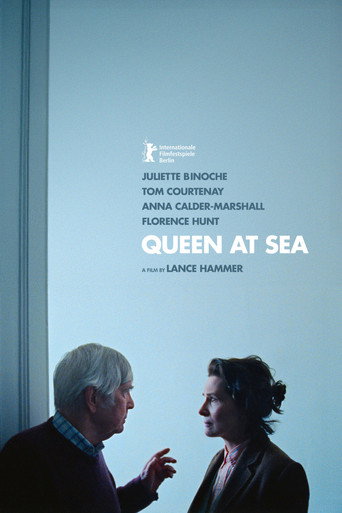
Queen at Sea is a film that raises a difficult moral question and avoids easy answers (for the most part), making you question and shift your own stance as it goes. The story takes place in London and follows Amanda (Juliette Binoche), who has temporarily moved from Newcastle with her teenage daughter to stay close to her mother, Leslie (Anna Calder-Marshall), who is suffering from dementia that is steadily getting worse. One day, Amanda makes an unexpected visit and catches her stepfather, Martin (Tom Courtenay), having sex with Leslie, something she has already warned him against doing. Leslie’s doctor has determined that she is no longer capable of giving sexual consent, while Martin argues that he knows his wife and sees no harm in their intimacy. As always, things get worse when the state gets involved.
BACKGROUND
Queen at Sea marks the return of American filmmaker Lance Hammer, 18 years after his feature debut, Ballast (2008), which won the directing award at Sundance. Hammer wrote, directed, and edited the film, which was originally conceived as an American production set in New York, before his decision to cast Juliette Binoche and Tom Courtenay led him to move the story to London. Shot on 35mm by cinematographer Adolpho Veloso (Train Dreams), the film premiered in competition at the 2026 Berlin International Film Festival, where it won the Silver Bear Jury Prize, while Courtenay and Anna Calder-Marshall shared the Silver Bear for Best Supporting Performance.

THE REVIEW
For a while, this is the film Fjord wanted to be. A complicated and mature drama that has you questioning your own beliefs, portraying both sides of the equation with balanced care.
The key word here is balanced. Compared to Mungiu’s film, which turned social workers into witches just so that its audience could question their allegiances, making the film limp and repetitive in the process, Hammer’s work comes across as much less biased, at least until its disproportionate conclusion.
It is easy to understand Amanda’s point of view and initially side with her. Coming from her own struggles with a recent separation, which she apparently has not yet fully moved on from, she approaches her mother’s situation with much more practicality and rationality, especially compared to Martin, who quickly looks for the answers he wants to hear from doctors on the Internet. Leslie clearly oscillates, and even when she reminds Martin of her old self, the tragic reality is that, more often than not, that consciousness is quickly fading.
At the same time, Amanda uses the situation to advance her own preference for putting her mother in a nursing home, and she can’t hide her bias against Martin, at one point outright stating her high ground. Despite having tried to stop Martin earlier and resolve the situation privately, she clearly underestimates how dependent Leslie is on him and how pivotal his care is to her well-being. An eventual separation may protect Leslie from one harm while exposing her to several others, including confusion, distress, and losing the person who knows her routines best. Tom Courtenay’s performance is essential to making us believe that his character genuinely wants the best for Leslie, and he even sells how this kind but stubborn man truly believes that his wife is giving consent and that their physical intimacy is good for her.
The film develops a no-win scenario with no easy answers beautifully, thanks not only to the authentic performances but also to Adolpho Veloso’s cinematography, which builds intimacy in scenes where Amanda or Martin shares a warm moment with Leslie while capturing their moments of conflict with cold distance. The scene in which Leslie demonstrates her love for Martin in front of the social worker is heartwarming, and Amanda gradually comes to understand just how much he means to her mother. There is also an interesting, albeit overlong and repetitive, parallel between Leslie and Sara, who may not yet be emotionally mature but is given much more freedom by her mother to make her own decisions.
The delicacy is unfortunately lost when the film, seemingly determined to keep the conflict going until the very last minute, starts sabotaging its own verisimilitude. An incident at the nursing home feels extremely forced, as does the incompetence of a nurse who seems to be on her first day at work. The conclusion takes the film to an unpredictable and bold place that also clashes with the tone of everything that came before. It could have worked far better if Hammer had hinted at the possibilities without needing to fully commit to them.
FINAL THOUGHTS
Queen at Sea is a beautifully acted and remarkably mature drama that presents a complicated moral dilemma and keeps you questioning whose side you’re on. It reaches a contrived conclusion that unfortunately clashes with the delicacy the film had so carefully built, but its genuinely heartwarming moments of affection make up for it.
Still courtesy of Vortex Media
- 1Everytime
- 2Hadestown: The Musical
- 3Minotaur
- 4You Can See Everything
- 5Hope
- 53Queen at Sea#53 of 228
- Where to watch
- New In Theaters
- Where to watch
- Coming soonJan 7, 2027
 Play trailer


- Original title
- Queen at Sea
- Director
- Lance Hammer
- Genre
- Drama
- Cast
- Juliette Binoche, Tom Courtenay, Anna Calder-Marshall, Florence Hunt, Steven Cree, Michelle Jeram, Elizabeth Rushbrook, Noah Hunt Basden
- Rated
- NR
- Screenwriter
- Lance Hammer
- Cinematography
- Adolpho Veloso
- Editor
- Lance Hammer
- Country

- Language
- English
- Distributor (CA)
- Vortex Media