
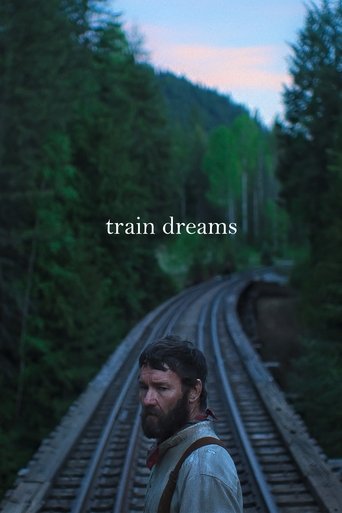
Train Dreams is a contemplation of life. A visually arresting piece that inspires perseverance amidst life’s hardships and tragedies. Premiering at Sundance during the wildfires ravaging LA, it embraces the enduring human capacity to persevere and rebuild in the wake of overwhelming loss.
In its best moments, Train Dreams evokes the poetic grandeur of Terrence Malick’s work to capture that resilience to great effect. It meditates on the life of Robert Grainier, a railroad worker in the early 20th century, while exploring themes of identity, guilt, purpose, and legacy. Visually, the film is stunning. Its cinematography impresses with extremely memorable imagery (like a window catching fire or a branch falling) and Bryce Dessner’s score perfectly complements these visuals, creating an atmosphere that is both soothing and evocative. Director Clint Bentley strives for profundity, and there are moments where he succeeds, particularly in portraying Robert’s guilt over a death early in the film, conveyed through haunting flashes. Yet, for all its beauty, Train Dreams drifts at times, prioritizing visual poetry over direct emotional impact.
This deep exploration of profound themes can be challenging to nail. Even Malick himself occasionally falters, and sometimes his films come off as pretentious (or even tedious). Train Dreams oscillates between scenes that hit the mark and others that reveal an obvious attempt to achieve depth without fully succeeding.
One of Bentley’s choices that ends up working against him is the narration. It recites passages from the novella, but. In contrast, in Malick’s greatest work, the narration or voice-overs complement the on-screen action (as in the fantastic Journey to the Line sequence in The Thin Red Line), here it often merely repeats what we are already seeing or what an actor is conveying. This becomes particularly distracting in emotional moments, such as Robert’s struggle with unspeakable loss and the climactic airplane scene. These moments could have been far more impactful if the film had relied solely on its visuals and Edgerton’s performance.
Joel Edgerton, as always, is great at playing introspective characters. He’s so naturally suited to this role that it feels like watching the actor himself transported to that era. Yet, despite his efforts, Robert Grainier is such a passive character that his journey is often difficult to engage with. Only in the third act, when Kerry Condon’s character appears, does the character gain a much-needed spark. The rest of the cast is efficient but largely forgettable. And for a movie titled Train Dreams, it’s oddly light on trains.
At its core, Train Dreams gives the sensation of witnessing a full life unfold, efficiently transporting us to its era. Its visuals and music create an evocative, immersive experience. Yet, the film often feels like it’s observing rather than expressing, struggling to impart the emotional weight of its meditations to the audience.
- 1Sentimental Value
- 2Hamnet
- 3One Battle After Another
- 4Ne Zha 2
- 5Blue Moon
- 112Train Dreams#112 of 256
- 1Sentimental Value
- 2Hamnet
- 3Blue Moon
- 4Sirāt
- 5Tuner
- 43Train Dreams#43 of 74
- 1Kiss of the Spider Woman
- 2The Ballad of Wallis Island
- 3The Wedding Banquet
- 4Together
- 5Twinless
- 12Train Dreams#12 of 27
- Where to watch
 Netflix
- Where to watch
- Netflix
 Play trailer


- Original title
- Train Dreams
- Director
- Clint Bentley
- Cast
- Joel Edgerton, Felicity Jones, Nathaniel Arcand, Clifton Collins Jr., John Diehl, Paul Schneider, Kerry Condon, William H. Macy
- Rated
- PG-13
- Screenwriter
- Clint Bentley, Greg Kwedar
- Composer
- Bryce Dessner
- Cinematography
- Adolpho Veloso
- Editor
- Parker Laramie
- Country

- Language
- English
- Budget
- $10 million