

OVERVIEW
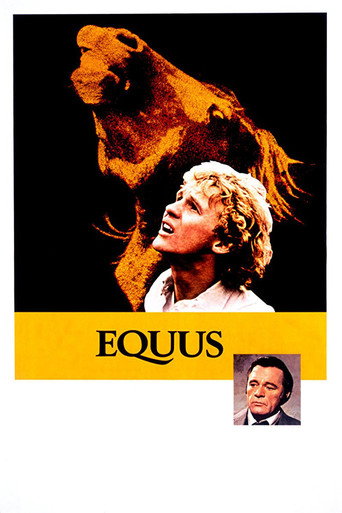
A faithful adaptation of the acclaimed Broadway play, Equus follows psychiatrist Martin Dysart (Richard Burton), who is tasked with treating Alan Strang (Peter Firth), a troubled teenager who, despite his seemingly normal exterior, has inexplicably blinded six horses at the stable where he worked. Through a series of increasingly revealing sessions, Dysart gradually uncovers Alan’s motives, leading the experienced psychiatrist to confront his own dissatisfaction with life. Through lengthy conversations and monologues, the film explores religious and sexual repression and how they can lead to obsession, as well as the role of psychological treatment in a society with narrow definitions of normality.
BACKGROUND
The play Equus was written by Peter Shaffer, who was inspired by a real-life incident involving a young man who blinded several horses. The image affected him so much that he chose not to investigate the details of the incident and developed his own fiction instead. The play received enthusiastic acclaim when it premiered in London and on Broadway, attracting actors such as Anthony Hopkins, Anthony Perkins, and Richard Burton, who reportedly agreed to perform in the play on the condition that he would also play the character in an eventual film adaptation. That adaptation didn’t take long, as Shaffer returned to write the screenplay just two years after the play’s premiere, while the studio, looking for its next awards contender, fast-tracked the production with director Sidney Lumet, himself coming off the enormous success of Dog Day Afternoon (1975) and Network (1976). The film was mostly shot in Toronto, and because Burton was suffering from back pain, all eight of his monologues were filmed in a single day. The film wasn’t as well received as expected, but still managed to earn three Academy Award nominations, including Burton’s final nomination. The play briefly returned to the spotlight for a while when Daniel Radcliffe was cast as Alan Strang in a 2007 revival (with his nude scenes attracting considerable media attention), but the film has largely faded from public attention, with both its director and Peter Firth later publicly expressing their dissatisfaction with the finished result.
THE REVIEW
It is a curious reaction, as it is hard to imagine a much better adaptation than what we got, with far more merits than the usual stage-to-screen translation. Despite retaining the lengthy monologues, some delivered straight to the camera, and actors accustomed to performing the material on stage, Lumet impressively makes it all feel cinematic, shooting the conversations dynamically and moving naturally between locations. The score is used sparingly but effectively, while Oswald Morris’s cinematography captures Alan’s ecstasy in pivotal moments and intelligently plays with the dynamic between the two characters during their sessions, keeping the exchanges engaging and even exciting.
Their interactions are easily the film’s highlights, with an almost chess-like game of strategy as Dysart attempts to get Alan to open up. These are interspersed with Dysart discussing the sessions with magistrate Hesther Saloman (Eileen Atkins), conversations with Alan’s family, and Dysart himself recounting the events directly to the audience from a later point in time. We piece things together alongside Dysart, though if you’re fresh from Carrie (1976), you might see where things are headed well before he does.
While the mystery box-like development of Alan’s story is intriguing, with Peter Firth convincingly portraying the young man’s tortured soul, the film’s main focus is how all of this affects Burton’s Dysart. And that’s where not all of the film’s ambitions land. The question it raises is interesting, and the idea of having an experienced psychiatrist questioning his profession and his own existence at such an advanced stage of his life is promising. However, Alan’s story never quite feels like something that would provoke such a profound crisis (his actions seem largely driven by repression rather than the passion that so deeply moves Dysart), which makes his repeated attempts to come to terms with his feelings a bit indulgent and repetitive. That is, of course, not Burton’s fault, as he remains commanding in his delivery, balancing empathy with clinical scrutiny, while his physicality (perhaps partly due to his back pain) makes the character’s exhaustion feel palpable.
The eventual climax is well handled, and its brief but brutal depiction of violence is important to fully confront the horror of Alan’s actions, especially after so much time spent empathizing with him. You wish the film had arrived at its point sooner and continued the story a little longer, but for such a faithful retelling, the result is about as effective as it could have been.
FINAL THOUGHTS
Sidney Lumet brings Peter Shaffer’s acclaimed play to the screen with skill and confidence, making even its lengthy conversations and theatrical monologues engaging. Supported by excellent performances from Richard Burton and Peter Firth, Equus is a fascinating psychological drama whose ideas are sometimes more intriguing than their eventual resolution.
- Where to watch
- Not available for streaming
- Where to watch
- Not available for streaming
 Play trailer


- Original title
- Equus
- Director
- Sidney Lumet
- Cast
- Richard Burton, Peter Firth, Joan Plowright, Harry Andrews, Colin Blakely, Eileen Atkins, Jenny Agutter, Kate Reid
- Rated
- R
- Screenwriter
- Peter Shaffer
- Composer
- Richard Rodney Bennett
- Cinematography
- Oswald Morris
- Editor
- John Victor-Smith
- Country


- Language
- English