OVERVIEW
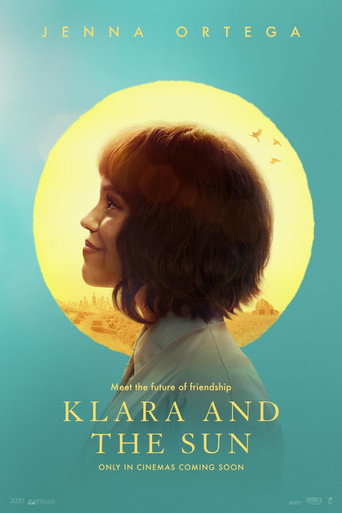
Who isn’t excited for a whimsical take on artificial life that combines grief, existential questions, and religious allegory, all from the perspective of a wide-eyed, youthful-looking robot who worships the sun? Taika Waititi brings his peculiar sensibilities to Kazuo Ishiguro’s acclaimed novel, following Klara (Jenna Ortega), a solar-powered Artificial Friend who is purchased to accompany Josie (Mia Tharia), a seriously ill teenager living with her mother (Amy Adams). As Klara becomes increasingly attached to Josie, she begins to believe that the sun might hold the power to save her.
BACKGROUND
Originally conceived as an illustrated children’s book, Kazuo Ishiguro’s novel was a major critical success when published in 2021, praised for its philosophical depth and exploration of themes that proved far too dark and complex for young readers. Its unusual combination of childhood innocence and deeper questions seemed particularly suited to Taika Waititi, who had (arguably) done something similar with his Oscar-winning Jojo Rabbit (2019). The New Zealand director was enjoying a remarkable period in his career, having earned considerable acclaim for his early independent films and proven his ability to handle large-scale fantasy and special effects with Thor: Ragnarok (2017). He joined the adaptation in 2023 with Ishiguro’s blessing to infuse the story with his particular brand of humor. By the time production began in early 2024, however, Waititi’s reputation had taken a hit following the divisive Thor: Love and Thunder (2022) and the poorly received Next Goal Wins (2023). Klara and the Sun would prove another challenging project, with Waititi struggling to find the right tone while the finished film sat on the shelf for more than two years before finally reaching theatres. Or, you know, perhaps Sony was just waiting for the right moment to get it out of its backlog.

THE REVIEW
The biggest issue with Klara and the Sun is that, unlike other similarly themed AI sci-fi films this year (Sheep in the Box and Paradise Lost), it has genuinely interesting ideas and is never downright bad, yet somehow never manages to be particularly good either. In terms of its themes, it is hardly breaking any ground that Spielberg’s A.I. Artificial Intelligence hadn’t already explored 25 years ago, or that countless films and television series haven’t revisited since. We have the wide-eyed robot learning how to love, the humans gradually developing affection for it, and the cynical realization that the two may never truly coexist as equals. Klara’s almost religious devotion to the sun is similarly reminiscent of David’s belief in the Blue Fairy in Spielberg’s film, while the idea of an artificial being assigning divine significance to something it doesn’t fully understand has been explored in everything from Sausage Party to The Lego Movie. Throughout the film, you are reminded of everything from The Stepford Wives and Westworld and Alita: Battle Angel, all of which have approached some variation of these ideas, often with considerably more to say about them.
Of course, familiar ideas can still make for compelling storytelling through well-developed characters, but Klara and the Sun struggles to make us care about its human characters, none of whom feels fully fleshed out. The worst offender is Amy Adams’ Chrissie, a woman repeatedly confronted with pain, much of it brought upon herself by her obsession with appearances and social status. Whenever the opportunity arises to challenge her decisions, the film shies away from difficult conversations, afraid to confront its darker ideas and make her face the consequences of her actions. Mia Tharia’s Josie is also explored in a rather strange way, gradually shifting from a character into a plot device. The screenplay sidelines some of her most interesting aspects, including what initially draws her to Klara, the loneliness she experiences, and her eventual realization that even her own ‘slave’ Artificial Friend might be betraying her.
The character who receives the most development is, of course, the titular Klara, which is also where the film feels most generic. Played with wide-eyed curiosity by Jenna Ortega, who nails the physicality of the robot’s movements and her awkward mannerisms, Klara is the familiar Pinocchio-inspired AI whose desire to be loved and childlike naivety lead her to selflessly seek solutions to everyone else’s problems. The result is often saccharine, with emotional beats that feel unearned, no matter how much Michael Giacchino’s admittedly lovely score tries to convince us otherwise with its soothing choir and delicate melodies.
There are creative touches in the production design and screenplay, such as the futuristic scarecrow (whose final appearance is arguably the film’s most striking image), the remote-controlled birds, and, of course, the costumes worn by the lifted children, which feel like a clever, slightly exaggerated extension of contemporary fashion. Waititi has a great visual eye and nails the aesthetics of this universe, contrasting the gloomy downtown with Chrissie and Josie’s artificially colorful home. What remains is some occasionally amusing fish-out-of-water humor as Klara learns about the real world, but little that feels particularly fresh or memorable, alongside human characters who show promise but whom the screenplay never fully commits to exploring.
FINAL THOUGHTS
Klara and the Sun brings some visual imagination and a committed Jenna Ortega performance to an otherwise familiar exploration of artificial life and human connection. Unfortunately, Taika Waititi’s adaptation is too sentimental and reluctant to explore its darker ideas, leaving its underdeveloped characters and intriguing premise feeling disappointingly shallow and much of its potential unrealized.
Still courtesy of Sony Pictures Releasing Canada
- 1Everytime
- 2Hadestown: The Musical
- 3Minotaur
- 4You Can See Everything
- 5Hope
- 169Klara and the Sun#169 of 222
- Where to watch
- New In Theaters
- Where to watch
- Coming soonOct 29, 2026
 Play trailer


- Original title
- Klara and the Sun
- Director
- Taika Waititi
- Genre
- Science Fiction, Drama
- Cast
- Jenna Ortega, Mia Tharia, Amy Adams, Natasha Lyonne, Aran Murphy, Rachel House, Steve Buscemi, Davida McKenzie
- Rated
- 14A
- Screenwriter
- Dahvi Waller, Taika Waititi
- Composer
- Michael Giacchino
- Cinematography
- Mike Berlucchi
- Editor
- Adam Gough, Tom Eagles
- Country


- Language
- English
- Distributor (CA)
- Sony Pictures Releasing Canada