


Overview
Of the roughly 40 films I watched at TIFF 2026, none frustrated me more than Paradise Lost, a film with many fascinating ideas that is somehow capable of wasting all of them. Yeon Sang-ho explores, among other things, the emotional connection between a person and an artificial being, and if that idea already makes you nervous after Sheep in the Box earlier this year, Paradise Lost at least finds an interesting twist on what is basically another iteration of the A.I. Artificial Intelligence premise.
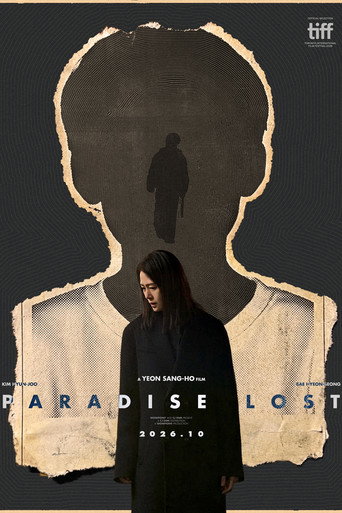
After a school bus carrying several children disappears inside a mine, a single mother, Ryu So-young (Kim Hyun-joo), is left believing that her young son, Sun-woo, is dead. To cope with the pain, she is approached by the company Paradise Lost, which recreates a virtual version of the boy that only she can see and that doesn’t age. Eight years later, she is still attached to the ‘boy’ when she receives the news that her real son might have survived after all. The film deals with, among other things, the conflict between the artificial and the real, especially when the latter is much harder to accept. It is a shame that all this potential only makes the disappointment worse once the film begins revealing its problems.
Background
Paradise Lost arrives during an almost absurdly productive period for Yeon Sang-ho. After directing Revelations (great) and The Ugly (mediocre) in 2025, he followed them with the competent but unremarkable Colony and Paradise Lost in 2026, while also writing and executive producing Netflix’s Japanese series Human Vapor. Yeon has joked that he deals with work stress by doing more work, and Paradise Lost itself came together through an unusual process, to say the least. The original idea came from a three-page story written in pencil by his mother after Yeon told her that anyone could write if they had a story to tell. The film became his second recent low-budget production after The Ugly, shot in only 14 days on a reported 500 million won budget, an approach Yeon appreciates for the freedom from the financial pressures of larger commercial productions.
The Review
The film starts promisingly by depicting the events that lead Ryu to lose her son, one of several children aboard a school bus that disappears inside a mine, and immediately calls attention with a very economical, thriller-like opening. We are introduced to the concept of Paradise Lost, the new connection she develops with her son, and then quickly jump several years ahead. The fact that we see Sun-woo before his disappearance creates an attachment that lingers through the film. It also helps that young Yu Ji-wan is extremely natural in the role, delivering a fantastic, authentic child performance that never exaggerates the emotions.
If there is something in the film that really works, it is everything around the artificial version of the boy, who knows exactly what to tell his mother to keep her attached to him. We are convinced of her attachment to this imagined, eternal version of her son, who can always be exactly what she wants him to be. The scene in which he suggests that the grown Sun-woo may actually be the man responsible for killing the children is easily the film’s most creative idea, opening the door to the possibilities of artificial intelligence manipulating its user by telling them precisely what they want to hear. A great hook for a thriller that is far smarter than anything in Mercy earlier in the year, but, like much of the film, fails to develop into anything remotely interesting.
Unfortunately, the film wastes much of that potential through the way it portrays the real Ryu Sun-woo. Instead of using everything it has built to capture the conflict between reality and the artificial, the screenplay decides to treat Sun-woo as a one-dimensional psychopath, which not only removes much of the complexity from the story, but also ends up damaging the rest of the film by introducing another major narrative element without having the time to explore it. His motivations and explanations are consequently delivered in increasingly absurd ways, including a scene where he essentially confesses what he has done to his mother out loud. There is very little connection between the boy’s trauma and the artificial intelligence storyline, and the conclusion becomes more and more ridiculous as it goes.
Final Thoughts
Yeon Sang-ho’s talent still comes through in a few sequences, particularly early on, when the mixture of thriller and tragedy is handled quite effectively. Some scenes are very well shot, and there are flashes of a genuinely compelling mystery, but the entire film eventually feels like a first pass at a screenplay that needed several more revisions. With Yeon making so many films in such a short period, perhaps that is exactly what happened here. It is a shame, especially considering how many genuinely interesting possibilities Paradise Lost introduces before throwing most of them away.
- Original title
- 실낙원
- Director
- Yeon Sang-ho
- Genre
- Thriller, Drama, Science Fiction
- Where to watch
- Out of Theaters
- Where to watch
- Coming soon
- Cast
- Kim Hyun-joo, Bae Hyeon-seong, Kim Jong-tae, Lee Hyun-kyun, Lee Yoo-joo, Yu Ji-wan, Koo Kyo-hwan, Kim So-wan
- Rated
- NR
Crew and more details
- Screenwriter
- Ryu Yong-jae, Yeon Sang-ho
- Composer
- Chae Min-ju
- Cinematography
- Song Hyun-suk
- Editor
- Park Ju-ae
- Country

- Language
- Korean
 Play trailer
- 1Everytime
- 2Hadestown: The Musical
- 3Minotaur
- 4You Can See Everything
- 5Hope
- 201Paradise Lost#201 of 232
- 1Minotaur
- 2Wild Horse Nine
- 3The Man I Love
- 4The Unknown
- 5La Gradiva
- 48Paradise Lost#48 of 55


