OVERVIEW
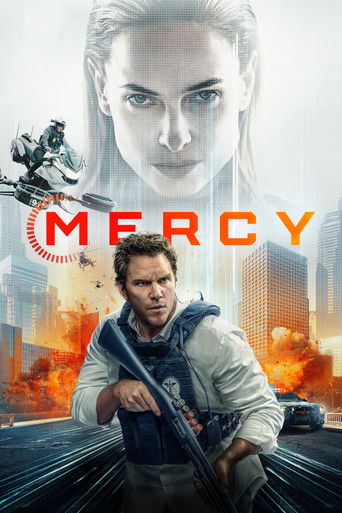
Mercy is a Screenlife sci-fi film set in the near (imminent) future, where the justice system has been replaced by AI. Detective Chris Raven (Chris Pratt) helped establish this system by bringing many people in to be interrogated by the technology, but he wakes up one day and finds himself on trial, accused of murdering his wife. He has 90 minutes to prove his innocence in “court,” with Rebecca Ferguson playing the personification of the AI, using the system’s own tools to find what it may have missed.
BACKGROUND
Inexplicably marketed as a theatrical-only, 3D, IMAX release (a curious choice for a Screenlife film), Mercy arrives in theaters in January, a month studios often use to release films they feel less confident about.
Director Timur Bekmambetov has been championing the subgenre, having produced Unfriended, Searching, and War of the Worlds (2025), and having directed Profile (2018). He has called Screenlife a “new film language” for the internet era, one that offers creative freedom due to its relatively lower cost and flexibility. The subgenre is usually kept on the lower-budget side, and it makes a lot of sense as a streaming original, so having A-listers and a premium release format is an unexpected move by Amazon MGM, likely aimed at capitalizing on the quieter landscape theaters offer this time of year.

THE REVIEW
As a huge defender of movie theaters, I’m usually in the mindset that every film is better on a big screen, yet while watching Mercy, I was constantly baffled by the decision to go IMAX. Nothing shown on the screen during its static 100 minutes comes close to justifying the premium push. A huge amount of the time is spent, as expected, on characters watching and interacting with screens, or on close-ups of their reactions. Visually, the film is extremely uncreative and largely unpleasant. Narratively, it is laughably ridiculous, full of convenient plot devices and illogical gaps. Thematically, it feels confused, never finding an interesting angle on its timely topic. I haven’t seen the much-maligned War of the Worlds (2025), but I can’t imagine it’s much worse than this bomb.
Bekmambetov’s mishandling of the 3D technology becomes apparent in the film’s introduction, as Chris Pratt’s character wakes up confined in a tiny room, shot in close-up with shallow depth of field (blurred background), a choice that renders 3D completely pointless. That visual approach takes over at least half the runtime. You have plenty of time to study Pratt’s and Rebecca Ferguson’s noses in glorious IMAX.
When Mercy is not shoving faces into close-up, it has its characters watching screens that awkwardly flip between feeling “in 3D” and “in 2D.” There are a few action scenes, but they are not much better. One sequence in particular, involving a high-speed truck and people scrambling out of its way, offers some of the worst images 2026 is set to deliver in any format. Bekmambetov has proudly stated that the film did not use AI for any aspect of its production, and if there was an intentional attempt to replicate the look of AI-generated videos, they completely nailed it. I doubt that was the goal.
There is no point in going through all the gaps of logic in its script, from the fact that the lead character being right-handed (you know, like most of the world) plays a major part in why he is on trial, to how each introduced character conveniently plays a part in the plot, to the absurd levels the villain goes through to make the plan work, and how lucky they are for how conveniently placed a few cameras are, to Chris Raven grieving his wife for two minutes and then quickly forgetting about her. The list surely goes on, but you get the point.
What needs to be stated, however, is how confused the film is regarding its topics, and how unethical some of its points ultimately are. If the whole premise is that AI lacks the instincts of a human detective, why does the film feel like it needs to give AI a “heart of gold”? Is the film ultimately in favor of such a system, since it ends without dealing with the consequences? There is a five-second protest from a character about her privacy being violated and her personal videos being analyzed without her permission, but it lasts exactly that long, as the film quickly frames the violation as necessary for the investigation.
The film doesn’t propose any interesting observations about the elephant in the room, nor does it use the concept to generate thrills we haven’t seen before. Sure, Pratt and Ferguson can hold our attention (the latter commits to a robot voice throughout, but deserves much, much better), yet the film around them is extremely hard to watch, to the point you’re begging it to stop.
FINAL THOUGHTS
Painful visuals, a plot full of holes, and muddled ideas about AI justice make Mercy a premium release that feels pointless, leaving Chris Pratt and Rebecca Ferguson stuck in a Screenlife thriller with no mercy for its viewers.
Still courtesy of Amazon MGM Studios
- 1Everytime
- 2Hadestown: The Musical
- 3Tuner
- 4Minotaur
- 5You Can See Everything
- 214Mercy#214 of 219
- Where to watch
 Prime Video
- Where to watch
- Prime Video
 Play trailer


- Original title
- Mercy
- Director
- Timur Bekmambetov
- Genre
- Science Fiction, Thriller, Crime, Mystery
- Cast
- Chris Pratt, Rebecca Ferguson, Kali Reis, Kylie Rogers, Chris Sullivan, Jeff Pierre, Annabelle Wallis, Rafi Gavron
- Rated
- PG
- Screenwriter
- Marco van Belle
- Composer
- Ramin Djawadi
- Cinematography
- Khalid Mohtaseb
- Editor
- Austin Keeling, Lam T. Nguyen, Dody Dorn
- Country

- Language
- English
- Budget
- $60 million
- Box office
- $54.708 million
- Distributor (CA)
- Amazon MGM Studios