

OVERVIEW
Nearly 30 years after Eye of God, Tim Blake Nelson returns to Oklahoma with another story about a lonely woman who develops feelings for a convicted man through his writing. Amanda Seyfried plays Karen, an English teacher trapped in an abusive marriage who takes a job at a maximum-security prison, where she meets Wilson Shedd (Scoot McNairy), an inmate serving life for murder who takes an unusual interest in her class. As Karen encourages the prisoners to write more about themselves, Wilson begins putting the crimes that brought him there on the page, gradually creating a connection between the two. Nelson tells their story across different timelines, moving between their relationship in prison and the consequences waiting for Wilson in the future.
BACKGROUND
Nelson began writing The Life and Deaths of Wilson Shedd about a decade ago, loosely inspired by the 2015 escape of Richard Matt and David Sweat from Clinton Correctional Facility with the help of prison employee Joyce Mitchell, a story later dramatized in Escape at Dannemora. He moved the action to his native Oklahoma and created his own conclusion, which went through several revisions before settling on something considerably darker. Financing took years to secure and required compromises, including shooting digitally rather than on Nelson’s preferred film stock. The film arrived at TIFF 2026 without a distributor and, as of this writing, has yet to secure one.
THE REVIEW
Watching the film, it’s easy to see why distributors were worried about this competently made yet strangely distant prison drama, which is upsetting, as Nelson has clearly put a lot of care into the proceedings. The Life and Deaths of Wilson Shedd unfortunately finds itself in the unwanted position of being neither commercial enough to attract a broad audience nor exceptional enough to make its difficulty an attraction. It is also a bleak downer, with glimpses of hope in an otherwise depressing story. In other words, it is the kind of project audiences would probably rather watch in a diluted form at home as a prestige series than seek out theatrically.
Nelson shows a sure hand in the director’s chair, especially in conveying that bleak atmosphere. There is one prison escape and one effective shootout, but it is a film far more interested in its characters than its thrills, which Nelson captures through the sparse score and Benoît Soler’s brownish cinematography. Characters are immersed in suffocating muted tones and constantly trapped within the frame by walls and doors. Even a moment of seemingly joyful singing by two children carries foreshadowing hints of sadness, as their parents look proudly at them. It always feels like tragedy is waiting to happen in a cruel, merciless world. Small hints at empathy demonstrated by Karen’s friends and her boss feel insignificant compared to the extreme violence that punctuates the story.
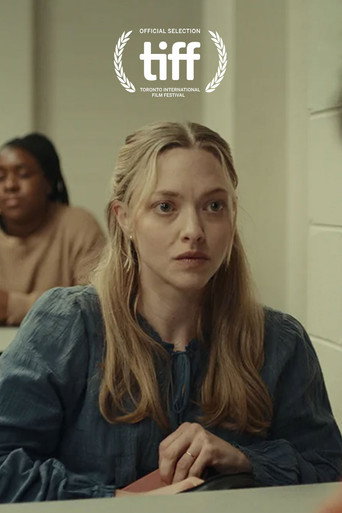
Seyfried is compelling as the insecure and unfulfilled Karen, and convincing in Karen’s attraction to the prisoner. She conveys her character’s newfound hope, aided by costumes that gradually give her more freedom as she begins wearing different shades of blue, per Wilson’s request. It is a rawer performance than what we are used to seeing from her, and she once again proves to be one of the best actors working today.
The film, however, belongs to McNairy, playing a character you could easily imagine Nelson himself taking on two decades ago. He brings intensity and pain to Wilson while contrasting his gentle voice with a cold look. It all makes Wilson difficult to pin down. How much is he manipulating Karen? How much is he genuinely falling in love? And how much is she truly changing him?
That ambiguity works wonderfully for McNairy’s performance, but it becomes a problem when the film’s entire third act hinges on how much we sympathize with the prisoner. Who, in the end, is Wilson Shedd? Nelson gives us one answer in a gut-wrenching scene where one of his essays is being read while a squirrel is repeatedly shot. It is extremely hard to watch and does much of the film’s emotional heavy lifting, but because it comes through Wilson’s own subjective account, it can only tell us so much. Whenever the film comes close to revealing him more directly, Nelson cuts away, whether by not showing us the killing that sent him to prison or glossing over his reaction when he realizes Karen is not where she is supposed to be. For a film called The Life and Deaths of Wilson Shedd, his life remains too elusive, and his subsequent deaths don’t hit as hard.
FINAL THOUGHTS
The Life and Deaths of Wilson Shedd is a strong, confidently directed drama with excellent performances, an oppressive atmosphere, and two very impactful scenes. It tells an engaging story with a few captivating turns (a prison escape is always welcome!), while Scoot McNairy and Amanda Seyfried bring considerable humanity and nuance to their characters. Yet as good as they are, we never truly grasp their true nature, resulting in a film that is compelling in its storytelling but strangely distant in its emotions.
- Where to watch
- Coming soon
- Where to watch
- Coming soon


- Original title
- The Life and Deaths of Wilson Shedd
- Director
- Tim Blake Nelson
- Genre
- Drama
- Cast
- Amanda Seyfried, Kevin Wayne, Scoot McNairy, Tim Blake Nelson, Missi Pyle, William Jackson Harper, Elizabeth Marvel, Grant Harvey
- Screenwriter
- Tim Blake Nelson
- Cinematography
- Benoît Soler
- Editor
- Tristan Baylis
- Country

- Language
- English
- Budget
- $5.5 million