
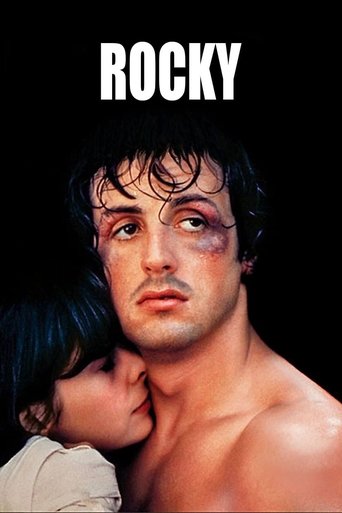

Like it or not, Rocky Balboa has earned his place as one of the most iconic characters in movie history. It may be hard to believe that Sylvester Stallone had to fight to get his first film off the ground—partly because he insisted on playing the lead himself, despite being unknown at the time. The film was made for less than $1 million in 1976, and yet it became a massive box office success, launched what would become a nine-film franchise, and earned 10 Oscar nominations—winning three, including Best Director and, most surprisingly (even to Stallone himself), Best Picture. Rocky‘s victory at the 1977 Oscars was as unlikely as the story it told—beating out heavyweights like Network, All the President’s Men, and Taxi Driver. Much like the character himself, the film was the underdog of awards season.
The image of the brute fighter at the top of the Philadelphia steps, arms raised in triumph, has become a symbol of the American Dream—plastered on shirts, posters, murals, and memes around the world. (Even I own a Rocky T-shirt!) So it’s always a bit of a shock to revisit the original film and see how quiet, intimate, and melancholic it is. Rocky isn’t introduced as a champion, but as a wandering soul—a man whose best days never came, someone giving pep talks to himself in the mirror just to make it through another lonely night.
Rocky starts small, with delicate piano melodies underscoring a life filled with quiet resignation. Stallone and director John G. Avildsen build the film like a slow burn—humble, grounded, and richly textured. Then, almost imperceptibly, it grows. Momentum builds. And before you know it, you’re in a trumpet-blazing finale that feels earned, euphoric, and timeless. People often remember the last 15 minutes, but it works so well only because the hour leading up to it is such a beautifully observed portrait of ordinary people who never got their shot.
Despite its extremely low budget, the film feels confident and cinematic. The team had to think outside the box to make the most of what they had: Stallone’s real dog appears in the film, and scenes were shot guerrilla-style—like Rocky’s jog through the Philly market—without permits. And yet, the result feels anything but cheap. The final fight is staged with real grandeur. The camera slowly reveals the size of the crowd, the atmosphere thickens, and the moment begins to feel monumental. While the scope of a true national championship may not fully come across, the emotional impact absolutely does.
We tend to associate Rocky with its bare-bones plot: the unexpected opportunity, the training montage, the climactic fight. But the film’s soul lies in the quiet moments—Rocky venting to himself in his apartment (arguably the film’s most powerful scene), his awkward flirtations with Adrian, and his interactions with people like the gruff trainer Mickey, the volatile Paulie, and even a street kid he tries to steer in the right direction. Stallone’s script is full of small, piercing details that reveal just how much Rocky feels stuck in a life he never chose. When Adrian asks why he became a fighter, his answer is simple: “Because I can’t sing or dance.” It’s a line that’s funny on the surface, but beneath it is a lifetime of being told he’s not good enough for anything else. He’s not chasing glory—he’s clinging to the one thing he’s been allowed to be.
The cast is uniformly strong. Talia Shire brings gentle vulnerability to Adrian, and we watch her slowly shed her shell and come alive. Burt Young plays Paulie with a sadness and resentment that give depth to an otherwise unlikable man—a balance he sadly lost in later sequels. Burgess Meredith’s Mickey is tough, bitter, and soulful. Carl Weathers doesn’t have much to do beyond playing the cocky champion, but his charisma is undeniable. But the best performance is, of course, by Stallone himself. His work is full of subtle physical choices—slouched posture, hesitant speech, expressive eyes—quietly crafting a man whose toughness masks deep wells of longing and decency. It’s not just a performance—it’s a complete embodiment. Stallone inhabits Rocky so naturally that the line between actor and character vanishes. Every choice feels organic, from his gentle stammer to the way he repeats “you know what I mean?” at the end of nearly every sentence.
Bill Conti’s score deserves just as much praise. “Gonna Fly Now” is one of the most iconic themes in movie history, but his work throughout the film is equally important—capturing Rocky’s loneliness with simple, melancholic piano motifs before swelling into full orchestral glory in the final act.
The makeup team does excellent work showing the brutal toll of the fights, while the sound design and editing in the final bout make every punch visceral. James Crabe’s cinematography, with its muted tones, captures Philadelphia as a city of faded dreams and quiet desperation. It’s a modest film, but one that uses every tool it has to maximum effect.
Rocky might not have the sophistication or sharp political bite of its fellow nominees, but it has something even harder to pull off: sincerity without sentimentality. It believes in the value of showing up, of trying, of standing your ground with whatever you’ve got left. That’s why it endures—not just as a great sports movie, but as a story of emotional honesty and quiet triumph. It reminds us that going the distance isn’t about winning. It’s about proving to yourself that you’re worth the fight.
- Where to watch
 Prime Video
 Crave
Crave- Where to watch
- Prime Video
 Play trailer


- Original title
- Rocky
- Director
- John G. Avildsen
- Genre
- Drama
- Cast
- Sylvester Stallone, Talia Shire, Burt Young, Carl Weathers, Burgess Meredith, Thayer David, Joe Spinell, Jimmy Gambina
- Rated
- PG
- Screenwriter
- Sylvester Stallone
- Composer
- Bill Conti
- Cinematography
- James Crabe
- Editor
- Scott Conrad, Richard Halsey
- Country
- Language
- English
- Budget
- $1 million
- Box office
- $117.253 million