
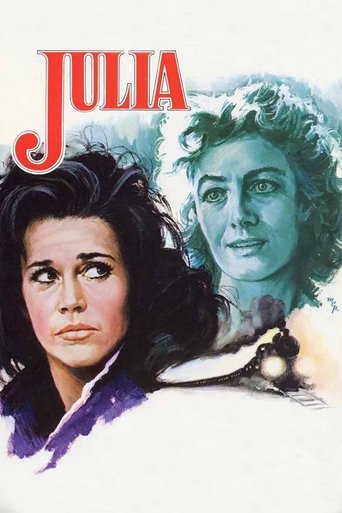

Julia is the kind of prestige film that gives the Oscars a bad name. Nominated for a whopping 11 Academy Awards (including Best Picture) it falls into that familiar category of awards bait: films that are made to look important, making voters proud of themselves, while not truly saying anything at all. Directed by Hollywood legend Fred Zinnemann, and built around what was considered bold at the time (two strong female leads at the center of a serious drama, can you believe that!?) it wraps itself in elegant production values and the illusion of importance. Yet years later, its legacy can be reduced to Vanessa Redgrave’s winning Oscar speech, in which she denounced “Zionist hoodlums” and sparked one of the ceremony’s most enduring controversies, and the fact that it introduced Meryl Streep to the screen, in a small role she reportedly disliked, especially after her voice was dubbed without her consent.
The film adapts a chapter from Pentimento, Lillian Hellman’s memoir, and recounts her connection with Julia (Vanessa Redgrave), a brilliant and politically committed woman who leaves behind her life of privilege to fight fascism in 1930s Europe. Both were friends growing up, but they grew apart through the years. Julia sacrifices everything, her health, her safety, her fortune, even raising her child, to smuggle people and money across borders and challenge the Nazi regime. But instead of exploring that extraordinary life, the film fixates on Lillian (Jane Fonda), who agrees, after considerable hesitation, to help Julia once, by smuggling cash into Germany. That single act becomes the emotional and narrative centerpiece. A story of resistance and sacrifice is reduced to one woman’s timid brush with danger, while the real hero is mostly glimpsed from afar, through letters and secondhand recollections.
Lillian, as portrayed here, is far from a compelling narrator. She’s passive, hesitant, and too often self-absorbed. During her one mission, meant to be the film’s climax, she ignores clear instructions, acts recklessly, and turns a life-or-death moment into a performance of personal courage. The film, unintentionally, paints her as someone who wants to feel brave without ever really earning it. Jane Fonda’s performance doesn’t help. She never disappears into the role, instead delivering a performance that feels stiff and overly staged, as though she’s constantly aware of the camera. There’s no intimacy, no vulnerability, just an actress holding a sign that says “Oscar-worthy” in every frame. And while Redgrave’s Julia exudes strength and resolve in her brief scenes, the film gives her little to do, other than serve as a kind of saintly cipher for Lillian’s growth. The only remarkable performance is Maximilian Schell’s, who, in just a few scenes and despite the script’s limitations, conveys a life marked by suffering, yet grounded in kindness and empathy toward Lillian (his Oscar nomination, along with the one for costumes, might be the only nods the film truly deserved).
The emotional foundation of the story, the friendship between Lillian and Julia, is rushed and underdeveloped. We’re told they shared a deep bond from childhood, but this is not well established in the film’s opening scenes and is later glossed over in flashbacks and letters, never fully dramatized on screen. So when the film asks us to invest in Lillian’s grief, or Julia’s disappearance, there’s a strange hollowness. For all the talk of bravery and sacrifice, Julia lacks urgency. There’s no tension in the storytelling, no real sense of danger in the resistance efforts. For a film about political activism in the shadow of fascism, it feels oddly decorous and detached. The stakes are high, but the tone is strangely flat.
Technically, Julia is well made, handsome costumes, finely dressed sets, a gentle, lyrical score, and an aura of literary sophistication. It’s a self-congratulatory story that flatters the woman who wrote it, while sidelining the woman who actually did the work. Considering that anti-fascist activist Muriel Gardiner has claimed that “Julia” portrayed in the novel was actually herself, and that she had never met and interacted with Lillian before, leaves an even sour taste. In hindsight, Julia feels like a film made to win awards, not to tell a story. And while it may have succeeded in the first, it failed completely at the second.
- 1Sorcerer
- 2Annie Hall
- 3The Ascent
- 4Star Wars
- 5Close Encounters of the Third Kind
- 37Julia#37 of 40
- Where to watch
 Hollywood Suite
- Where to watch
- Not available for streaming
 Play trailer


- Original title
- Julia
- Director
- Fred Zinnemann
- Cast
- Jane Fonda, Vanessa Redgrave, Jason Robards, Maximilian Schell, Hal Holbrook, Rosemary Murphy, Meryl Streep, Dora Doll
- Rated
- PG
- Screenwriter
- Alvin Sargent
- Composer
- Georges Delerue
- Cinematography
- Douglas Slocombe
- Editor
- Walter Murch, Marcel Durham
- Country

- Language
- English
- Budget
- $7.84 million
- Box office
- $20.7 million