
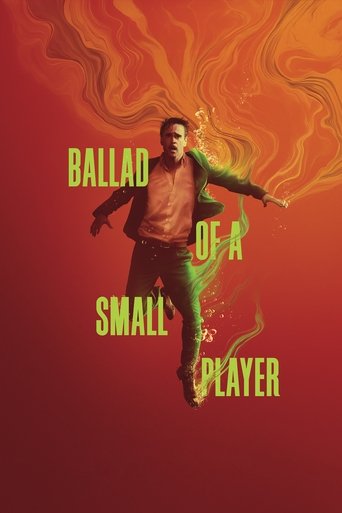
Macau is a city that invites outsiders to play along with its myth-making illusions. Gold ceilings, choreographed fountains, and servers treating you like a king build a façade that appealed to the film’s protagonist. “Lord” Doyle, as he likes to be called in Macau, stole an old widow’s fortune and for a while, lived off that money, taking what the city had to offer, dressing in fancy suits and wearing a glove that built a minor celebrity image while playing card games at night, until his routine led him to self-destruction and accumulating debt.
German director Edward Berger was also seeking an escape. After films that demanded heavy precision (All Quiet on the Western Front) and extreme control and discipline (Conclave), he wanted a freer, more playful outlook. Macau offered that space. Here he could experiment with color, grand music, humor, and volatility, going for what he called an “explosive attack of the senses.” It was meant to be as far from his previous two works as possible.
On that level, the film succeeds. Macau comes alive in James Friend’s bold colors, its rhythms carried forward by Volker Bertelmann’s dramatic, propulsive score. The result is an experience best enjoyed when you sit back and let it wash over you. At the same time, the style remains grounded. There are no long dream sequences to derail the pacing, so even when the story is not saying much, it never drags or becomes dull.
Beyond the aesthetic appeal, adapting Lawrence Osborne’s novel allowed Berger to continue his theme of protagonists seeking liberation, here from temptation and addiction and portraying Colin Farrell, magnetic yet hilarious, capturing despair alongside impulsiveness and self-destructive urges. Supporting turns from Tilda Swinton, Alex Jennings, and Fala Chen add color, though none leave much of a lasting impact.
This becomes a bigger issue with Chen’s role. Her character is essential to Doyle’s development, and in a pivotal scene, she takes pity on him at his lowest and gives him a second chance. The film tries to justify her decision, but it never feels convincing, and, as a result, the moral of the story collapses. What lesson has Doyle really learned? That’s when you hit rock bottom in Macau, a pop-up appears offering a second life, and you press yes. What did he ever do to deserve such a chance?
Other issues stand out. Card games are simply not interesting to watch, no matter how beautifully they are shot or how much Farrell tries to sell the bluff. If not even Casino Royale, one of the best action films of the century, could make them exciting, this never had a chance. Swinton’s character also leaves more questions than answers, especially regarding her motivation and the moral of her arc.
The film does have a strong bookend, and in its best moments, it recalls last year’s dreamlike and divisive Queer. That film was hypnotic and carried a fantastic lead performance, but it also had a clear moral center and knew precisely what it wanted to say about its protagonist. Here it feels more like Macau itself: golden, dazzling, but fake beneath the surface. Beautiful to visit, but hollow in the end. Like Doyle, Berger deserves a chance to escape purgatory, and one hopes it will be spent as far away as possible.
This is part of Reviews On Reels TIFF 2025 Coverage. Due to the hectic rhythm of a film festival, it may be tweaked in the future. Still courtesy of TIFF.
Still courtesy of Netflix
- 1Sentimental Value
- 2Hamnet
- 3One Battle After Another
- 4Ne Zha 2
- 5Blue Moon
- 150Ballad of a Small Player#150 of 256
- 1Sentimental Value
- 2Hamnet
- 3Blue Moon
- 4Sirāt
- 5Tuner
- 50Ballad of a Small Player#50 of 74
- Where to watch
 Netflix
- Where to watch
- Netflix
 Play trailer


- Original title
- Ballad of a Small Player
- Director
- Edward Berger
- Cast
- Colin Farrell, Fala Chen, Tilda Swinton, Deanie Ip, Alex Jennings, Jason Tobin, Adrienne Lau, Anthony Wong Chau-Sang
- Rated
- 14A
- Screenwriter
- Rowan Joffé
- Composer
- Volker Bertelmann
- Cinematography
- James Friend
- Editor
- Nick Emerson
- Country


- Language
- English
- Distributor (CA)
- Netflix