
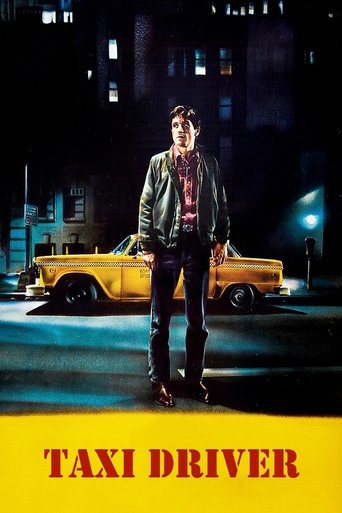

I was born in the ’90s, so by the time I started getting into films, the name Martin Scorsese was already sacred (Shutter Island was my first Scorsese film!). That’s why it’s hard to imagine Taxi Driver coming from a relatively unknown director with only a few small projects and one modest success to his name. At the time, it was a risky, uncomfortable film, one that needed serious backing just to get made. And yet, nothing about it feels like the work of someone still finding their voice. The control is remarkable, present in every shot and decision. Even the second act’s slow, meandering pace masterfully mirrors Travis’s growing isolation and gives the third act its weight. There’s nothing tentative about it, it feels like the work of a filmmaker who already knew exactly what he wanted to say.
The film follows one of the most iconic and bleak characters in cinema: Travis Bickle. Born from Paul Schrader’s personal crisis, a time when he was consumed by loneliness and existential dread, Travis has no friends, no family, and no meaningful work. He’s desperate for purpose but lacks the tools to escape his spiral. One particularly telling moment has his coworkers trying to pull him into a casual conversation. Travis replies with something generic, then retreats into silence. He’s a ghost in plain sight. He woos Betsy, a campaign worker, with quiet confidence, but takes her to a porn theater on their first date, completely unaware of how wrong that is. He sabotages every chance he has to break out of his routine.
Scorsese and Bernard Herrmann show how a score can reflect a character’s inner world. Herrmann’s final work, completed just a day before his death, deserves to be studied on its own. The dissonant passages and sharp percussion heighten Travis’s unease, but it’s the recurring main theme that truly defines the film. Built on jazz motifs and a lonely saxophone, it captures both seduction and danger, isolation and allure. It plays when Travis finds a flicker of purpose: at the beginning, when he takes the job, when he’s with Betsy, and then disappears during his most unhinged stretch. The theme only returns once he connects with Iris and redirects his violence. The music tracks his mental state with eerie precision.
Not that De Niro needed the score to do the heavy lifting. The actor gives one of his most lived-in performances where every choice feels calculated but never showy. His smile seems like something Travis practiced in the mirror, a learned behavior meant to pass as normal. His speech patterns feel rehearsed, like he’s mimicking how people are “supposed” to sound. The performance is so precise it becomes invisible, which is exactly what makes it brilliant.
While Travis is a fascinating character, Taxi Driver isn’t just about one man’s descent, it’s about a society that feels broken at every level. That’s where a film like Joker (2019) falls short; it tries to explain everything through personal pain and rejection. Taxi Driver is far more layered. Scorsese’s own cameo reveals a man with equally disturbing thoughts, and even characters like Betsy or the faceless patrons in the porn theater seem just as lost. The film isn’t simply about a lone threat, it’s about a world rotting from within. As Travis puts it, it’s full of scum. And Scorsese brings that to life with a version of New York that feels like a waking nightmare. Before Disney cleaned up Times Square, the city really was a pit of smut, violence, and despair. Taxi Driver captures it like a time capsule. The smoke, the close-ups, the eerie point-of-view shots, they all draw you deeper into Travis’s warped perspective.
By the end of the film, Travis is seen as a hero, the man who saved Iris (Jodie Foster, in an astonishingly mature performance at just 12 years old). He even receives thank-you letters from her parents. But just days earlier, he was preparing to assassinate a presidential candidate, only backing off after being spotted by security. If his focus had shifted even slightly, the ending could have been a national tragedy instead of a rescue story. The scariest part is that, for Travis, both paths feel the same. He’s using violence to create meaning, and whether it’s seen as noble or horrifying is purely circumstantial. He ends the film being treated as “the good guy” by society, the man who saved Iris.
From the lived-in performances to the precise editing, moody cinematography, haunting score, and immersive sound design, every element in Taxi Driver works to elevate the script. It is Scorsese’s first true masterpiece, a film that pushed cinema into darker, more psychological territory. It captures an era, a city, and a kind of loneliness that still resonates today. The experience leaves you hollow, unmoored, and deeply unsettled, unpleasant, exactly as Scorsese intended. But in the end, what lingers isn’t just the discomfort. It’s the clarity of vision from a director who, even at the start of his career, was already reshaping what cinema could be.
- Where to watch
- Rent or buy at Apple TV Store, YouTube, Amazon Video
- Where to watch
 Max
Max
 Play trailer


- Original title
- Taxi Driver
- Director
- Martin Scorsese
- Cast
- Robert De Niro, Jodie Foster, Cybill Shepherd, Harvey Keitel, Peter Boyle, Leonard Harris, Albert Brooks, Diahnne Abbott
- Rated
- R
- Screenwriter
- Paul Schrader
- Composer
- Bernard Herrmann
- Cinematography
- Michael Chapman
- Editor
- Melvin Shapiro, Tom Rolf
- Country

- Language
- English
- Budget
- $1.9 million
- Box office
- $28.58 million