
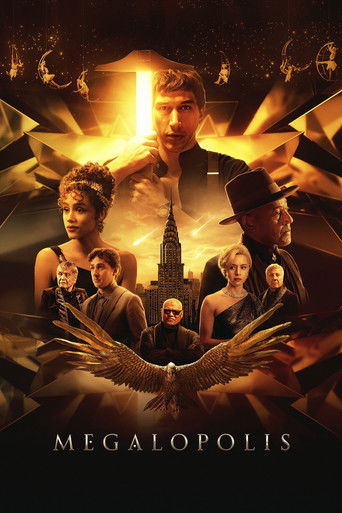
Few films in modern cinema carry the weight of anticipation that Megalopolis does. Francis Ford Coppola, at 85 years old, has spent decades bringing his passion project to life, a film conceived in the late 70s, shelved numerous times, and eventually self-financed by Coppola himself. Inspired by the fall of Rome and how it echoes in contemporary society, Megalopolis seeks to examine the intersection of politics, power, and progress through a blend of political drama, science fiction, and romance. It’s a towering idea from a director whose past works have left indelible marks on cinema history.
The film centers on Cesar Catilina (Adam Driver), a brilliant architect grieving the loss of his wife, who embarks on creating Megalopolis, an immense project that aims to reshape New Rome with a revolutionary new material called Megalon. This miraculous substance, infinitely malleable and possibly granting its creator the ability to control time and space, becomes the focus of both wonder and conflict. Standing in Cesar’s way is the city’s mayor, Cicero (Giancarlo Esposito), a staunch defender of tradition who grows increasingly alarmed by Catilina’s idealistic designs. As Catilina and Cicero clash, a romance between Catilina and Cicero’s daughter Julia (Nathalie Emmanuel) further complicates the struggle between lofty visions and earthbound realities.
To say that Megalopolis is ambitious is an understatement. Coppola imbues the film with bold philosophical musings on the nature of genius, power, and the future of civilization. Yet, what makes the film fascinating isn’t just its scale or ideas but the relentless energy Coppola brings to it. In many ways, Megalopolis feels like the work of an inexperienced director handed a blank check to pursue their wildest ideas. It’s bursting with exuberance, and it’s hard not to admire its huge swings, even when things go off the rails.
But they go off the rails in big ways. Some choices, like a character’s face spinning on top of a mug or a moment involving an arrow, end up being some of the year’s funniest scenes, unintentionally, since these moments were clearly meant to be taken seriously. The chapters, announced with Roman font slides, feel amateurish and unintentionally amusing. Certain sequences, including a rushed retelling of a 9/11 parallel, miss their intended emotional mark. Even some of the acting veers into over-the-top territory, with lines awkwardly repeated or delivered with exaggerated fervor. The performances are inconsistent across the board, some actors go for loud theatrics while others attempt, and often fail, to strike a serious tone. To top it off, Laurence Fishburne’s narration feels out of place and detracts from the film.
But to its credit, Megalopolis never becomes boring. There’s always something wild happening on screen, and Coppola’s unwavering commitment to his vision is palpable. Even when the film feels clumsy, it’s the kind of clumsiness that comes from striving to do something truly different, something meaningful. It’s a film that asks big questions, and while not all of them get satisfactory answers, the very attempt is commendable.
Themes of hope and utopia echo throughout the film, reminiscent of the optimism found in Brad Bird’s Tomorrowland (2015). It’s refreshing to see a movie that dares to look forward with hope rather than cynicism, and I left Megalopolis feeling unexpectedly inspired. The film’s ultimate message is one of belief in the potential for a better world, a message that feels especially poignant coming from a director in the twilight of his career.
For some special screenings, where the cinema lights are turned on and a real person steps in and interacts directly with the protagonist. It is a good idea that adds nothing to the movie.
The romance between Catilina and Julia may be clumsy at times, but it manages to convey genuine emotion by the film’s end. Cicero, too, is more than just a one-dimensional antagonist, and his ultimate realization adds a layer of depth to the story that is unexpectedly touching.
Could Megalopolis have been a masterpiece if Coppola had made it earlier in his career? Perhaps. But as it stands, it’s a fascinating, flawed, yet earnest work that’s far from the disaster some are making it out to be. In an era where many films play it safe, Coppola’s willingness to take risks and dream big is something to be celebrated. It’s a movie you may laugh at, question, and criticize, but it’s also one that will leave you thinking and feeling, and isn’t that what cinema is all about?
Still courtesy of Lionsgate
- 1Dune: Part Two
- 2Conclave
- 3Better Man
- 4The Substance
- 5Challengers
- 48Megalopolis#48 of 110
- 1Conclave
- 2Better Man
- 3The Substance
- 4The Assessment
- 5Queer
- 23Megalopolis#23 of 50
- Where to watch
- Out of Theaters
- Where to watch
 Telecine
 Play trailer


- Original title
- Megalopolis
- Director
- Francis Ford Coppola
- Genre
- Science Fiction, Drama, Fantasy
- Cast
- Adam Driver, Giancarlo Esposito, Nathalie Emmanuel, Aubrey Plaza, Shia LaBeouf, Jon Voight, Laurence Fishburne, Talia Shire
- Rated
- 14A
- Screenwriter
- Cristiano Donzelli, Francis Ford Coppola, Oscar Chichoni, Craig Gilmore, Vincent Proce
- Composer
- Osvaldo Golijov, Grace VanderWaal
- Cinematography
- Mihai Malaimare Jr.
- Editor
- Cam McLauchlin, Glen Scantlebury, Robert Schafer
- Country

- Language
- English
- Budget
- $120 million
- Box office
- $14.387 million
- Distributor (CA)
- Lionsgate