
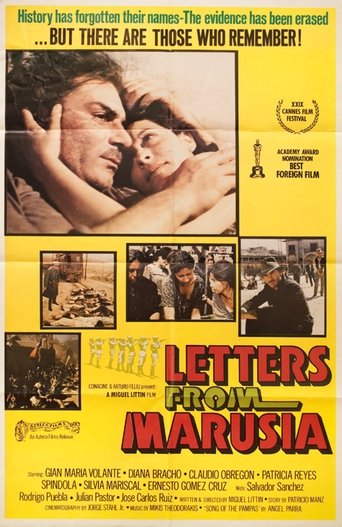
Letters from Marusia employs a gritty, documentary-like realism to draw viewers into the brutal world of Chile’s “Nitrate Era” (1880 to 1929), a period marked by grueling labor and violent suppression of workers’ rights. Set in the remote mining town of Marusia, the film focuses on the exploitation of miners by foreign companies, with the government’s full backing. When a worker is unjustly executed by authorities on mere suspicion, it sparks the miners to unite and rebel. But their courage is met with state-sanctioned violence, as the government ruthlessly crushes the uprising, leaving Marusia in ruins and its people massacred. Based on true events, Letters from Marusia lays bare the brutal costs of labor movements, illuminating both the exploitation and the defiant bravery of those who fought back, only to be erased from history.
The movie takes a collective approach, keeping individual characters at arm’s length. Faces are familiar, and personalities surface here and there, but the film mainly uses them as symbols of the broader workers’ struggle. Unsurprisingly, the film’s best moments come in scenes with minimal character emphasis, like when a man pleads for his life outside a door, another shames an official after killing a train conductor, and Gregorio, the main character, delivers a stirring call to arms. This constant lack of character focus makes the movie feel episodic, as though we’re watching a series of key moments without the context that builds up to them. In one scene, for instance, a few women make a significant sacrifice. Yet, we’re shown only the action, without insight into their inner conflict or motivations, leaving the audience wanting more depth.
The battles are well-depicted, with an impressive production design that gives the conflict a vast, immediate feel. Yet, the repeated scenes of execution start to lose impact with each repetition. Overall, Letters from Marusia tells a story that needs to be told, serving as a powerful depiction of historical struggle with a hard-hitting ending. Yet, it often keeps audiences at an emotional distance, feeling more informative than truly moving.
- 1One Flew Over the Cuckoo's Nest
- 2Dersu Uzala
- 3Jaws
- 4Nashville
- 5Manila in the Claws of Light
- 37Letters from Marusia#37 of 51
- Where to watch
- Not available for streaming
- Where to watch
- Not available for streaming


- Original title
- Actas de Marusia
- Director
- Miguel Littín
- Cast
- Gian Maria Volonté, Diana Bracho, Patricia Reyes Spíndola, Salvador Sánchez, Claudio Obregón, Julián Pastor, Silvia Mariscal, José Carlos Ruiz
- Screenwriter
- Miguel Littín, Patricio Manns
- Composer
- Míkis Theodorakis
- Cinematography
- Jorge Stahl Jr.
- Editor
- Alberto Valenzuela, Ramón Aupart
- Country

- Language
- Spanish