
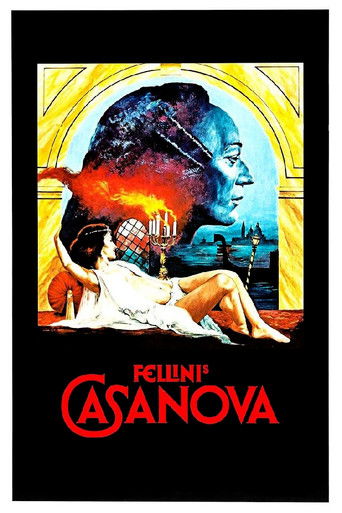

There’s a scene in Fellini’s Casanova where five organ players blast their instruments in unison, filling the space with an overwhelming, almost unbearable cacophony. Watching the film feels exactly like that, undeniably beautiful instruments, but played at full volume, creating an extravagant yet grating experience.
In many ways, Fellini’s Casanova feels like a culmination of Fellini’s career up to that point, melding his dreamlike excess from 8½, Roma, and Amarcord with his increasingly cynical view of humanity. Everything is deliberately artificial, from the soundstage sets to the theatrical performances to Donald Sutherland’s mask-like face. It shouts its themes with an exaggerated, almost operatic grandeur, purposefully distanced from any real emotion.
Visually, the film is one of Fellini’s most ambitious productions, boasting a massive budget and extravagant craftsmanship that make every frame feel like a staged performance. Shot entirely on elaborate, surreal sets, the film rejects historical realism in favor of an artificial, theatrical aesthetic, Venetian canals are recreated indoors, skies are painted, and every backdrop feels like part of a stylized dream. The result is a world that is both grand and suffocating, where the opulence becomes a prison as much as a spectacle.
Fellini takes a highly original approach to the character of Giacomo Casanova, reimagining him not as a charming libertine, but as a tragic, mechanical performer, enslaved by society’s expectations and his own legend. As with many of his films, Fellini draws direct parallels to himself, channeling his own anxieties about fame, artistic performance, and the burden of living up to a larger-than-life reputation. Casanova is, in many ways, a mirror of Fellini’s own struggles.
Yet, for all the themes Fellini explores, aging and decay, the theatricality of celebrity, the emptiness of excess, it all becomes too much, too relentless, and honestly, exhausting. Amusingly enough, the film’s first ten minutes already establish everything Fellini is trying to say, particularly in a striking early moment where Casanova desperately tries to convince a rich voyeur that he should be known for more than just his sexual conquests. That single expression of despair is the film’s most powerful moment. But then it repeats that idea over and over again, stretching it across an overlong runtime.
There is no shortage of visual spectacle, the intricate sets, the stunningly detailed (and Oscar-winning) costumes, the elaborate makeup. Nino Rota’s score is also hauntingly memorable, especially in the eerie automaton scene, which stands as one of the film’s most unforgettable moments. Donald Sutherland, beneath layers of artifice, delivers a committed performance, embodying Casanova’s loneliness behind all the facade. But after a while, the sheer excess becomes numbing, drowning out any sense of variation or pacing.
Fellini deserves credit for reshaping Casanova’s story through his own artistic lens, making it entirely justified that his name appears in the film’s title. Yet the film desperately lacks the balance between excess and normalcy that defined his best work. Perhaps integrating moments of realism, maybe even a framing device set in the present, could have made the result more bearable. As it stands, Fellini’s Casanova is an admirable artistic statement, but one that pushes its extremes so relentlessly that it risks suffocating the viewer.
- 1Rocky
- 2Taxi Driver
- 3Assault on Precinct 13
- 4Kings of the Road
- 5All the President's Men
- 42Fellini's Casanova#42 of 51
- Where to watch
- Not available for streaming
- Where to watch
- Not available for streaming
 Play trailer


- Original title
- Il Casanova di Federico Fellini
- Director
- Federico Fellini
- Cast
- Donald Sutherland, Tina Aumont, Cicely Browne, Carmen Scarpitta, Clara Algranti, Daniela Gatti, Margareth Clémenti, Mario Cencelli
- Rated
- R
- Screenwriter
- Federico Fellini, Bernardino Zapponi
- Composer
- Nino Rota
- Cinematography
- Giuseppe Rotunno
- Editor
- Ruggero Mastroianni
- Country

- Language
- Italian