
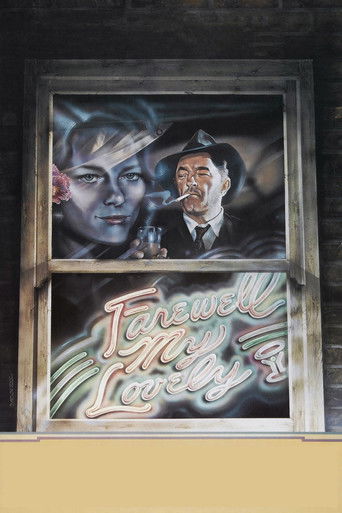
Following the Oscar-winning success of Chinatown in 1974, which redefined the noir genre, three notable entries surfaced in 1975: French Connection II, Night Moves, and Farewell, My Lovely. Each brings classic noir elements back into focus, but none fully transcend the genre in the way Chinatown did. In Farewell, My Lovely, the tone is set immediately, with David Shire’s score blending moody piano and muted saxophone. While beautiful, the score feels comfortably familiar, evoking classic noir and echoing the style of Goldsmith’s Chinatown score, establishing that this film will be a well-executed, but ultimately predictable, journey through noir conventions.
Adapted from Raymond Chandler’s novel, Farewell, My Lovely is the second cinematic take on the story, following the 1944 adaptation, Murder, My Sweet. This version remains closer to Chandler’s novel, casting Robert Mitchum as private detective Philip Marlowe. In Farewell, My Lovely, private detective Philip Marlowe is hired by ex-con Moose Malloy to find his old girlfriend, Velma, leading Marlowe deep into 1940s Los Angeles. Along the way, he’s drawn into a web of deceit involving powerful figures, beautiful women, and hidden motives. As Marlowe digs further, he realizes that nothing is as straightforward as it seems.
Mitchum, older than the average actor in such a role, brings a palpable weariness to Marlowe. This touch makes Marlowe feel like a detective who’s seen it all and is too tired to care, but too compelled to stop. Noir archetypes appear in full force: the tragic Jessie Florian (Sylvia Miles), the dangerously alluring Helen (Charlotte Rampling), and the powerful Baxter Grayle, while even a young Sylvester Stallone shows up as one of Malloy’s lackeys.
Technically, the film delivers: its costumes, set design, and cinematography immerse viewers in the noir world, recreating the dark allure of Chandler’s world. The colors are striking, and, once again, the score is very evocative. Yet, for all its polished execution, the plot remains straightforward and predictable, offering few surprises. Even a late twist feels hollow, as the minimal character development of the key players makes it difficult to care about the outcome.
The performances are solid but don’t push the film much beyond standard noir conventions. Mitchum brings a weight and world-weariness to Marlowe that’s fitting, though it makes some scenes, particularly with Rampling’s Helen, feel a bit awkward. While Sylvia Miles was nominated for an Oscar for her brief role (the film’s sole nomination), Charlotte Rampling herself makes a more lasting impression and embodies the allure of classic noir. The one notable misstep is a scene where Marlowe is drugged, which lacks the intensity and focus seen in French Connection II, and leads to a bizarre interaction between Mitchum and Kate Murtagh.
In the end, Farewell, My Lovely is a well-crafted entry into the noir genre, capturing the atmosphere and tone with style but offering little that’s fresh. It’s a classic noir through and through, but one that plays it safe rather than pushing any boundaries.
- 1One Flew Over the Cuckoo's Nest
- 2Dersu Uzala
- 3Jaws
- 4Nashville
- 5Manila in the Claws of Light
- 18Farewell, My Lovely#18 of 51
- Where to watch
 Prime Video
 Criterion Channel
- Where to watch
- Not available for streaming
 Play trailer


- Original title
- Farewell, My Lovely
- Director
- Dick Richards
- Cast
- Robert Mitchum, Charlotte Rampling, John Ireland, Sylvia Miles, Anthony Zerbe, Harry Dean Stanton, Jack O'Halloran, Joe Spinell
- Rated
- R
- Screenwriter
- David Zelag Goodman
- Composer
- David Shire
- Cinematography
- John A. Alonzo
- Editor
- Walter Thompson, Joel Cox
- Country
- Language
- English
- Budget
- $2.5 million
- Box office
- $2 million