
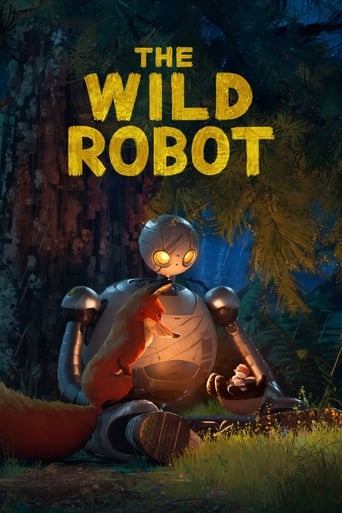
Since its premiere at TIFF and throughout its journey to the Oscars (where it ultimately lost to Flow), The Wild Robot has been hailed as peak DreamWorks, its reception rivaling How to Train Your Dragon (2010). It has mesmerized critics and audiences alike with its breathtaking visuals (I don’t say this lightly: it comfortably ranks among the top three best-looking animated films ever). At its core lies a moving premise: a robot, overwriting its own programming, learning to become the mother a baby goose needs.
And yet, despite being in constant awe of its artistry, I found myself strangely detached from the experience. While many have fallen in love with The Wild Robot, I never fully connected with it. I admired nearly every frame, but admiration alone doesn’t always translate to engagement. The film is visually stunning, but its pacing and storytelling choices kept me at a distance, preventing a deeper emotional connection.
On the surface, The Wild Robot follows a familiar animated storytelling formula, the kind that has shaped countless children’s films over the years. Even Roz as a character isn’t entirely new (Baymax, anyone?). What elevates it is its sheer artistry and meticulous attention to detail. Unfortunately, that artistry is often undermined by the film’s tendency to move too fast, rarely allowing its most powerful moments to breathe. It frequently spells things out for its audience instead of letting emotions and visuals do the work.
It frustrates because all the pieces for a masterpiece are here. The fusion of 2D aesthetics with 3D animation and watercolor textures has never looked better. Every frame is a work of art, not just in composition but in movement. The way the camera flows through scenes, the intricate character designs, and the delicate interplay of light and texture all contribute to its painterly beauty. Every detail impresses, from the shimmering water as birds swim to the lifelike textures of snow and feathers. The animation breathes life into the island’s wildlife with personality, without making them feel overtly humanized.
The film is at its best when it lets the visuals and score tell the story. But these moments are too brief, constantly interrupted by characters speaking over each other. Take, for instance, a moment where an older goose tells Brightbill about a gift Roz gave him. Before we even get a second to absorb the weight of his realization, the child instantly replies, “I haven’t thought of that.” The pacing doesn’t allow emotions to settle, and this issue extends to key sequences, like when the animals unite to survive the winter. Instead of letting the audience sit with these moments, the film rushes to the next development. Great family films trust their viewers, especially children, to come to realizations on their own. The Wild Robot doesn’t.
Adding to my detachment is how the supporting characters are handled. Outside of Roz, most of them follow the same pattern: they start with a rigid perspective, only to shift their views almost instantly. These rapid changes flatten the emotional weight of their arcs, making conflicts feel too easily resolved. As a result, the film starts to feel like a collection of loosely connected moments rather than a cohesive journey.
This episodic format also keeps the story from building momentum, with conflicts arising and resolving within minutes. The film’s most effective sequence is the migration scene, where the score and visuals take center stage without a single word. It’s reminiscent of Dinosaur (2000), a film whose strongest moments were dialogue-free. Tellingly, the film’s first trailer, which sparked much of the initial excitement, contained no dialogue at all.
While individual moments like these might even bring tears, I don’t see Roz and Brightbill’s relationship becoming as iconic as Hiccup and Toothless or Lilo and Stitch. In a better-paced version of this film, one that cut 70% of its dialogue, let scenes linger, and trusted its audience more, perhaps that connection could have been achieved. As it stands, I was left admiring the film more than enjoying it. For others, it might be an instant classic. For me, it’s a remarkable achievement in animation, with a great score, and little more.
Still courtesy of Universal Pictures Canada
- 1Dune: Part Two
- 2Conclave
- 3Better Man
- 4The Substance
- 5Challengers
- 54The Wild Robot#54 of 110
- 1Conclave
- 2Better Man
- 3The Substance
- 4The Assessment
- 5Queer
- 26The Wild Robot#26 of 50
- Where to watch
 Netflix
- Where to watch
- Netflix
 Play trailer


- Original title
- The Wild Robot
- Director
- Chris Sanders
- Genre
- Family, Animation, Science Fiction, Adventure
- Cast
- Lupita Nyong'o, Pedro Pascal, Kit Connor, Bill Nighy, Stephanie Hsu, Matt Berry, Ving Rhames, Mark Hamill
- Rated
- PG
- Screenwriter
- Chris Sanders, Heidi Jo Gilbert, Steven A. MacLeod, Genevieve Tsai, Catherine Yuh Rader, Benjamin Balistreri, Andrew Erekson, Taylor Meacham, John Puglisi, Sarah Gold Amburgey, Matt Flynn, Daniel Tal, Lorna Cook, Joanne Matte, Nelson Yokota, Adam Rosette
- Composer
- Kris Bowers
- Editor
- Mary Blee
- Country

- Language
- English
- Budget
- $78 million
- Box office
- $331.982 million
- Distributor (CA)
- Universal Pictures Canada