
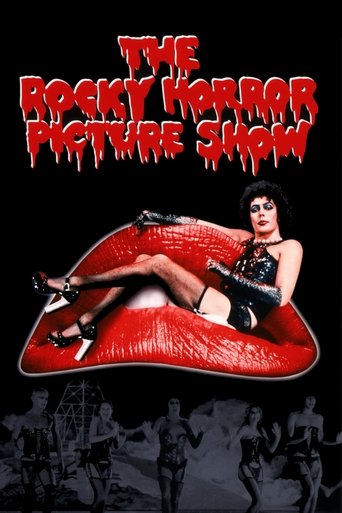
Make no mistake, despite its long life as an interactive phenomenon where audiences dress up as the characters, mimic the choreography, and shout lines at the screen, The Rocky Horror Picture Show is, by most cinematic standards, a bad movie. It’s narratively incoherent, riddled with plot holes and conveniences, and filled with excruciating characters whose behaviors shift on a whim, dictated by the needs of the scene rather than any consistent logic. Calling it a story feels generous, it’s more of a loosely connected series of bizarre set pieces. It throws half-baked ideas at the screen with reckless abandon, as if hoping sheer eccentricity will compensate for the complete lack of structure. Nothing makes sense.
The interactive viewing experience is likely fun, but that doesn’t change the fact that, at its core, Rocky Horror is more of a cultural meme than a work of genuine artistic merit. Wouldn’t a similar screening of The Room, with everyone yelling “Oh hi, Mark,” be just as entertaining?
Directed by Jim Sharman and based on the stage musical (with several original cast members reprising their roles), the film begins with a seemingly straightforward setup. A wholesome couple’s car breaks down, leading them to a castle filled with eccentric characters, where they become trapped in the strange world of Dr. Frank-N-Furter, a flamboyant scientist unveiling his latest creation: a muscular artificial man named Rocky. As they’re drawn further into the castle’s bizarre happenings, they encounter mind-controlled servants, unexpected betrayals, and a series of increasingly nonsensical twists. Initially, there’s a sense of structure with a few clever early songs and a clear trajectory. But the longer they stay, the more the film spirals into a disjointed string of musical numbers and absurd detours. The chaos may be intentional, some might even argue that it’s the film’s defining feature, but that doesn’t make it any less exhausting to sit through.
The soundtrack, often cited as the film’s saving grace, is wildly uneven. “Time Warp” is energetic enough to justify its cult status, and “Dammit Janet” has clever lyrics and a catchy melody, but beyond those, the songs swing between forgettable and grating, memorable, but often for the wrong reasons. Many don’t match the tone of the scenes they accompany, feeling awkwardly placed (like “Over at the Frankenstein Place”), while others rely too heavily on repetition rather than strong composition (“Touch-a, Touch-a, Touch Me” being a prime example). The weaker tracks blend together into a monotonous haze, dragging the film’s energy down instead of elevating it. The rare moments where a song works are almost always thanks to Tim Curry’s performance.
Curry is, without question, Rocky Horror’s greatest asset, and possibly the main reason for its success. Without his presence, the film would be unwatchable. He sells every absurd moment with unwavering theatricality, making even the worst jokes and the weakest songs entertaining. His character’s motivations are just as inconsistent as everything else in the film, yet he brings a layer of depth that nothing else in Rocky Horror possesses. Beneath all the exaggerated camp, there’s a flicker of something tragic in Frank-N-Furter, an undercurrent of sadness masked by flamboyant bravado. It’s the kind of complexity that’s miles beyond anything else happening in the film. The rest of the cast, meanwhile, feels like they’re simply along for the ride, playing exaggerated caricatures with no real weight behind them. Susan Sarandon, in particular, delivers an embarrassingly cringeworthy performance.
Visually, Rocky Horror does have some charm. The production design leans into classic Universal monster-movie aesthetics, adding a nostalgic throwback appeal. A handful of jokes land, like the scene where characters dramatically yell each other’s names, but the relentless over-the-top reactions from the cast quickly wear thin.
Does popularity make something good? Rocky Horror is proof that a film can endure for reasons entirely separate from its quality. It’s like Taco Bell, an experience that lingers with you, though not necessarily for the right reasons. Unfairly elevated to a cultural phenomenon, The Rocky Horror Picture Show traps its audience in a disjointed mess, dragging them through a chaotic narrative that feels just as frustrating and aimless as its characters. Only Tim Curry’s campy brilliance and a couple of catchy songs keep it from being completely unbearable. In a more just world, Tommy would be the 1975 musical with an impassioned cult following. As for Rocky Horror, I’ll pass on doing the time warp again.
Still courtesy of 20th Century Fox
- 1One Flew Over the Cuckoo's Nest
- 2Dersu Uzala
- 3Jaws
- 4Nashville
- 5Manila in the Claws of Light
- 49The Rocky Horror Picture Show#49 of 51
- Where to watch
 Disney+
- Where to watch
- Disney+
 Play trailer


- Original title
- The Rocky Horror Picture Show
- Director
- Jim Sharman
- Genre
- Comedy, Science Fiction, Horror
- Cast
- Tim Curry, Susan Sarandon, Barry Bostwick, Richard O'Brien, Patricia Quinn, Nell Campbell, Jonathan Adams, Peter Hinwood
- Rated
- R
- Screenwriter
- Jim Sharman, Richard O'Brien
- Composer
- Richard Hartley
- Cinematography
- Peter Suschitzky
- Editor
- Graeme Clifford
- Country

 Netherlands Antilles
- Language
- English
- Budget
- $1.4 million
- Box office
- $171.181 million
- Distributor (CA)
- 20th Century Fox