
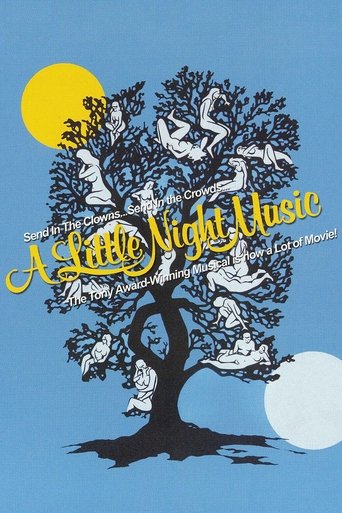

I don’t think I have ever, in all my years of watching movies—3,555 logged on Letterboxd and counting—seen worse direction than in the 1977 film adaptation of A Little Night Music. And I say this with a serious face: yes, even worse than what Tom Hooper did to Cats many years later.
Completely forgotten by everyone but the most ardent Broadway fans, this film had high expectations at the time of its release, promising a prestige adaptation of a very popular musical. It featured lush songs composed by the great Stephen Sondheim and a cast that included Elizabeth Taylor and Diana Rigg. It even received Oscar nominations for Best Costume Design—winning one for Best Adapted Score. Clearly, people behind the scenes were working with care and aiming for something special. And yet, director Harold Prince—an acclaimed stage director who helmed the original Broadway production—somehow gets in the way of every good thing about it.
That the film is even remotely watchable at times is a credit to all the other forces around it. Based on the Broadway musical—which itself was adapted (or according to the credits, “Suggested”) from Ingmar Bergman’s 1955 gem Smiles of a Summer Night, a romantic ensemble comedy about mismatched lovers spending a weekend together—the material had all the ingredients for a light, charming, witty, elegant, and even subversively sensual story. Both of its sources certainly are. But here, Prince gets the tone all wrong. The film is overly serious when it should be playful, and characters react with strange, awkward timing. It feels stagy when it should be cinematic, and cinematic when it should feel intimate. The musical’s elegance and charm are lost in awkward edits, misused close-ups, abrupt song endings, and scene transitions that often feel out of place.
Sondheim’s emotional rhythms—built on precise timing and layered lyrical interplay—are constantly undermined by the film’s lack of spatial logic and dramatic pacing. And when it comes to portraying the women, Prince seems to completely miss what he himself achieved on stage—and what Bergman captured so deftly in his film. In Smiles of a Summer Night and the original musical, the women are witty, emotionally layered, and quietly in control—even when tangled in romantic entanglements. There’s irony, melancholy, and agency. But in this adaptation, that balance is thrown off. The female characters are flattened into sentimental figures or romantic prizes, stripped of their intellect and complexity. Anne especially is reduced to little more than an object of desire, sidelined from the story’s emotional chess game.
Almost nothing escapes unscathed—least of all the performances. Elizabeth Taylor, dealing with personal issues at the time, seems adrift in every scene. She never finds a spark or sense of energy. Her entrance is oddly placed and confusing for anyone unfamiliar with the stage version. And her character’s emotional climax—singing the show’s most famous song, “Send in the Clowns”—comes and goes without impact. The film gives us no reason to believe she’s earned that moment, or that anything has been building toward it. The rest of the cast is similarly stranded, forced into strange bits of blocking (playing cello creepily in the woods, for example) or reacting to small things with outsized emotion. The wit, joy, and emotional nuance of the original musical are largely absent here.
The exception—thankfully—is Diana Rigg. She’s a delight to watch. Even when asked to do awkward things (starting a musical number while sitting in a moving carriage, or executing a plan at dinner that would be incomprehensible if not spelled out beforehand), she delivers a performance full of strength, sadness, spark, and subtlety. Every time she’s on screen, she commands your attention. She nearly makes the film worth watching all by herself.
Next to her, fighting against all odds, are Sondheim’s marvelous compositions, which remain a thing of beauty. The score is elegant, entirely composed in waltz time, and masterfully orchestrated. Songs like “Now/Later/Soon” showcase Sondheim’s brilliance—musical counterpoint, emotional layering, and clever structure that demands your full attention. At times, I found myself wanting to close my eyes just to focus on the music, because the film around it was doing everything it could to distract. His lyrics are rich with intelligence and subtext, which the film makes no effort to dramatize. In some scenes, an actor staring vaguely into the distance becomes the better option—at least it doesn’t get in the way of the song.
Thankfully, the legacy of the musical itself lives on. A Little Night Music is now a classic, performed around the world, with “Send in the Clowns” becoming one of Sondheim’s most enduring ballads—even showing up in Joker (2019), of all places. A far superior version was filmed in 1990 at Lincoln Center—a semi-staged concert performance with full orchestra and multi-camera direction for PBS. It captures the show’s wit, musical elegance, and ensemble dynamic far better than this adaptation ever does. The film itself is now nearly impossible to find—barely available on physical media, streaming platforms, or even online. It wasn’t the comeback Elizabeth Taylor needed either; her later career consisted mostly of TV appearances, stage work, and only a handful of small film roles. As for Harold Prince, he returned to the stage—for the betterment of all humanity—and went on to direct Sweeney Todd, Evita, The Phantom of the Opera, and more.
If you’re curious, watch Diana Rigg’s scenes on YouTube—particularly “Every Day a Little Death” and her part in “A Weekend in the Country.” Search for the soundtrack to hear the full beauty of Jonathan Tunick’s lush orchestrations. As for the rest of the movie? Perhaps they should’ve sung: “Soon… but never.”
- 1Sorcerer
- 2Annie Hall
- 3The Ascent
- 4Star Wars
- 5Close Encounters of the Third Kind
- 39A Little Night Music#39 of 40
- Where to watch
- Not available for streaming
- Where to watch
- Not available for streaming
 Play trailer


- Original title
- A Little Night Music
- Director
- Hal Prince
- Cast
- Elizabeth Taylor, Diana Rigg, Len Cariou, Lesley-Anne Down, Hermione Gingold, Laurence Guittard, Christopher Guard, Lesley Dunlop
- Rated
- PG
- Screenwriter
- Hugh Wheeler
- Composer
- Stephen Sondheim
- Cinematography
- Arthur Ibbetson
- Editor
- John Jympson
- Country



- Language
- English
- Budget
- $6.6 million