
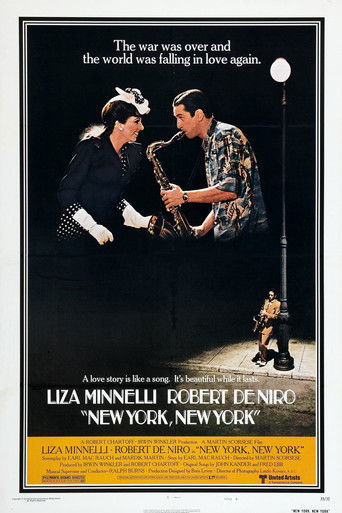

The song New York, New York has become so iconic that it almost feels like a sprawling Martin Scorsese epic was the only fitting way to introduce it to the world. Yet few people today associate the song with the film where it originated—a movie that, ironically, spends little time celebrating the city itself, despite being originally intended by Scorsese as a vibrant tribute to New York after the bleakness of Taxi Driver.
Instead, the film veers in the opposite direction, centering on a turbulent love story between an abusive musician and a gifted singer, where resentment and insecurity gradually tear them apart. Even on its own terms, the lack of emotional foundation and repetitive structure make it one of the more significant missteps of Scorsese’s career.
Scorsese’s artistry remains evident throughout the film. As always, he demonstrates his command of cinematic language through dynamic camera movements, meticulous scene construction, and his ability to capture the dazzling production design, costumes, and Liza Minnelli’s powerhouse musical performances. But all of it is ultimately wasted on a messy, unfocused plot, anchored by arguably Scorsese’s most unlikable protagonist—which is remarkable for a director who created figures like Travis Bickle and Jake LaMotta.
At its core, the film feels torn between too many competing ambitions. Scorsese tries to blend the commercial appeal of A Star Is Born, a loving tribute to 1940s musicals, a personal showcase for Minnelli, and the gritty realism of Taxi Driver. While he technically succeeds in crafting a fascinating stylistic hybrid, narratively it often feels like he’s more invested in the experiment than in telling a compelling, cohesive story.
The film’s biggest problems stem from its pacing and its central relationship, which never convinces. Robert De Niro’s character is abrasive and self-absorbed from the outset, making it difficult to understand why Minnelli’s character would stay with him. The first thirty minutes, in particular, are where the film falters most. Rather than establishing De Niro’s charm or magnetism, we watch him repeatedly force his way into Minnelli’s life, skipping from hotel to hotel without paying the bills. It’s a long, shapeless introduction that saps momentum before the story has even properly begun. Instead of building emotional investment, New York, New York quickly bogs down in a repetitive cycle of arguments and reconciliations, draining the energy from the otherwise impressive musical performances.
While De Niro convinces as a saxophone player during the musical scenes, he feels miscast elsewhere, unable to ground the character’s volatility in any real charisma. Minnelli, meanwhile, brings vitality and heart to every moment she’s given—even if the script leaves her with little more than the basic demands of the plot.
Technically accomplished but narratively hollow, New York, New York flopped at the box office, overwhelmed by the phenomenon of Star Wars and rejected by audiences who didn’t respond to its strange mix of sensibilities. Shut out of the Oscars despite producing one of cinema’s most enduring songs, the film’s failure nearly ended Scorsese’s career and life, as he spiraled into drug addiction and suffered a near-fatal overdose. In hindsight, it remains a fascinating but deeply flawed reminder that ambition alone isn’t enough—and that even the greatest filmmakers can sometimes lose control of the story they set out to tell.
- 1Sorcerer
- 2Annie Hall
- 3The Ascent
- 4Star Wars
- 5Close Encounters of the Third Kind
- 35New York, New York#35 of 40
- Where to watch
- Not available for streaming
- Where to watch
- Not available for streaming
 Play trailer


- Original title
- New York, New York
- Director
- Martin Scorsese
- Cast
- Liza Minnelli, Robert De Niro, Lionel Stander, Barry Primus, Mary Kay Place, George Memmoli, Dick Miller, Murray Moston
- Rated
- PG
- Screenwriter
- Earl Mac Rauch, Mardik Martin
- Composer
- John Kander
- Cinematography
- László Kovács
- Editor
- Bert Lovitt, David Ramirez, Tom Rolf
- Country

- Language
- English
- Budget
- $14 million
- Box office
- $16.4 million