OVERVIEW
The world’s favorite nuclear lizard is back, but this time he is not the only monster threatening Japan. Two years after the events of Godzilla Minus One, Koichi Shikishima (Ryunosuke Kamiki) and Noriko (Minami Hamabe) live a quiet domestic life with their adopted daughter, Akiko, when Ghidorah, a massive dragon-like creature that can fire lightning beams, begins destroying cities. While Noda (Hidetaka Yoshioka) prepares a new operation against the creature, scientist Kanji Murakami (Min Tanaka) proposes a far more dangerous solution: lure the regenerated Godzilla into fighting Ghidorah, then eliminate whichever monster survives. Koichi initially wants nothing to do with another battle, but soon finds himself pulled back into it.
BACKGROUND
The success of Godzilla Minus One put Takashi Yamazaki in an unusual position when approaching a sequel. Made for less than $15 million, with only 35 artists responsible for its 610 visual effects shots, the film grossed more than $100 million worldwide and became the first Japanese production to win the Academy Award for Best Visual Effects. More importantly, it became widely celebrated for something considerably less expected from a Godzilla film: how much attention it gave to its human characters. Yamazaki had already identified the danger of losing that balance. Asked in 2023 about introducing another kaiju, he said his biggest concern was that once two monsters started fighting, audiences would naturally begin waiting for the battle and the human story could get lost around it. Three years later, he returned with considerably more resources. Godzilla Minus Zero received a larger budget, although its exact figure has not been disclosed, and became the first Japanese production officially ‘Filmed For IMAX’.

THE REVIEW
In terms of scope and spectacle, it is a significant level up from its predecessor. It opens in medias res with the destruction of Matsumoto City, a brief but ginormous burst of destruction that immediately makes clear that Yamazaki does not aim to surpass only its predecessor, but humiliate every Western iteration of the monster. In terms of quantity, there aren’t many full-on action scenes, but when they come, he certainly achieves his goal.
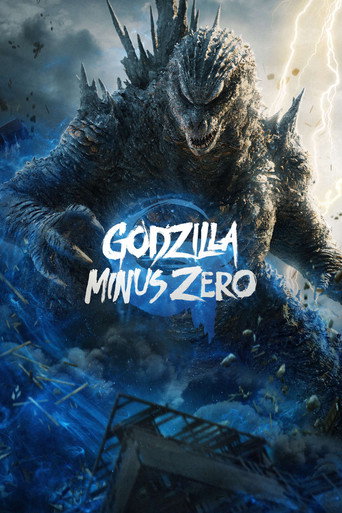
The sound is deafening, the effects are nearly flawless, and Akira Ifukube’s classic Godzilla theme blares through the theater at full volume. Godzilla no longer looks or moves quite as much like his 1950s incarnation, instead becoming a full-on beast closer to the modern interpretation, making him more brutal and physically imposing. Striking shots such as Ghidorah suddenly appearing behind a plane or Godzilla’s first roar give chills. The monster battle in particular is visceral, with actual and shocking carnage between them as limbs are torn off. Again, there may only be around ten minutes of this kind of action, but it is more than enough. If anything, the restraint makes those scenes feel as impactful as possible.
Where Minus Zero takes a clear step down from its predecessor is in almost everything surrounding those scenes, and part of the problem is how easy it is to separate the spectacle from the rest of the film in the first place. One of Godzilla Minus One’s biggest achievements was how much it felt like a character study that happened to have Godzilla in it, with the focus remaining on the characters even when the monster took center stage and on what his destruction meant for them. Here, that balance has inverted. The film has clear destination points it wants to reach, particularly the eventual battle between Godzilla and Ghidorah, and much of the narrative feels built around getting us there. In other words, it feels much more like a very well-made monster movie.
Three main plots and ideas populate the narrative, and one works considerably better than the other two. The film is most successful when expanding the political ideas of the first one, modernizing the nuclear fears that have defined Godzilla since the original while also examining the looming presence of the United States and Japan’s complicated desire for revenge. Murakami, a survivor of Hiroshima who lost his family in the bombing, becomes particularly important to this thread. The ideas are not as deep as the film seems to think they are, but they at least give the destruction a contemporary political context that feels respectful of the franchise’s history while pushing it into new territory, particularly in how it reflects modern anxieties surrounding American dominance, something also explored in this year’s other major Asian monster film, Hope.
The second plot is the one that takes the most time and is unfortunately the least interesting: the logistics and human schemes required to fight the monsters, and eventually put them against each other. These scenes are slow, with characters spending considerable time explaining increasingly elaborate ideas, especially when compared with how efficiently the first film communicated its central plan. They also rely on several conveniences and ‘ex machinas’, including meteorologist Makoto Aoyama (Masami Nagasawa), whose ability to predict the monsters’ movements through weather patterns becomes almost too useful whenever the screenplay needs it. The climax consequently has far less urgency and stakes than the first film, which, by contrast, focused on a small group of civilians and veterans who genuinely felt like humanity’s last hope against the huge unstoppable monster.
Unfortunately pushed into the background is the drama between Koichi and Noriko. Koichi had a fantastic arc in the previous film, culminating in him finally choosing life after spending years consumed by survivor’s guilt, and Minus Zero takes that into a natural next step: now that he and Noriko have actually built a life together and formed a family with Akiko, how much of that peace are they willing to sacrifice when the world needs them again? It is a promising progression, but unlike in the previous film, their relationship is no longer at the center, and the movie leaves them aside for long stretches before suddenly demanding much more emotional intensity. Kamiki and Hamabe, who already had a few rough moments in the first film but ultimately made the relationship work, do not always manage to sell it here, occasionally tipping into almost soap opera-level melodrama. The screenplay does them few favors either, particularly in the frustratingly sexist way Koichi reacts when Noriko becomes involved in the fight. More damaging, however, is how little time the film spends developing any of this before their final scene together, which finally brings the emotional weight their arc has been missing but never feels completely earned.
FINAL THOUGHTS
If Godzilla Minus One surprised many by being basically a character study that happened to have Godzilla in it, Godzilla Minus Zero is clearly aiming for maximum kaiju spectacle, with the human drama often feeling like an afterthought. In terms of thrills, it often succeeds spectacularly, with a handful of tremendous action sequences that rank among the best monster fights put on screen. The problem is that everything connecting those moments feels considerably less involving, from the elaborate planning to the thinner character development and several convenient turns in the screenplay. It is still an impressive monster movie, and the ending recovers some of the emotion missing along the way, but after how unusually rich Minus One felt, this sequel is a noticeable step down.
Still courtesy of Cineplex Pictures
- 1Hadestown: The Musical
- 2Tuner
- 3Minotaur
- 4The Weight
- 5Wicker
- 98Godzilla Minus Zero#98 of 207
- Where to watch
- Coming soonNov 6, 2026
- Where to watch
- Coming soonNov 5, 2026
 Play trailer


- Original title
- ゴジラ-0.0
- Director
- Takashi Yamazaki
- Genre
- Science Fiction, Horror, Action
- Cast
- Ryunosuke Kamiki, Minami Hamabe, Yuki Yamada, Kuranosuke Sasaki, Jun Kunimura, Miou Tanaka, Sakura Ando, Masami Nagasawa
- Rated
- R
- Screenwriter
- Takashi Yamazaki
- Composer
- Naoki Sato
- Country

- Language
- Japanese
- Distributor (CA)
- Cineplex Pictures