OVERVIEW
The Uprising follows one of the largest popular uprisings in medieval English history: the Peasants’ Revolt of 1381, when workers, angered by rising taxation and exploitation under new laws, rebelled and marched to London to plead their case directly before the king. They believed that the problem rested with his advisers rather than the Crown itself, and that if the king could hear what was being done in his name, he might put an end to it.
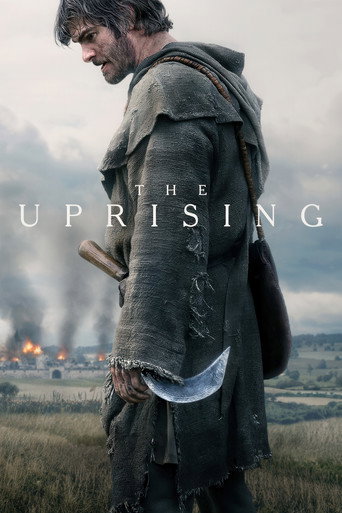
Andrew Garfield plays Ploughman, a widowed farmer who inadvertently encourages his village to rise up after fighting back against representatives of the Crown who abuse young women while collecting the tax. Initially unwilling to become involved, he reluctantly joins rebel leader Wat Tyler (Cosmo Jarvis), radical priest John Ball (Jamie Bell), and the thousands gathering behind their cause. In London, fourteen-year-old King Richard II (Woody Norman) is surrounded by advisers determined to preserve the system.
BACKGROUND
Greengrass began working on The Uprising during the pandemic, returning to the story of the Peasants’ Revolt he learned growing up in England, now finding new relevance in its anger. The project was first announced at Cannes in 2022 as The Hood, with Benedict Cumberbatch attached to star, before disappearing for several years and resurfacing in 2025 as The Rage, now with Matthew McConaughey in the lead and Jason Blum producing. McConaughey eventually left the project, Andrew Garfield replaced him, and Focus Features acquired the U.S. rights for a reported $11 million.
Greengrass drew from historical accounts of the revolt as well as William Langland’s Piers Plowman, a poem written a few years before the rebellion that provided the basis for Garfield’s fictional Ploughman. Filming took place across Germany, using preserved medieval locations and thousands of extras to recreate the march toward London. The film went through one final transformation shortly before release, when Focus added The Rise of Robin Hood to the American marketing and began presenting Ploughman as part of the origin of the legendary outlaw. The decision proved controversial, with the British distributor publicly rejecting the Robin Hood framing and continuing to market The Uprising simply as a historical epic about the Peasants’ Revolt.

THE REVIEW
Although the story carries clear parallels to today’s world and should make for a rousing account of ordinary people standing up against exploitation, The Uprising is ultimately inert. As with Greengrass’s previous film, The Lost Bus, the director seems far more interested in the mechanics of how events unfold than in the people experiencing them, who become little more than placeholders within the history. That film, however, could at least fall back on the impressive technical challenge of recreating a wildfire and trapping its characters inside it. The Uprising has little comparable excitement or technical achievement to compensate for how distant it all feels. We watch people march, suffer, give speeches, and die, but rarely feel the urgency, anger, or intensity that should make any of it stirring.
It is simply not a pleasant or exciting watch, made worse by Greengrass’ tendency to suck all the fun out of the material. Cinematographer Pål Ulvik Rokseth drains most of the color from the image, covering medieval England in a grayish palette that blends mud, smoke, wood, and overcast skies into an unappealing blur, while Greengrass, of course, brings his familiar handheld camera directly into the crowd. At times, the approach works, giving the revolt a convincing documentary realism, almost as if someone had been dropped into 1381 with a camera and recorded what was happening around them. But that commitment also sacrifices much of the scale these events demand. Despite thousands of extras reportedly being used during production, the rebellion rarely feels like more than the same crowd walking from one muddy environment to another. Spending so much time pressed against these bodies only makes their lack of characterization more apparent, with our investment largely dependent on their terrible circumstances and a series of monologues about the misfortunes they have endured. Even the violence feels surprisingly tame after years of medieval stories such as Game of Thrones and the similarly humorless The Death of Robin Hood. More gore would hardly solve the problem, but Greengrass often stages brutality in the most unremarkable way possible, with little tension leading into it or emotional consequence once it happens.
The only character who sparks curiosity is the king himself, whom Woody Norman plays with welcome unpredictability as we watch his increasingly pathetic behavior. Watching such a pitiful figure gradually discover the power at his disposal and grow more assured in wielding it is far more compelling than Andrew Garfield’s stock lead character, Ploughman, who is mostly reduced to brooding looks into the distance. It is one of Garfield’s most muted and forgettable performances, and the development meant to form the spine of the film remains so bland that its predictable conclusion fails to register. Volker Bertelmann’s score is equally unremarkable, once again recycling familiar ideas from Conclave, although the occasional songs performed by the rebels as they march finally bring some of the communal identity missing elsewhere. Those moments briefly suggest a far superior version of The Uprising, one that captures how people emerging from years of sickness into further exploitation and injustice gradually recognize their suffering in one another, turning individual grievances into a shared identity, collective anger and, eventually, hope.
FINAL THOUGHTS
Much like The Death of Robin Hood earlier in the year, it is easy to watch The Uprising and wonder who was asking for this approach to the material in the first place. This kind of ultra-serious, relentlessly dour medieval filmmaking already feels about a decade too late (I was never particularly fond of it to begin with). The film isn’t educational or historically detailed enough for all that seriousness to have much impact, yet it offers no joke, glimpse of color, or moment of genuine warmth to invest in either. How dare anyone fall in love, feel happy, or have some fun? Greengrass is so committed to misery that the film becomes lifeless and unpleasant, while lacking enough meat to become particularly infuriating.
There is at least some unpredictability during the first half, particularly around Richard II, how he will respond to the revolt, and what role his mother might play in his decisions. Once the film hints at its direction around the midway point, however, everything starts falling into place exactly as expected, repeatedly taking the easiest and most familiar paths all the way to the final credits. Greengrass can recreate the mud, violence, and the look of a rebellion forming, but never the feeling that would make thousands of people sacrifice everything to join one.
Still courtesy of Universal Pictures Canada
- 1Everytime
- 2Hadestown: The Musical
- 3Minotaur
- 4You Can See Everything
- 5Hope
- 198The Uprising#198 of 223
- Where to watch
- Rent or buy at Apple TV Store, Amazon Video
- Where to watch
- Out of Theaters
 Play trailer


- Original title
- The Uprising
- Director
- Paul Greengrass
- Cast
- Andrew Garfield, Jamie Bell, Stephen Dillane, Tom Hollander, Cosmo Jarvis, Thomasin McKenzie, Jonny Lee Miller, Woody Norman
- Rated
- 14A
- Screenwriter
- Paul Greengrass, Tamás Pálmai
- Composer
- Volker Bertelmann
- Cinematography
- Pål Ulvik Rokseth
- Editor
- William Goldenberg
- Country


- Language
- English
- Budget
- $20 million
- Box office
- $10.188 million
- Distributor (CA)
- Universal Pictures Canada