
OVERVIEW
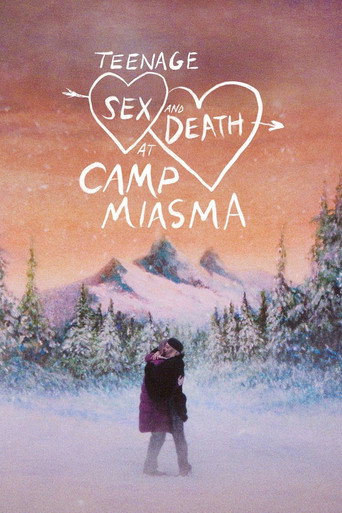
The premise is, in writer-director Jane Schoenbrun’s own description, “Portrait of a Lady on Fire set in a Friday the 13th sequel.” A young filmmaker (Hannah Einbinder) is hired to rescue a long-running summer-camp slasher franchise from terminal sequel rot, and her path to doing that runs through the original film’s vanished Final Girl (Gillian Anderson), now a recluse living at the abandoned camp where the first movie was shot. The reboot pitch becomes a courtship, and a fictional slasher series called Camp Miasma serves as the framework for Schoenbrun’s exploration of sex and identity.
BACKGROUND
You’d think that Schoenbrun’s follow-up to I Saw the TV Glow, a film that earned six Independent Spirit nominations and made Schoenbrun the rare trans filmmaker with both critical leverage and a growing following, would be the easy sell. It was not. Every major studio and distributor passed on Camp Miasma. The only company that said yes was Mubi, which financed the film outright and brought Plan B (the Brad Pitt, Dede Gardner, and Jeremy Kleiner shop behind Moonlight and 12 Years a Slave) on to produce. Schoenbrun returned with the TV Glow core team (DP Eric Yue, production designer Brandon Tonner-Connolly, colorist Mikey Rossiter), around an idea that started as just a title, scribbled down years ago while sitting on a couch.

THE REVIEW
There is plenty to like in Teenage Sex and Death at Camp Miasma, and Schoenbrun, whose work keeps building on itself film to film, is operating with real confidence at the level of the individual sequence. The opening title montage, which traces the rise and fall of the fictional Camp Miasma franchise through fake VHS art, taglines, and decades of merchandise, is a small marvel. Einbinder, in her first real outing outside of Hacks, anchors the early stretches with a watchful, slightly hungry energy that is highly magnetic. And the arrival at the lake (that first long evening between Kris and Billy) is the best passage in the film. Anderson is so locked into a register of faded-icon strangeness, part Norma Desmond, part stoned art-camp counselor, part genuinely wounded, and the sequence sets a bar the rest of the film keeps reaching for.
Schoenbrun keeps excelling in sequences like that. There is a fried chicken and dipping sauce moment that will have you craving some after the credits, and a long late-night killing spree where the I Saw the TV Glow crew (Eric Yue’s camera, Brandon Tonner-Connolly’s production design, Mikey Rossiter’s color) produce some of the most distinctive genre work in American cinema right now, the kind of sequence that will be talked about for years. There is also a Zoom call with studio executives that lands some of the sharpest fun anyone has had at Hollywood’s expense in a while, blowing recent “edgy” satires like The Studio out of the water. When the film is on, it reaches five-star territory.
Both leads deserve real credit here, fearless in their commitment to Schoenbrun’s vision. Einbinder is very good as the director’s surrogate, moving Kris from an intelligent but constrained filmmaker to someone experiencing actual freedom by the end. Anderson, however, is the film’s strongest asset. She eats every line up, hamming Billy up to the rafters without ever losing the character’s humanity, which is essential for the whole thing to work. There is a real ache underneath the camp from her very first scene, and it only deepens as the film goes on, and the empathy towards Kris is the film’s emotional center.
What Schoenbrun has not yet solved is how the parts add up to one experience. The combination of great sequences remains a bit too loose and disjointed, and the tonal swings (slasher pastiche, sapphic romance, Hollywood satire, post-transition memoir) all land individually but pull in slightly different directions. The connective tissue stretches thin around the middle, and the film keeps returning to a few ideas that already landed on first pass. It is genuinely Schoenbrun’s most accessible work so far, and you can feel the reach for something looser and more pleasurable than TV Glow. It is not effortless yet.
FINAL THOUGHTS
Schoenbrun once again makes a film for themselves and for the audience already on their wavelength, and viewers who read the slasher genre as a coded conversation about queer awakening and dissociated bodies will have an enormous and succulent meal here, with plenty of meanings and different perspectives to dissect for a long time. Those who haven’t connected to the director’s previous films, especially I Saw the TV Glow, will be frustrated by how alienating it still comes through, despite Schoenbrun clearly trying to make it more accessible than anything they have done before. Schoenbrun, much like Kris in the film, remains too academically focused for their own good at this point, too full of ideas they want to cram into a single movie, and too precious about those ideas, insisting they be cycled back multiple times. They are on the right path, and it is gratifying to see the world’s most prestigious festival embrace such a bold work. The moment Kris finally becomes the final girl in her own slasher movie is the best in Schoenbrun’s career yet, and will easily remain one of 2026’s strongest scenes. They have not yet made the film where every idea lands and the work opens up to a wider audience, but they are getting closer.
Still courtesy of MUBI Canada
- 1Everytime
- 2Hadestown: The Musical
- 3Tuner
- 4Minotaur
- 5You Can See Everything
- 59Teenage Sex and Death at Camp Miasma#59 of 219
- 1Minotaur
- 2Hope
- 3The Man I Love
- 4The Unknown
- 5La Gradiva
- 14Teenage Sex and Death at Camp Miasma#14 of 34
- Where to watch
 Mubi
- Where to watch
- Mubi
 Play trailer


- Original title
- Teenage Sex and Death at Camp Miasma
- Director
- Jane Schoenbrun
- Cast
- Hannah Einbinder, Gillian Anderson, Amanda Fix, Arthur Conti, Eva Victor, Zach Cherry, Sarah Sherman, Patrick Fischler
- Rated
- R
- Screenwriter
- Jane Schoenbrun
- Composer
- Alex G
- Cinematography
- Eric K. Yue
- Editor
- Graham Mason
- Country


- Language
- English
- Budget
- $8 million
- Box office
- $8.63 million
- Distributor (CA)
- MUBI Canada