
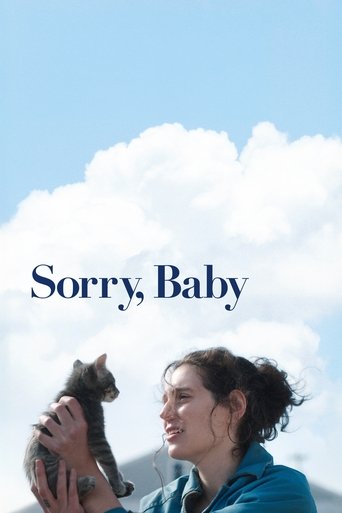
I applaud Eva Victor for showcasing her voice as a debut director, screenwriter, and lead actress, making bold choices that bring a surprising freshness to a #MeToo film, a genre that, unfortunately, has become stagnant and struggles to find new angles. The TikTok comedian injects her own sense of humor into a story about rape and its aftermath, signaling that even after abuse, life continues.
Yet, for me, the humor mostly didn’t work and made connecting with Sorry, Baby difficult, as it often softened the weight of its subject matter to the point of feeling almost trivial, making it hard to engage with the characters and their emotional journeys fully.
The second chapter, which finally puts everything into context, contains Victor’s most striking directorial choice. Instead of depicting the assault, the camera remains outside as Agnes enters a house. Time passes. Hours later, she rushes out in distress. No explicit visuals, no dialogue, just implication. It’s a brilliantly restrained approach and easily the film’s most memorable moment.
However, after these strong early chapters, the film starts to lose focus. It leans into overly literal symbolism, such as a scene where Agnes boards up her window with pages from her thesis (written under her abuser). The message, “he took all the light from her life”, is clear, but too on-the-nose.
Certain characters also feel out of place. Both Natasha (Kelly McCormack) and Fran (Lydie’s wife) don’t act like real humans and seem to belong in a completely different movie, with all of their interactions coming off as cringeworthy.
There’s a great film within Sorry, Baby, one that deserves much of the praise it has received. However, for me, its uneven humor and unique tone prevent it from fully landing emotionally, at times downplaying the impact of what occurred.
- 1Sentimental Value
- 2Hamnet
- 3One Battle After Another
- 4Ne Zha 2
- 5Blue Moon
- 111Sorry, Baby#111 of 256
- 1Kiss of the Spider Woman
- 2The Ballad of Wallis Island
- 3The Wedding Banquet
- 4Together
- 5Twinless
- 11Sorry, Baby#11 of 27
- Where to watch
 Crave
Crave- Where to watch
 Telecine
 Play trailer


- Original title
- Sorry, Baby
- Director
- Eva Victor
- Cast
- Eva Victor, Naomi Ackie, Louis Cancelmi, Kelly McCormack, Lucas Hedges, John Carroll Lynch, Hettienne Park, E.R. Fightmaster
- Rated
- 14A
- Screenwriter
- Eva Victor
- Composer
- Lia Ouyang Rusli
- Cinematography
- Mia Cioffi Henry
- Editor
- Alex O'Flinn, Randi Atkins
- Country


- Language
- English
- Budget
- $1.5 million
- Box office
- $2.28 million