OVERVIEW
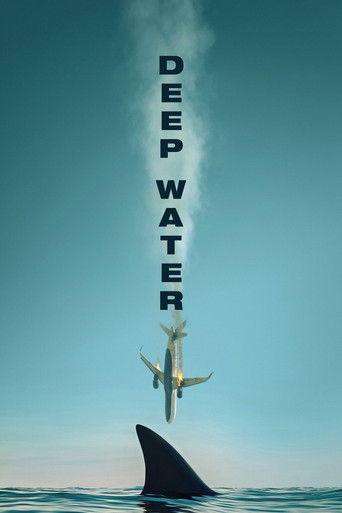
A throwback to the disaster films of the 70s, Deep Water combines the premise of the Airport films with Deep Blue Sea and The Shallows to provide some gnarly kills for destruction-hungry audiences. After a power bank explodes during a routine intercontinental flight between Los Angeles and Shanghai, the plane goes down in the Pacific, and the survivors are left to wait for rescue with sharks circling the wreckage. Aaron Eckhart plays the first officer Ben, an estranged family man who keeps moving between the fuselage and the water, trying to keep as many passengers alive as he can while working through what he left behind on land.
BACKGROUND
Deep Water marks the return of the auteur of guilty pleasure films, Renny Harlin, to the genre. The once-in-demand director, responsible for popcorn classics like A Nightmare on Elm Street 4, Die Hard 2, Deep Blue Sea, and Cliffhanger, has never stopped working, but a string of bombs had him locked deep in director’s jail. A long journey that involved multiple Chinese films, direct-to-VOD action flicks, and the terribly received Strangers horror trilogy has finally brought him back, and now, in his eighth feature in five years, he is dealing with sharks again, 27 years after Deep Blue Sea delighted audiences. Harlin has spoken at length about keeping everything as grounded as possible, opting for practical effects wherever the budget allowed, rather than leaning on CGI.

THE REVIEW
Despite all the promises, Deep Water is, on paper, a bad film even for its genre. It has an awful script that makes little to no sense, full of cardboard cutout characters all with one personality trait, embodied by badly directed, inexperienced actors. Dialogue is laughable. There is hardly any scene that doesn’t contain gaps in logic or huge conveniences. Eckhart seems constantly embarrassed to be here and gives what is easily the worst performance of his career, while Kingsley hardly leaves an impression. Had it been released in the early 2000s, it would have certainly been added to the list that sank Harlin into obscurity. Yet, in 2026, in a time where digitally polished films dominate streaming services and their most-watched top 10 lists, seeing a film that proudly embraces all these flaws, says “the shrug is mutual,” and continues to do its thing is genuinely refreshing.
Not that intentionality alone is enough to address all aspects. The film didn’t need any complex characters, but a few curveballs could have gone a long way. It’s very easy to instantly spot who will make it and who will become shark food, and until that point arrives, the characters’ dynamic can be very annoying. There’s the obnoxious jerk responsible for the accident, the captain ready to retire, the grandmother with a photo of her granddaughter as her lock screen wallpaper, the teenagers in love who haven’t found the courage to tell themselves that yet, and the disconnected siblings. The lead character starts the film receiving a call that his hospitalized son is unwell, and chooses to ignore it. Originality and risks are nowhere to be found.
Similarly, Harlin will, once in a while, make a choice that sticks out like a sore thumb. For every genuinely cool shot, like the power bank first catching fire and the blaze spreading to the airplane’s engine (the single strongest sequence in the film), there is a baffling one, like a tracking shot moving through the plane’s cabin, exposing its set-like nature and drawing the viewer out instantly. Harlin also overplays Fernando Velázquez’s score, which leans on Lost-style Giacchino piano chords and, later, aggressive strings. Harlin’s out-of-touch sensibilities are nowhere clearer than in the plane’s crash, when a requiem-like cue swells melodramatically while characters we’ve barely known embrace for impact (this is no Titanic for such indulgence).
After the plane crashes and the characters are separated across the wreckage, there is not much left to do, with repeated shark POV shots and characters’ bickering. Yet, despite its predictability and awkward moments, the film does succeed in what it is offering. It has an adequate runtime of 105 minutes, and to Harlin’s credit, he wastes no time getting the characters on the plane and letting the mayhem begin. Characters might be unidimensional, but the film gets it right by not dwelling on them before the crash (even if it loses that discipline afterward). The spectacle is not the most impressive, and budget constraints are constantly visible. But you can feel the difference. The crash feels like a plane tearing itself apart, walking a fine line between disaster-movie destruction and serious tone, avoiding falling into Final Destination territory. Swimming between floating pieces of wreckage feels dangerous because of the practical sharks (that is, until they start flying). None of this would register in a film made for streaming, where everything is rendered, smoothed, and lit until it looks like nothing at all.
FINAL THOUGHTS
Considering how easily this film could have ended up shot in a tank with CGI sharks lazily added in post, it is almost praiseworthy that Deep Water still relies on practical effects for its spectacle. It doesn’t compare to the joys of rewatching an old DVD of one of Harlin’s golden years films, and it definitely needed more polishing in its second half, where the shark-attack scenes quickly become monotonous, and in the awful lines the poor cast delivers with embarrassment written on their faces. Yet there is something to be said for a $30 million shark movie that walks into theaters in 2026, where the actors actually get wet. There is enough of Harlin’s genre instinct left to keep it from sinking.
Still courtesy of Magenta Light Studios
- 1Everytime
- 2Hadestown: The Musical
- 3Tuner
- 4Minotaur
- 5You Can See Everything
- 144Deep Water#144 of 219
- Where to watch
 Paramount Plus
- Where to watch
- Rent or buy at Apple TV Store, Amazon Video
 Play trailer


- Original title
- Deep Water
- Director
- Renny Harlin
- Cast
- Aaron Eckhart, Ben Kingsley, Molly Belle Wright, Angus Sampson, Elijah Tamati, Zhao Simei, Li Wenhan, Nashi
- Rated
- 14A
- Screenwriter
- Shayne Armstrong, Damien Power, Pete Bridges, S.P. Krause
- Composer
- Fernando Velázquez
- Cinematography
- DJ Stipsen
- Editor
- Geoff Lamb
- Country




- Language
- English
- Budget
- $40 million
- Box office
- $7.34 million
- Distributor (CA)
- Magenta Light Studios