OVERVIEW
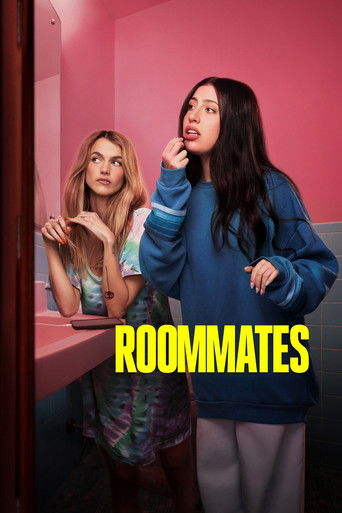
Set across one freshman year at Walton University, Roommates is framed as an extended flashback told by Dr. Schilling (Sarah Sherman), a campus dean mediating a separate roommate feud on the day the film opens. The story she unpacks belongs to Devon (Sadie Sandler), a naive first-year who asks the confident Celeste (Chloe East) to move in, and whose instant best-friendship curdles into passive aggression, betrayal, and open warfare. Canadian director Chandler Levack directs from a screenplay by SNL’s Jimmy Fowlie and Ceara Jane O’Sullivan.
BACKGROUND
Roommates is the sixteenth film Happy Madison has produced for Netflix, and part of a clear shift at Adam Sandler’s company, which spent years leaning on Sandler vehicles before handing the lead of You Are So Not Invited to My Bat Mitzvah to his daughter Sunny in 2023. Adam, playing the good father, now doubles the gesture by giving his other daughter, Sadie, her own vehicle. He contacted former music and film critic Chandler Levack himself, to her shock, impressed by her personal coming-of-age feature debut, I Like Movies. For the Canadian director, who worked on this film amidst post-production on Mile End Kicks, it was her first time working with a studio, and also the first time directing a movie she hadn’t written or pulled from her own life. She was drawn by the strangeness of freshman year at college, and interested in giving it her own spin.

THE REVIEW
Roommates wants to be to Gen Z what Clueless was to teenagers in the 90s, Mean Girls was in the 2000s, or Pitch Perfect in the 2010s, and for a while it succeeds at that. It is a tougher challenge to explore a generation fixed on Instagram reels and TikTok loops, but Chandler largely downplays the role of cellphones and offers an organic, character-focused coming-of-age story instead. She also captures what made those films stick: memorable jokes, scene-stealing sidekicks, and compelling leads. The recurring gags land (the jealous boyfriend calling one of the girls’ friends every ten minutes, the frisbee-throwing club), and when a bit tries too hard to be Gen-Z (the gay robot, really?), moments like Carol Kane’s cameo more than make up for it.
The roster is stocked with reliable veteran presence as the parents (Nick Kroll and Natasha Lyonne, both great), a solid companion for Devon in her brother Alex (Aidan Langford, perhaps the film’s strongest asset), and an effective love interest in Michael (Billy Bryk), the architecture TA she falls for. Building supporting characters who feel like they have their own lives, and don’t live only for the protagonist, has always been one of Chandler’s strengths, and it is once again alive and well here. Sadie Sandler and Chloe East are up to the task of carrying the film, striking a real balance between how different the two are and how they could possibly be drawn to each other; Devon’s anxiety is well-handled, and the hints of Celeste’s darker side keep us hooked.
For a while, the film is on track to become a worthy installment of the subgenre for a new generation, but it stalls halfway. A lot of it is because the film spends too much time asking the audience to figure Celeste out along with Devon, and its attempts to make us empathize with her land flat. The best teenage friendship films, especially between girls, capture the deep bond formed at that point in life, and the film here feels headed that way but pivots too quickly to the conflict. The conflict then stays passive-aggressive for too long before escalating exponentially in the final moments.
Then the other recognizable trait of Chandler’s work comes back to haunt her: the way-too-intentional “I want to go against the norm” syndrome. Once again, she establishes the starting point well and clearly knows where she wants to end, but doesn’t quite get us there smoothly. The destinations she reaches are creative and even daring, but they feel unearned. I wanted to empathize or at least understand the characters even when I hated their choices, but what Celeste does toward Alex feels uncalled for, while Devon’s actions toward Celeste always feel tame in comparison, to the point that the ending is a head-scratcher (despite a fantastic cameo).
FINAL THOUGHTS
As a UofT student, it is nice to see a fellow Torontonian filmmaker break out and transition to larger budgets and greater recognition. Despite the influence the Sandler family must have had on the production, what can be said about Roommates is that it feels like a Chandler film through and through, which means both its strengths and weaknesses carry over. I still wait for the day when her spin on conventional formulas truly captures its potential, and her desire to go against the norm lands as more than simply a cool gimmick.
Still courtesy of Netflix
- 1Hadestown: The Musical
- 2Tuner
- 3Minotaur
- 4The Weight
- 5Wicker
- 106Roommates#106 of 208
- Where to watch
 Netflix
- Where to watch
- Netflix
 Play trailer


- Original title
- Roommates
- Director
- Chandler Levack
- Genre
- Comedy
- Cast
- Sadie Sandler, Chloe East, Billy Bryk, Sarah Sherman, Martin Herlihy, Josh Segarra, Carol Kane, Natasha Lyonne
- Rated
- R
- Screenwriter
- Ceara Jane O'Sullivan, Jimmy Fowlie, Nick Shakespeare
- Composer
- Ryan Holladay, Hays Holladay
- Cinematography
- Maria Rusche
- Editor
- Tom Costain, Brian Robinson
- Country

- Language
- English
- Budget
- $30 million
- Distributor (CA)
- Netflix