
OVERVIEW
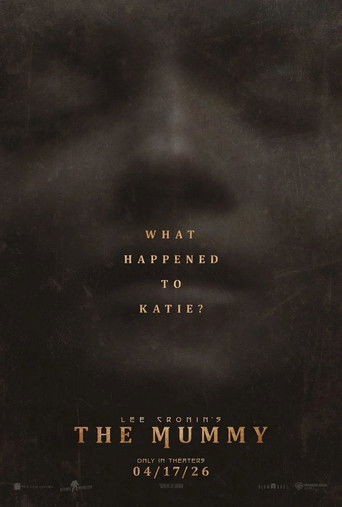
A journalist on a temporary assignment in Egypt has his oldest daughter kidnapped, and for eight years there are no signs of her. That changes after a mysterious plane crash, when she is found inside a sarcophagus, completely altered, barely resembling a human being. Doctors recommend she move back with her family to recover from the trauma, but her behavior becomes dangerous, putting the whole family at risk. Written and directed by Lee Cronin, it is a completely different interpretation of the monster, sharing very little beyond the title, sitting closer to The Exorcist and the Evil Dead franchises.
BACKGROUND
Originally just The Mummy, the film was officially rebranded Lee Cronin’s The Mummy so that audiences would not be confused by the lack of Brendan Fraser or any other trademark usually associated with the concept. The director, coming off the successful Evil Dead Rise, was admittedly irritated by the whole pre-release process, including the internet rumors that followed every announcement. He had stated on multiple occasions that he had no interest in any of the traditions surrounding Mummy films and wanted to use the concept to explore grief in a personal way. A more honest approach would have dropped the mummy from the title altogether.
THE REVIEW
Watching Evil Dead Rise, it was hard not to notice how effective and economical the film was in developing its family relationships in the opening minutes, grounding the horror that would follow. That film ran 97 minutes and felt urgent and had weight, two things heavily missing in Lee Cronin’s The Mummy, despite being framed as a personal and emotional work. The irony is that by dedicating so much time to building emotional grounding through characters and lore, the film ends up diluting itself and working against the one thing it does well: the horror sequences.
That indulgence is felt from the opening, or rather, the openings. The film takes its first 30 minutes to introduce characters and events, setting each up as if it is the focus of the film, while oddly rushing through scenes that could use more breathing room. There is a nice brother and daughter conflict where he breaks her doll, only for it to never come back as his character gets neglected after the time jump. The policewoman gets a long conversation with her superior setting up her motivation, while her actual interaction with Katie’s parents is rushed, so we never fully feel the frustration the father has for her when they meet again. The worst, however, is during the kidnapping sequence, which starts building well as Katie talks to the magician in the film’s most effective scene, before the father’s ultra-dramatic revelation, wide-eyed and dumbfounded by candy wraps, running to find Katie in the street, and then inexplicably skipping the actual reaction from him or anyone in the family after realizing she is gone. That was the moment we needed to see something like the mother receiving the news her daughter is gone.
After the time jump, the film reunites us with a family that shows no convincing signs of having spent eight years in grief. When Katie is finally brought home, she is heavily deformed and grotesque, too much so for anyone to see the girl underneath. A glimpse of the sweet child from the beginning would have gone a long way, but the makeup, overblown from the start, never allows anything through beyond the physicality of the role. Emily Mitchell, as the younger version, carries more emotional weight in a single worried look during the kidnapping than the parents do across the entire runtime.
Spending most of the film next to these parents is an endurance test. Jack Reynor cycles through the same three expressions from start to finish, while Laia Costa remains permanently misty-eyed, neither actor given anything that develops or changes. The sibling relationships are similarly wasted: the brother and the younger sister both get good setup scenes with Katie early on, moments that suggest the film knows what it is building toward, and then nothing comes of any of it.
Instead, the film dedicates a long stretch to the lore investigation and the back and forth between the father and the policewoman: he examines the bandages, visits a university, calls the detective, cannot provide a last name, receives a sign from the daughter, finds a letter with the candy (would they not have opened that letter long before the candy became significant?), calls the detective again, who finds the house, gets a hint, and calls back to say she has something important. It is all plot for the sake of plot. The film would have benefited enormously from simply having the policewoman show up with the information she found, cutting 30 minutes of a subplot that adds almost nothing.
Cronin clearly knows how to stage horror: a wall chase sequence delivers genuine dread, the sound design is relentlessly immersive, and a few individual images land with real force. The problem is how rarely any of this appears. For the bulk of the runtime, the horror amounts to Katie attacking the grandmother in three nearly identical sequences, speaking in a demon voice that The Exorcist and Evil Dead already perfected. The effective moments feel like evidence of a better, shorter film trapped inside this one.
FINAL THOUGHTS
The frustration with Lee Cronin’s The Mummy is that you can see, in the horror sequences and in a few quiet moments early on, the film Cronin actually wanted to make. The grief of parents who lost their young daughter, and the impossible conflict of a family trying to love someone now completely unrecognizable, are genuinely compelling ideas. They just never feel fully explored. What fills the 133 minutes instead is investigation, repetition, and emotional beats the script sets up and then abandons, with bursts of genuine horror scattered across the runtime like reminders of what it could have been. By the end, we are not scared, we are not invested, and we simply want it back in the sarcophagus.
- Where to watch

 Crave
Crave
 Max
Max
 Play trailer


- Original title
- Lee Cronin's The Mummy
- Director
- Lee Cronin
- Cast
- Jack Reynor, Laia Costa, May Calamawy, Natalie Grace, Shylo Molina, Billie Roy, Veronica Falcón, Hayat Kamille
- Rated
- 18A
- Screenwriter
- Lee Cronin
- Composer
- Stephen McKeon
- Cinematography
- Dave Garbett, Cathal Watters
- Editor
- Bryan Shaw
- Country


- Language
- English
- Budget
- $22 million
- Box office
- $90.552 million
- Streaming (CA)
- Crave
- Buy / rent (CA)
- Apple TV Store, Amazon Video