
OVERVIEW
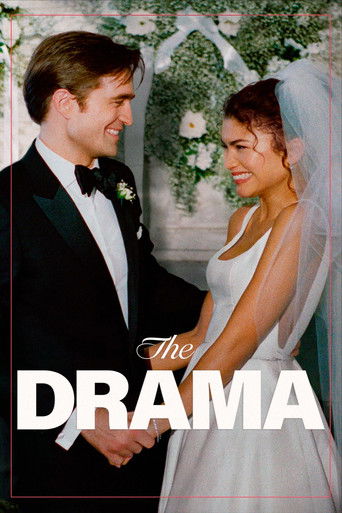
Do you think your relationship would survive if your partner knew your darkest secret? In The Drama, Charlie (Robert Pattinson), a British museum director, is days away from marrying Emma (Zendaya), a bookstore clerk from Baton Rouge, when a parlor game makes them question what they truly know of each other. Written and directed by Kristoffer Borgli, it is a dark romantic comedy about the price of total honesty, putting both characters in genuinely uncomfortable situations as they wonder whether one confession can undo everything they have built together.
BACKGROUND
The film continues themes Borgli explored in Sick of Myself and the inventive but unfocused Dream Scenario, of how people build performances around themselves, and how humiliation drives the true self to appear. Compared to those films, The Drama works with a far more grounded context: a couple in love. A24 packaged it as a mainstream event, releasing on Easter weekend and leaning heavily on the chemistry between two of the most bankable and likable young stars working today to attract unsuspecting couples, while efficiently keeping its true themes under wraps. By 2026, the studio had found real commercial traction in adult romances, with Materialists and We Live in Time both performing very well. The Drama looks, on the surface, like another entry in that run, although the topics it explores are far more daring and will make a considerable amount of viewers uncomfortable.
THE REVIEW
Contrary to what the cute poster might suggest, The Drama is a film that puts viewers to work, asking complex questions that prompt reflection and shape their own takes while watching (for that, please try going in without knowing the twist!). It aims for the same discomfort that Dream Scenario and Luca Guadagnino’s After the Hunt sought, but it does a much better job than either of them at keeping the audience alongside its protagonists. It also invites comparison with Force Majeure and Scandinavian cinema in general, capturing some of the awkwardness associated with those films, though its conclusion is slightly sugar-coated. It has the feel of a Hollywood film in conversation with European cinema.
It is Borgli’s best film yet, carrying over what already made his earlier work appealing, an intriguing central concept, inspired work with actors, and a consistently funny script, while showing real growth in how tightly he controls the premise. He keeps the film focused, lets the tension breathe without throwing too many ideas onto the table, and builds discomfort admirably through precise editing and deliberate framing.
Much of the film’s success rests on Zendaya and Pattinson, who are instantly convincing together. The meet-cute scenes that open the film provide some of the most memorable romantic moments in recent years, and the way Borgli captures their first awkward date and kiss is so charming that you cannot help but smile. As the film progresses, he begins to challenge not only those scenes but also the image we have built around the actors themselves. Zendaya often carries herself with such composure that her screen presence can feel almost untouchable, while Pattinson has spent years leaning into nervousness, eccentricity, and emotional fragility (best seen in Mickey 17, perhaps his best performance to date), and part of the film’s pleasure comes from watching that balance shift in unexpected ways. Both are also excellent at keeping the audience wondering what is actually going through their heads, with layers of feeling surfacing through looks and pauses. Zendaya, in particular, gets some very strong scenes of vulnerability in the final act.
Around them is a movie that moves economically and is very intentional about how it delivers information to the audience. There are well-executed detours that break the tension, such as the hilarious moment with a wedding photographer (played by a scene-stealing Zoë Winters). Elegant quick cuts give tiny glimpses of what characters fear, imagine, or briefly convince themselves is happening. In one good moment, Emma looks at Charlie and momentarily imagines him laughing at what just happened, only for the film to cut back and show him still drifting in discomfort.
The film’s best sequence comes in the pivotal scene where the secret is revealed. It grows from a casual, funny conversation into something unbearable, with the camera moving closer and closer to the characters, tightening the frame through extreme close-ups that make the scene suffocating. When a waitress interrupts, and the framing momentarily loosens, the tension is instantly released. It is an exquisitely performed and edited moment that arrives early, and the film is never quite able to top it, no matter how hard it tries to escalate in its climactic passages.
While the film is very good at exploring how the couple’s dynamic shifts once the true self appears, I am not sure the means used to get there was the most appropriate choice, as it invites a conversation the film is not really interested in exploring: what truly drove such a character to arrive at a certain point. It is as if that theme needs a whole film built around it and cannot be shared with other concerns. Borgli does his best to keep the focus on the main discussion he wants to have, but for some viewers, it will be hard to look past it. Where he gets it right is in the contrast between someone like Rachel, who admits a cruel action almost proudly while being only partially honest, and the deeper revelation that triggers everything. Whatever you feel about the subject itself, that kind of raw honesty deserves to be valued. I did not fully buy every turn the film takes with its characters, especially regarding the arc of the one who received the confession, and a braver film might have pushed toward a more challenging conclusion. But The Drama handles it all with more grace than most would.
FINAL THOUGHTS
As you can probably tell, even with some reservations, I admired The Drama quite a lot. It is stylish without being showy, and moves with far more precision than Dream Scenario, which kept losing its grip on the material as it went on. The film may not fully land its conclusion, but it will spark real conversation between couples. That alone makes it one of the more interesting relationship films I have seen in a while.
- 1Everytime
- 2Hadestown: The Musical
- 3Tuner
- 4Minotaur
- 5You Can See Everything
- 28The Drama#28 of 218
- Where to watch
 Paramount Plus
- Where to watch
 Prime Video
 Play trailer


- Original title
- The Drama
- Director
- Kristoffer Borgli
- Cast
- Zendaya, Robert Pattinson, Alana Haim, Mamoudou Athie, Hailey Benton Gates, Sydney Lemmon, Hannah Gross, Anna Baryshnikov
- Rated
- 14A
- Screenwriter
- Kristoffer Borgli
- Composer
- Daniel Pemberton
- Cinematography
- Arseni Khachaturan
- Editor
- Joshua Raymond Lee, Kristoffer Borgli
- Country
- Language
- English
- Budget
- $28 million
- Box office
- $132.588 million