
PREMISE (WHAT IS IT ABOUT)
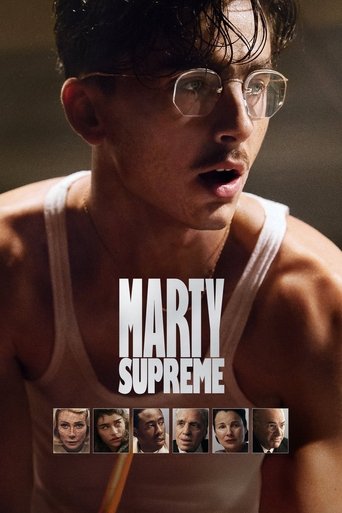
Loosely inspired by Marty Reisman’s autobiography, Marty Supreme follows a young man utterly convinced he is the greatest ping pong player alive and only needs the right chance to prove it. His talent is as big as his mouth, and Marty is the kind of guy who will bluntly tell his pregnant girlfriend she has no purpose in life. That ruthless honesty opens doors and closes others, and once he refuses an offer to throw a match for a marketing stunt, he has only a few days to gather the money for the next big tournament, pushing him into one of the most stressful weeks of his life.
CONTEXT (WHERE IT COMES FROM)
After the one two punch of Good Time and Uncut Gems turned the Safdie brothers into recognizable and admired filmmakers, 2025 marked their decision to work separately in pursuit of different creative paths. Benny’s The Smashing Machine earned a middling response from critics and audiences, while Josh stepped into A24’s largest budget to date for a far more expansive project. He rooted the film in the overlooked ping pong subculture of the early 1950s, drawing loosely from Marty Reisman’s autobiography and from his own childhood memories of New York table tennis clubs. That foundation shaped a story about ambition hardening into obsession, built with the same high energy and abrasive momentum that defined the brothers’ earlier collaborations. A24’s investment made room for extensive period reconstruction through practical sets, film stock, and a wide cast of background performers, while Timothée Chalamet’s long preparation and physical commitment positioned the film as a serious awards contender.
EXECUTION (HOW IT WORKS ON SCREEN)
Despite the brothers saying in interviews that the split came from a desire to explore new paths, it is ironic how Marty Supreme and The Smashing Machine circle many of the same ideas. Benny’s film takes a quieter, more wounded approach within the familiar mold of the sports biopic, leading many to overlook its portrait of a man unable to accept his own limits. His film is louder, more chaotic, and much more willing to ride its protagonist into uncomfortable territory. The Scorsese influence is evident, especially in the momentum and nocturnal paranoia of After Hours, which push Marty into darker, stranger corners.
The film benefits enormously from Daniel Lopatin’s textured, almost swaggering score, which maintains a steady tension even in the quieter passages, and Darius Khondji’s equally dynamic and memorable cinematography. Josh Safdie and Ronald Bronstein, who collaborate in the edit as much as in the writing,shape the film with a rhythm that never loses its grip. Like One Battle After Another, and in a completely opposite way from Benny’s film, Marty Supreme makes its long runtime feel like a breeze. It keeps feeding new information while circling back to earlier events and consequences. The opening stretch is the highlight. A self-contained prologue, followed by a creative title sequence and a tight thirty minutes that follow Marty’s first attempt to become a world champion, shows the two at their best in building character and momentum.
After the unexpected loss, Marty returns home and faces the crash of that failure, already planning how to reclaim his victory in the next tournament. When he receives an offer to lose again to the Japanese player who beat him as part of a marketing ploy, he rejects it outright, convinced the previous match was decided through cheating. That illusion he holds about himself, the idea that failure simply does not apply to him, shapes a protagonist who is both captivating and infuriating. It gives Timothée Chalamet the space to show how much he has grown as a performer. The character unfolds almost like a sharpened extension of Chalamet’s public persona, which we saw during his awards campaign for A Complete Unknown. While that persona is entertaining, the performance shines most in the small glances where insecurity slips through the bravado.
He is surrounded by a pitch-perfect cast that deserves recognition in the new Best Casting Oscar category. Kevin O’Leary brings authority and menace to Milton Rockwell. Gwyneth Paltrow delivers one of the best performances of her career. Abel Ferrara creates a character who is instantly memorable. Odessa A’zion emerges as a star. Even the smallest roles, often played by non-actors, leave a strong impression.
For all of this, the film does not replace Uncut Gems as the defining Safdie work. There are moments where Benny’s absence is felt. Just as The Smashing Machine needed more of Josh’s energy, this film occasionally needs more of Benny’s warmth. As strong as the scenes between Chalamet and A’zion are, their affection reads closer to a sibling bond. That is where the film slightly misses the chance to explore Marty’s internal emptiness with the depth the script suggests. The ending especially reaches for an emotional impact that does not fully land, at least not with the force the brothers once achieved together.
IMPACT (FINAL THOUGHTS)
Even so, Marty Supreme stands as one of the best films of 2025. It balances many moving parts with impressive control, and the many ping-pong sequences deliver real cinematic excitement. The energy never drops, even if the emotional core sits just a hair out of reach, close enough to feel but not fully realized. It is easy to imagine that with both brothers shaping it together, it might have reached that last level. Odds are this will be the Safdies’ first step into the Oscars, and something tells me that, like Marty himself, Josh will not stop until he earns that recognition. Lucky us.
Still courtesy of Elevation Pictures.
Still courtesy of Elevation Pictures
- 1Sentimental Value
- 2Hamnet
- 3One Battle After Another
- 4Ne Zha 2
- 5Blue Moon
- 8Marty Supreme#8 of 256
- Where to watch
 Prime Video
- Where to watch
- Prime Video
 Play trailer


- Original title
- Marty Supreme
- Director
- Josh Safdie
- Cast
- Timothée Chalamet, Gwyneth Paltrow, Odessa A'zion, Kevin O'Leary, Tyler, The Creator, Fran Drescher, Abel Ferrara
- Rated
- 14A
- Screenwriter
- Josh Safdie, Ronald Bronstein, Sammy Harkham
- Composer
- Daniel Lopatin
- Cinematography
- Darius Khondji, Ryan Marie Helfant
- Editor
- Ronald Bronstein, Josh Safdie
- Country

- Language
- English
- Budget
- $65 million
- Box office
- $192.406 million
- Distributor (CA)
- Elevation Pictures