
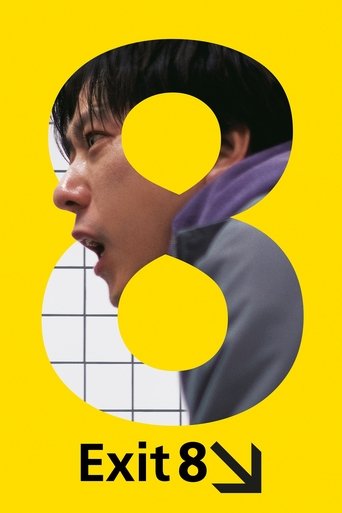
In 2024 a global survey indicated that people now spend more time watching others play video games on Twitch and YouTube than playing them themselves. The player becomes a host for viewers, who cheer in real time or offer help in the chat, turning it into a communal experience. Yet this feeling of watching someone play is rarely a priority in film adaptations. Most settle for reproducing characters and worlds in live action as faithfully as possible. Films such as Super Mario Bros. or Minecraft are praised as “faithful” simply for piling in cameos and hidden details, while never attempting to replicate the actual mechanics. Exit 8 at least starts with the promising idea of being the host and inviting us to join in. The problem is that the original game was too short to sustain a feature-length film built so heavily on that approach.
The original Exit 8 is a Japanese indie title with a simple but effective mechanic. Players walk endlessly through a Tokyo subway corridor, scanning for anomalies such as a crooked sign, a cracked ceiling, or a flickering light. Missing one resets the journey. The film leans on this design, placing its audience in the same role, eyes scanning each frame for something out of place. Its protagonist, a young man reeling from a call in which his ex-girlfriend says she is pregnant, enters the corridor and quickly learns the rules. We, like spectators watching a stream, lean forward, spotting anomalies ourselves, almost shouting warnings when he does not see them.
The translation of the actual game is effective. The illusion of endless corridors is well executed, and the design conveys a strong sense of claustrophobia. Some touches, especially involving the creepy NPC-like figures, are effectively unsettling. Others, such as lockers banging from the inside or the protagonist’s asthma, feel overused and less convincing as ways to create tension.
As clever as the setup is, its limits appear quickly. After a few intriguing cycles, the film drifts without meaningful progression. The game-like elements never evolve. New rules are added that work narratively but not within the game’s own logic. The audience knows something must go wrong each time or the story would end, and while the film gestures at breaking this pattern, it never finds a compelling alternative.
Its main attempt is to translate the endless cycle into a metaphor about daily routines and the way people ignore anomalies to keep walking in circles, a theme also explored more effectively this year in It Ends. The idea is relevant, and the opening subway scene hints at it well. Yet the script does not trust the metaphor to resonate on its own, repeating it so bluntly that it feels as if the protagonist might turn to the camera and announce, “Our routines make us all stuck in a loop.” Compounding this is the lack of urgency in his journey. There is no countdown, no pressure, no sense of time running out. Instead, the ‘Lost Man,’ played by Kazunari Ninomiya, is performed competently but written so muted that he comes across as bland.
Entertaining enough in its first act yet confined in every sense, Exit 8 is a film that loses energy quickly. The premise is intriguing and the execution occasionally effective, but without variations, engaging characters, or a stronger exploration of its metaphor, it cannot sustain ninety minutes without repetition giving way to monotony. For a film based on a game built on jolts of discovery and the communal hope of seeing someone succeed, it is not a good sign that much of the experience leaves you bored and disconnected, wishing you could reach the Exit 8 of your own cinema or living room.
Still courtesy of TIFF and Elevation Pictures
Still courtesy of Elevation Pictures
- 1Hadestown: The Musical
- 2Tuner
- 3Minotaur
- 4The Weight
- 5Wicker
- 145Exit 8#145 of 207
- Where to watch
 Shudder
- Where to watch
- Rent or buy at Apple TV Store, Amazon Video
 Play trailer


- Original title
- 8番出口
- Director
- Genki Kawamura
- Cast
- Kazunari Ninomiya, Yamato Kochi, Nana Komatsu, Naru Asanuma, Kotone Hanase, Hirota Otsuka, Tara Nakashima, Reo Soda
- Rated
- 14A
- Screenwriter
- Genki Kawamura, Kentaro Hirase, Kotake Create
- Composer
- Shouhei Amimori, Yasutaka Nakata
- Cinematography
- Keisuke Imamura
- Editor
- Sakura Seya
- Country

- Language
- Japanese
- Budget
- $1.4 million
- Box office
- $43.893 million
- Distributor (CA)
- Elevation Pictures