
OVERVIEW
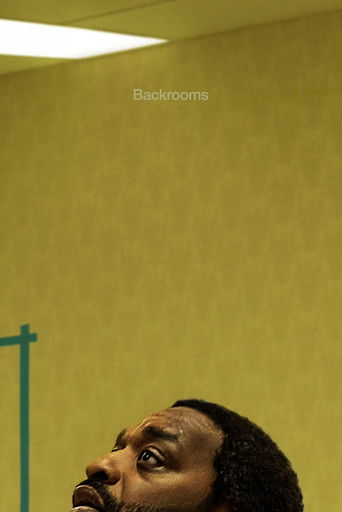
A furniture store owner named Clark (Chiwetel Ejiofor) discovers an entrance to a new dimension of endless yellow rooms in his shop’s basement. As he explores, he realizes that this maze contains distorted versions of reality, some frightening, some strangely appealing. After some time without returning, his therapist Mary (Renate Reinsve) enters the dimension herself to bring him out.
BACKGROUND
The concept behind Backrooms began with a photograph of an empty, yellow-wallpapered room posted on 4chan in 2019. Many were fascinated by the simple image, which quickly became the defining example of liminal horror, including sixteen-year-old Kane Parsons, who taught himself Blender and turned it into a YouTube found-footage series that achieved huge success on no budget. The series grew large enough to spawn video games and a 2024 episode of American Horror Stories. The phenomenon caught A24’s attention, leading to an offer that landed in the middle of his college applications. The studio gave the concept a ten-million-dollar budget, brought in two Oscar-nominated actors, and built a 30,000-square-foot practical set in Vancouver, large enough that cast and crew got lost inside it. Initial box-office numbers indicate that Parsons made the right choice.
THE REVIEW
Two things can’t be denied about Backrooms: first, a creative and intelligent director can turn even an empty room into a source of immense horror, and second, twenty-year-old Parsons is one of these directors.
The film opens with a remarkable seven-minute sequence that could almost stand on its own. Nearly dialogue-free, it drops us directly into the Backrooms, a maze of empty hallways and rooms filled with objects that feel familiar yet deeply wrong. Following a doomed wanderer through the space, Parsons lets the scale, silence, and sound design do most of the work, creating an atmosphere where it becomes increasingly clear that something else is lurking nearby.
Yet, what is far more impressive is how Parsons sustains that dread across an entire feature. Much of it is due to the fantastic production design, built from his own Blender creations, which is consistently fascinating, with each new room inviting audiences to search for anomalies and an escape route. But it is how Parsons patiently unpacks the mystery through negative space and careful framing, making even ordinary locations feel unsettling, that truly sells it. He also maintains a great sense of geography, keeping us as oriented and disoriented as the characters themselves. The film is at its strongest when characters simply explore the endless corridors, letting the fear of the unknown fill the gaps.
Casting Chiwetel Ejiofor and Renate Reinsve gives the film automatic legitimacy, elevating it beyond its YouTube origins. Both commit fully to the material, playing fear and frustration through small shifts in expression. They are better at the restraint needed than at the grand emotional displays the script unnecessarily forces on them.
In familiar A24 fashion, Backrooms eventually turns its premise into a metaphor for people stuck in the past, reliving the same moments rather than moving on and owning their mistakes. It recalls Exit 8, the video game adaptation released earlier in the year, in which everyday repetition serves as the backdrop for a man unable to escape a Japanese subway station. Backrooms is the better film, even if Exit 8 might have had more to say. Both places more weight on their metaphors than they can bear, and simply having them is a mistake.
That becomes clearest in a third-act expository scene delivered by Ejiofor, who sells the moment despite some awkward lines. Parsons simply has little to say on the subject, but thankfully, the horror remains strong. Even when we finally see the monster, whose design is silly but weirdly effective, the film keeps its strange grip. Less effective is the familiar off-key score, which spells out emotions Parsons is already conveying visually. Backrooms works best when it trusts the rooms, the silence, and the feeling that something may or may not be coming closer.
FINAL THOUGHTS
Overall, Backrooms makes a successful jump from YouTube series to feature film, building its dread across the runtime, working best when it keeps things simple and abstract, and earning a few eye rolls when it strains to fit A24’s formula of pushing metaphors everywhere. There will undoubtedly be sequels, and one hopes they remember what made the concept work in the first place, rather than filling its rooms with furniture and turning the strange into the ordinary.
- 1Hadestown: The Musical
- 2Tuner
- 3The Weight
- 4Wicker
- 5Minotaur
- 52Backrooms#52 of 188
- Where to watch
- Rent or buy at Apple TV Store, Amazon Video
- Where to watch
- Rent or buy at Apple TV Store, Amazon Video
 Play trailer


- Original title
- Backrooms
- Director
- Kane Parsons
- Genre
- Horror, Mystery, Science Fiction
- Cast
- Chiwetel Ejiofor, Renate Reinsve, Mark Duplass, Finn Bennett, Lukita Maxwell, Avan Jogia, Robert Bobroczkyi, Ember Ambrose
- Rated
- 14A
- Screenwriter
- Will Soodik
- Composer
- Edo van Breemen, Kane Parsons
- Cinematography
- Jeremy Cox, Jared Boyce
- Editor
- Greg Ng
- Country


- Language
- English
- Budget
- $10 million
- Box office
- $402.488 million
- Distributor (CA)
- Elevation Pictures