
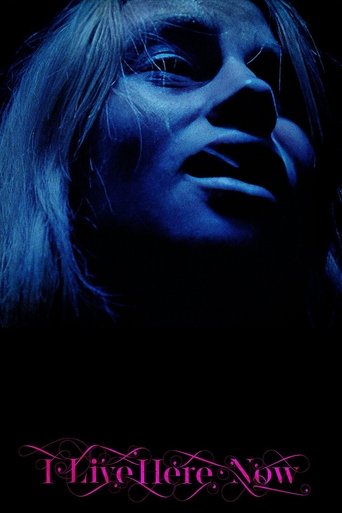
One of my most anticipated films from this year’s Fantasia lineup was I Live Here Now, the debut feature from Julie Pacino, yes, Al’s daughter, which had its world premiere on July 24 in the Compétition Cheval Noir section. Financed through an NFT-driven strategy, shot on 35mm (a choice that demands real discipline), and pitched as a blend of David Lynch, Dario Argento, and the Coen brothers, it promised surrealism, color-soaked nightmares, and a touch of dark comedy. Add to that a cast featuring Twin Peaks’ own Laura Palmer (Sheryl Lee) and comedian Matt Rife, and you can see why I went in with optimistic excitement.
That optimism wavered slightly when Pacino, introducing the film, described it as a story that “uses genre as a way to heal”, a well-meaning comment, but one that struck me as frustratingly narrow. Reducing genre to a purely therapeutic framework undersells its range and potential. Thankfully, the opening 20 minutes deliver: they’re funny, mysterious, and carried by great music and sharp visual direction.
We meet Rose (Lucy Fry), a struggling actress dealing with trauma, body image pressure, and the shock of an unexpected pregnancy she didn’t think was possible. After an awkward, uncomfortable encounter with her boyfriend’s domineering mother, played with eerie intensity by Sheryl Lee in what turns out to be the film’s best scene, Rose retreats to a remote hotel to clear her head and figure out what to do. It’s there that the film slips into abstraction: a hazy dreamworld where reality and imagination blur, memories resurface, and Rose’s fractured psyche is laid bare. And it’s there that the film starts to lose its footing.
The narrative leans heavily on tropes of hallucinations, drug-induced confusion, and reality-bending reveals, only to fall into a repetitive rhythm of dream/hallucination fake-outs. By the second, it already feels like a cop-out. By the third, the film is spinning its wheels. There are visually striking moments, yes, but without consequence or tension, their impact fades. (In the Q&A after the screening, Pacino said she loves movies that “pull the rug” from the audience and take them to unexpected places, even boldly comparing her film’s structure to Parasite. But ironically, once Rose arrives at the hotel, I Live Here Now becomes quite easy to predict.)
This might be more forgivable if the film had a stronger emotional core. Rose’s journey touches on so many ideas, motherhood, body autonomy, career anxiety, maternal wounds, societal pressure, identity, that none of them are given enough space to truly resonate. The film wants Rose to represent the modern woman as a vessel of trauma, but in trying to cover everything, it ends up saying very little. Lucy Fry is committed, but the script gives her a character that feels more like a collection of metaphors than a fully realized person.
Another issue is how closely the film clings to its influences. It’s beautifully shot, and the production design and score are often fantastic, but instead of feeling like a love letter to Lynch or Argento, it often plays like an imitation, much like how Don’t Worry Darling borrowed heavily from Weir and Peele. The references are always visible, but the film rarely builds something new from them. Like its protagonist, it struggles to form its own identity.
Ironically, I Live Here Now is most effective when it steps away from the surreal and leans into grounded, awkward humor. Sarah Rich has a few great scenes as Sid, but it’s Matt Rife’s Travis and Sheryl Lee’s Martha who truly steal the show, even when they’re just voices on the phone. Their dynamic feels sharp, darkly funny, and emotionally grounded in a way the rest of the film doesn’t. A hilarious portrait of Travis, and a simple instruction from Martha about how Rose can get to the bathroom, are far more memorable than any of the elaborate metaphors or dream sequences that follow. (Lee, by the way, needs more movie roles.)
There are great genre films that engage with trauma, but the best ones don’t treat horror as a therapy session, they let the horror be the emotion, strange and unresolved. I Live Here Now gestures toward that, but often stops short of letting the genre actually carry the weight. By the end, the film lands on a metaphor that’s both expected and underwhelming. There’s no doubt Julie Pacino has vision, her eye for tone and atmosphere is clear, but I Live Here Now is a film that needed to strip away half its ideas, focus more deliberately on two or three of them, and let its protagonist become more than a symbol. What’s left is a film full of ambition and style, but emotionally adrift. It wants to explore what it means to heal, but never quite finds its way through the fog.
- 1Everytime
- 2Hadestown: The Musical
- 3Tuner
- 4Minotaur
- 5You Can See Everything
- 185I Live Here Now#185 of 219
- Where to watch
- Rent or buy at Apple TV Store
- Where to watch
- Out of Theaters


- Original title
- I Live Here Now
- Director
- Julie Pacino
- Cast
- Lucy Fry, Sarah Rich, Madeline Brewer, Lara Clear, Matt Rife, Sheryl Lee, Cara Seymour, Alex Gaumond
- Screenwriter
- Julie Pacino
- Composer
- Jackson Greenberg, Pam Autuori
- Cinematography
- Aron Meinhardt
- Editor
- Matyas Fekete, Raaghav Minocha
- Country


- Language
- English