
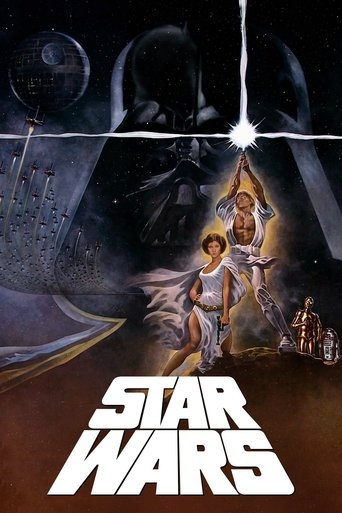

Contrary to what George Lucas insists, I don’t believe that when he wrote and directed the originally titled Star Wars in 1977 (the “Episode IV” and A New Hope subtitles came later), he had any concrete plans—nor even the faintest idea—of what the series would become. Nervous about the film’s reception, he famously went on vacation to Hawaii during its premiere. It’s strange to imagine an alternate timeline where that throne room scene was the last we ever saw of the galaxy far, far away, but that was certainly a possibility. I don’t think he had yet decided that Darth Vader was Luke’s father, much less that Luke and Leia were siblings. And with all the baggage built since its release—retroactive character arcs, lore insertions from the prequel trilogy, plot-hole patching from Andor and Rogue One, hideous special effects changes, and everything else—it’s hard to judge A New Hope purely as the 1977 film it once was.
And yet, even through all the noise, one thing remains clear: Star Wars was unlike anything else released that year—or, really, at the time. Its characters are instantly iconic. Its story is simple but captivating. The climax is thrilling. And the film carries itself with the weight of myth—less like a movie and more like a sacred text from a parallel universe. Countless franchises throughout the ’80s tried to replicate its success. None came close. So what made Star Wars the juggernaut it became?
I think it comes down to two key reasons. The first is world-building—a term that’s overused now, but in 1977, it felt bold and fresh. Star Wars suggests a universe that didn’t begin when the film started, and wouldn’t end when it stopped. The Force, the Clone Wars, Jawas scavenging the desert, Wookiees with their violent tempers, Sand People defending their land—everything hints at a galaxy with its own deep history. The film never pauses to explain most of it, or does so casually, and that’s what makes the world feel textured and real. That sense of immersion is helped by the fantastic production design: the imperial corridors, the gleam of the lightsaber, the battered hull of the Millennium Falcon, the angular terror of the Death Star, Leia’s unmistakable hair, Vader’s helmet, the robes, the ships. All of it now taken for granted, but still full of creativity.
The second pillar that elevates Star Wars is John Williams’ score—arguably the most important and consistent element across the entire saga. Right from the opening title, his music gives the film a sense of scale and importance that the visuals alone couldn’t fully deliver. The effects were groundbreaking, but it’s the music that holds the emotion together. Each theme shapes how we respond to the characters and the world around them. Leia’s Theme, for instance, adds a sense of grace that the script doesn’t really give her, and it subtly frames the Rebellion as the side we’re meant to root for. The Force Theme feels ancient and spiritual, bringing significant weight to the story and grounding it in something deeper. Even before the Imperial March was introduced, the Empire already felt massive and intimidating, thanks to how the music handled their presence. The Death Star, in particular, becomes more frightening because of the way Williams builds suspense around it. Without the score, Star Wars might still have looked good—but it wouldn’t have carried the same impact.
Together, world-building and score create the illusion of a fully realized universe—one with depth, history, and stakes. It’s why the destruction of Alderaan doesn’t require long speeches or dramatic cutaways. The music and the mythology do the work. They let the audience feel the weight, even when the film doesn’t slow down to explain it.
And while those are the film’s most defining strengths, the rest of the construction is often just as clever. Aside from a slightly sluggish stretch with the droids early on, the pacing is near perfect. Scenes breathe. Characters are introduced clearly and efficiently. Action arrives in well-measured doses, never overwhelming the human moments. Dialogue-heavy interludes—like Obi-Wan’s explanation of the Force—don’t drag and effectively anchor the story. There’s also a sense of adventure running through it—an earnest, fresh energy that only The Force Awakens, despite all its flaws, would come close to recapturing decades later. And the villains are used wisely—menacing but arrogant, intimidating yet flawed.
None of this happened by accident. Lucas, who had already proven himself a visionary director with THX 1138 and American Graffiti, screened an early cut for a group of heavyweight friends—Spielberg, De Palma, Coppola, Milius—and most were baffled. Spielberg, ever the visionary, was the only one who truly saw what Star Wars could become. Lucas took the feedback seriously. He tightened the first act, polished the edit, restructured the opening—and the result is a film that moves like clockwork but never feels mechanical. Listen to feedback, folks.
The casting, too, is deceptively sharp. Not all the performances are conventionally strong—Hamill is occasionally uneven, Ford hadn’t quite nailed the charm/selfishness balance, and Alec Guinness’s Oscar nomination was likely more about reputation than delivery. Peter Cushing, as Tarkin, gives the best performance in the film. But the actors look right. Hamill’s innocence fits Luke’s journey. Fisher’s defiance is baked into her every expression—something she had already shown in Shampoo. And she gives the script an edge it badly needs. Even the clunkier lines land better with her delivery. She looked at something like “Aren’t you a little short for a stormtrooper?” and made it ironic enough that it worked. Her verbal sparring with Tarkin about the Empire’s slipping control remains one of the sharpest written moments in the saga—at least until Andor came along.
So no, A New Hope wasn’t just spectacle. There was substance beneath the flash. Of course, some effects haven’t aged well—the X-wing battles still look remarkably good, but the lightsaber duel between Vader and Obi-Wan will always earn a chuckle. Still, A New Hope laid the foundation. It wasn’t yet a masterpiece, but it created the conditions for one. The Empire Strikes Back would take the franchise to deeper emotional and cinematic heights, but this film—the first—was a remarkable achievement on its own. It imagined a galaxy, then gave it form. And over the decades, that galaxy became a playground for countless stories, games, comics, series, and films. But it all started here.
- Where to watch
 Disney+
- Where to watch
- Disney+
 Play trailer


- Original title
- Star Wars
- Director
- George Lucas
- Genre
- Adventure, Action, Science Fiction
- Cast
- Mark Hamill, Harrison Ford, Carrie Fisher, Peter Cushing, Alec Guinness, Anthony Daniels, Kenny Baker, Peter Mayhew
- Rated
- PG
- Screenwriter
- George Lucas
- Composer
- John Williams
- Cinematography
- Gilbert Taylor
- Editor
- Richard Chew, Marcia Lucas, Paul Hirsch
- Country
- Language
- English
- Budget
- $11 million
- Box office
- $775.398 million