
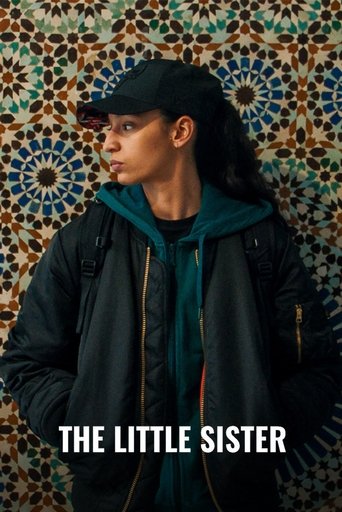
In a film like The Little Sister, it is easy to mistake restraint for depth. Stories about shy and introverted protagonists can appear subtle, when in fact they often say very little beneath the long and quiet stares into the void. This is the case with French-Algerian filmmaker Hafsia Herzi, making her first appearance in Cannes’ official competition after her previous feature screened in Un Certain Regard. Some audiences may leave believing they have watched a young woman bloom before their eyes, reading profound transformation into the smallest gestures. What they are really seeing is a striking new actress with an intense screen presence, trapped in a script that leans on the most familiar clichés of European queer coming-of-age cinema while circling timidly around its more difficult questions. What remains is a faint echo of Blue Is the Warmest Colour, with only a trace of that film’s urgency and depth.
Adapted from Fatima Daas’s autobiographical novel, the film follows a 17-year-old Muslim girl as she tries to make sense of her desire, her faith, and the expectations placed on her. It suggests a collision of identities in religion, queerness, and family, but never allows them to collide. Instead, it moves through familiar steps such as the half-hearted romance with a boy, the first stolen glance, the quiet panic of discovery, and a relationship that never finds real heat. Scenes play out in silences and hesitant looks, as though intimacy can be implied rather than earned. Restraint can be powerful, but here it comes across as fear. What could have been piercing feels instead like detachment, too careful and too mannered to speak plainly.
That reluctance shows itself in the details. A classmate mocks Fatima for being a lesbian, then vanishes from the story. A romance begins and ends without conviction, lacking both chemistry and heartbreak. A conversation with an imam is set up as if it will open something profound, but it dissolves almost immediately. A similar scene with her mother cuts away just when it might strike a chord. Again and again, the film lays out moments that seem ready for conflict or revelation, only to retreat before they matter. The result is a film that gestures toward depth while circling endlessly around the surface.
The one element that rises above everything else is Nadia Melliti, making her debut as Fatima. She has a magnetic presence, quiet and searching, with the sense of an inner life the script never puts into words. She deserved stronger material. Trapped in a romance without spark and surrounded by a family the film leaves unexplored, her performance cannot overcome the emptiness around her. Two brief encounters with older queer women hint at something richer but pass too quickly to leave an impression. In the end, The Little Sister is left with empty introspection.
- 1Sentimental Value
- 2Hamnet
- 3One Battle After Another
- 4Ne Zha 2
- 5Blue Moon
- 232The Little Sister#232 of 256
- 1Sentimental Value
- 2Hamnet
- 3Blue Moon
- 4Sirāt
- 5Tuner
- 69The Little Sister#69 of 74
- 1Sentimental Value
- 2Sirāt
- 3The Plague
- 4Arco
- 5Resurrection
- 27The Little Sister#27 of 28
- Where to watch
 Criterion Channel
- Where to watch
- Not available for streaming
 Play trailer


- Original title
- La Petite Dernière
- Director
- Hafsia Herzi
- Cast
- Nadia Melliti, Park Ji-min, Amina Ben Mohamed, Rita Benmannana, Melissa Guers, Razzak Ridha, Louis Memmi, Anouar Kardellas
- Screenwriter
- Hafsia Herzi
- Composer
- Amine Bouhafa
- Cinematography
- Jérémie Attard
- Editor
- Géraldine Mangenot
- Country

- Language
- French