
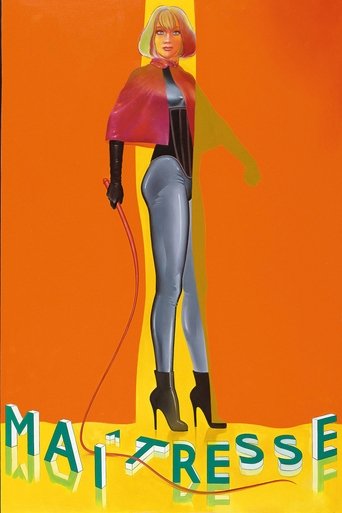

Many years before Fifty Shades of Grey, Maîtresse dared to blur the lines between romance, power, and taboo. Barbet Schroeder’s provocative 1976 drama follows Olivier (Gérard Depardieu), a small-time thief who, during a break-in at a Paris apartment, stumbles upon a fully equipped BDSM dungeon, and its enigmatic owner, Ariane (Bulle Ogier), a professional dominatrix. As they develop a relationship, Olivier’s understanding of love and control is challenged. The film, in turn, seeks to explore the complex dynamics of intimacy through its candid portrayal of unconventional lifestyles, all while refusing to moralize.
Cinema is often about exploring ideas, and while Maîtresse bravely brings its themes to the screen, it sometimes feels more preoccupied with presenting its subject matter than deeply examining it. As an educational piece, if we can call it that, the film succeeds. The first act is shrouded in mystery, slowly unveiling details about the practices it portrays. By the end, we gain a clear picture of what this world entails.
The film avoids passing judgment on its characters, which feels refreshing for its time, though its detachment occasionally results in a lack of emotional depth or narrative drive. It doesn’t fully delve into the psychology or motivations of those involved in this lifestyle, opting instead to let the practices speak for themselves. While this approach normalizes the subject matter, it also leaves the film feeling hollow in places.
We do get glimpses of Ariane’s backstory, which helps us understand her attraction to Olivier, a quiet but imposing presence. Depardieu, in an early role, gives a performance that leans more on physicality than emotional nuance, and his dynamic with Ogier is explored well enough, even if it never feels particularly revelatory. Olivier’s predictable discomfort with Ariane’s profession offers a clear critique of societal hypocrisy, but the film’s resolution, a seemingly happy ending, undermines this point. Some might interpret the conclusion as ironic or bittersweet, reflecting Olivier’s inability to fully reconcile with Ariane’s world, but it still feels overly neat compared to the complexity of the themes introduced earlier.
What the film misses is an opportunity to dive deeper into the more compelling aspects of its subject: what drives people to engage in or submit to these practices? The dominated individuals are barely explored, reducing them to props in Ariane’s world. This absence leaves a significant gap, as the narrative could have been richer with more nuanced perspectives. In the end, Maîtresse sets up an intriguing premise and delivers a strong first act, but it ultimately falters in execution. It feels more concerned with shocking the audience than truly challenging them, and its reluctance to engage with deeper questions about its characters’ desires or vulnerabilities prevents it from reaching its full potential.
- 1Rocky
- 2Taxi Driver
- 3Assault on Precinct 13
- 4Kings of the Road
- 5All the President's Men
- 34Maîtresse#34 of 51
- Where to watch
 Criterion Channel
- Where to watch
- Not available for streaming
 Play trailer


- Original title
- Maîtresse
- Director
- Barbet Schroeder
- Cast
- Gérard Depardieu, Bulle Ogier, André Rouyer, Nathalie Keryan, Roland Bertin, Tony Taffin, Holger Löwenadler, Anny Bartanovski
- Screenwriter
- Barbet Schroeder, Paul Voujargol
- Cinematography
- Néstor Almendros
- Editor
- Denise de Casabianca
- Country

- Language
- French