
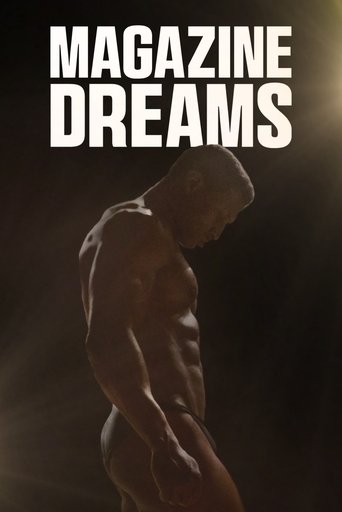
It’s hard not to draw parallels between Jonathan Majors’ career and the title of Magazine Dreams. When the film premiered at Sundance in January 2023, everything pointed to it being his moment, his transition into Hollywood’s A-list. Majors’ performance was singled out as extraordinary, and Searchlight quickly acquired the film, setting a strategic release for awards season. On top of that, he had been steadily building a fan base with standout performances in The Harder They Fall and Loki, was positioned as the next major MCU villain, and had Creed III coming up (which turned out to be really good). Then, just days after Creed III’s release, he was accused of assaulting his girlfriend. More accusations followed, leading to his removal from the MCU, and with that, Magazine Dreams was quietly shelved and removed from release schedules. Searchlight eventually sold the rights back to the filmmakers, and over two years later, the film is finally set to be released in March 2025, long after Majors has faded from public conversation. Would the film, or Majors, have gotten any awards attention? It’s impossible to say. The Oscars have surprised me before, but given how much this performance demands attention, he certainly would have been in the conversation.
The film itself draws heavy comparisons to Joker (2019), with touches of Taxi Driver, as it presents a bleak portrait of mental illness, societal neglect, and an unstable protagonist yearning for connection. Majors plays Killian Maddox, an aspiring bodybuilder obsessed with magazine stardom. His life is consumed by extreme workouts, steroid abuse, and self-inflicted pressure, all while he struggles with crushing loneliness. Just a few minutes into the film, we already understand everything about Killian, his room is plastered with bodybuilding posters, and despite caring for his grandfather, there is little else to his world and routine.
Majors is undeniably committed to the role. Physically, he’s massive, and his performance is just as commanding, every blink, every breath, every movement is deliberate and heightened, constantly demanding attention. There’s little breathing room in his performance, except in his early scenes with Jessie (Haley Bennett), particularly a restaurant scene that perfectly balances being touching, disturbing, and darkly comedic, easily the strongest moment in the film. But after this scene, the movie struggles to find meaningful directions for the character.
Much like Joker, Magazine Dreams stacks the deck against its protagonist with easy targets, whether it’s a former judge who criticized Killian’s physique or a bodybuilder he once idolized. Adding a tragic backstory to this, the film attempts to justify some of Killian’s more disturbing actions by framing them as symptoms of his mental illness. This is where the film undermines itself. The world of bodybuilding, the isolation, and the relentless pressure to maintain a sculpted physique should be more than enough to explore. But by doubling down on the tragedy and making mental illness such a focal point, and occasionally playing it for laughs, like when Killian breaks into a paint store, the film loses sight of its own gravity.
It also makes Killian’s arc difficult to follow. By the end, the film clearly wants us to root for Killian, framing him as a victim of a cruel and indifferent society. But does that excuse some of his truly dreadful actions? There are a couple of well-executed therapy scenes, but I wish the film had focused even more on that aspect, giving the character a more developed journey that reckons with his mistakes rather than simply explaining them away.
Technically, the film is well-crafted, with the suffocating atmosphere that director Elijah Bynum aims for coming through in the claustrophobic cinematography and oppressive score. Aside from a few humorous moments, his awkwardly recorded video, the restaurant scene, the film is relentlessly bleak and difficult to watch. In the second half, it falls into a few frustrating tropes, including visions and fake endings (four of them). When the film finally does end, it chooses the weakest of the options available, there was a great moment to close things off ten minutes earlier, but it didn’t take it.
Majors delivers a precise, technically impressive performance, but the film’s messaging works against him, making it difficult to fully engage with the character. Bodybuilding is rarely explored in cinema (Love Lies Bleeding did it exceptionally well last year), and Magazine Dreams had the opportunity to dive into that world with more nuance. Instead, it feels like a more muscular Joker, a film more interested in shouting at society than examining it, ultimately serving as a showcase for an actor whose career may never take off as intended.
Verdict: Majors gives a show-stopping performance, but the film struggles to say anything meaningful about its subject. Rather than truly exploring bodybuilding culture and the pressures of physical perfection, Magazine Dreams relies too much on a Joker-style descent into madness without fully considering the implications of its messaging. Ambitious, but unfocused.
Still courtesy of Briarcliff Entertainment
- 1Sentimental Value
- 2Hamnet
- 3One Battle After Another
- 4Ne Zha 2
- 5Blue Moon
- 176Magazine Dreams#176 of 256
- Where to watch
- Rent or buy at Apple TV Store, YouTube, Amazon Video
- Where to watch
- Not available for streaming
 Play trailer


- Original title
- Magazine Dreams
- Director
- Elijah Bynum
- Genre
- Drama
- Cast
- Jonathan Majors, Haley Bennett, Taylour Paige, Harrison Page, Harriet Sansom Harris, Mike O'Hearn, Bradley Stryker, Craig Cackowski
- Rated
- R
- Screenwriter
- Sienne Josselin Mascareñas Diaz, Elijah Bynum
- Composer
- Jason Hill
- Cinematography
- Matthias Schubert, Adam Arkapaw
- Editor
- Jon Otazua
- Country

- Language
- English
- Box office
- $1.076 million
- Distributor (CA)
- Briarcliff Entertainment