
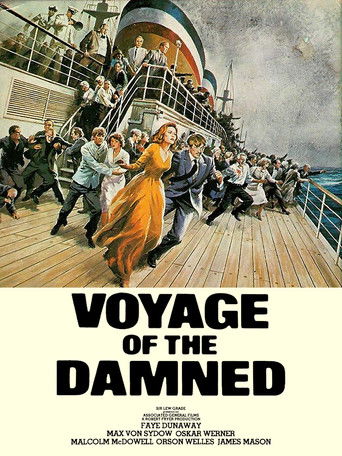

As part of my Catching Up: 1976 in Review series, I went into Voyage of the Damned almost completely blind. The only thing I knew came from a quick glance at the poster, and between that and the title, I assumed: yep, another ‘70s disaster film.
Then the movie started, and I was immediately reminded of The Hindenburg (1975), another attempt to add prestige to the disaster genre. At first, I thought this was going for the same approach, but I wasn’t remotely prepared for how far it would lean into tragedy. It goes from Poseidon Adventure campy to Schindler’s List serious. And maybe mixing Nazis, Jewish refugees, and a setup that constantly makes you expect a shipwreck wasn’t the best idea.
The weird thing is that the movie tries to do both. You’ve got big, melodramatic performances and ill-fated romances (turns out Jack and Rose weren’t the only doomed couple in a tragic boat movie), but also long stretches of political intrigue and a third act that abandons the blockbuster elements entirely, going full historical tragedy. It ends on a genuinely bleak note, which should work given the real-life story, yet it clashes with everything that came before.
The film is based on the real voyage of the MS St. Louis, a German ocean liner that set sail in May 1939, carrying over 900 Jewish refugees escaping Nazi Germany. They believed they were heading toward freedom in Cuba, but upon arrival, they were denied entry. The U.S. and Canada also refused to accept them, forcing the ship to return to Europe, where many later became Holocaust victims.
This story is way too heavy to fit within the Hollywood disaster movie mold, but because the film follows the disaster formula, you spend much of it waiting for a catastrophe that never happens. The huge cast, grand score, and massive scope all make it feel like a traditional disaster buildup, but the real tragedy is bureaucratic indifference.
It’s hard to tell exactly what the movie was aiming for. Was it deliberately subverting expectations or just using the disaster genre to make a serious film more marketable? Either way, the result is uneven. The shipboard drama is engaging, but the land-based political scenes slow things down. Key moments that should be heartbreaking end up feeling unintentionally ridiculous, like a character’s suicide attempt that plays out in an almost laughable way.
There are things to appreciate. The real-life event is powerful, and despite the film’s odd structure, you still feel for the characters and their impossible situation. As a big-budget Hollywood production, it’s undeniably impressive. The cast is stacked, Faye Dunaway, Max von Sydow, Orson Welles, James Mason, Malcolm McDowell, Katharine Ross, Lee Grant, and many others. Balancing all these subplots is no small feat, but the film flows better than most ensemble disaster movies.
There are standout performances, Katharine Ross has one of the film’s strongest scenes, while Lee Grant leans fully into Oscar-bait mode (earning a nomination). Her shared moments with Dunaway are melodramatic but oddly compelling. And for the first time, I actually found Malcolm McDowell likable, which was unexpected. The production value is also impressive, the ship looks fantastic, and Lalo Schifrin’s Oscar-nominated score is grand and sweeping. It feels like an event film.
But as a retelling of history, the film dilutes the real-life tragedy, turning it into the backdrop of a passable but not particularly tense or thrilling disaster film. It’s polished, well-acted, and compelling in parts, but it never fully commits to being either a prestige drama or a gripping thriller, which makes it feel like an uneasy hybrid of both.
Maybe in 1976, a glossy disaster-movie framework was the only way to get this story made on such a grand scale. But watching it now, that choice softens the impact of the real-life tragedy, leaving it feeling like a disaster film without a disaster.
- Where to watch
 Not available for streaming
 Not available for streaming
 Play trailer


- Original title
- Voyage of the Damned
- Director
- Stuart Rosenberg
- Cast
- Faye Dunaway, Oskar Werner, Lee Grant, Sam Wanamaker, Lynne Frederick, David de Keyser, Luther Adler, Wendy Hiller
- Screenwriter
- David Butler, Steve Shagan
- Composer
- Lalo Schifrin
- Cinematography
- Billy Williams
- Editor
- Tom Priestley, Desmond Saunders
- Country

- Language
- English
- Budget
- $7.3 million