
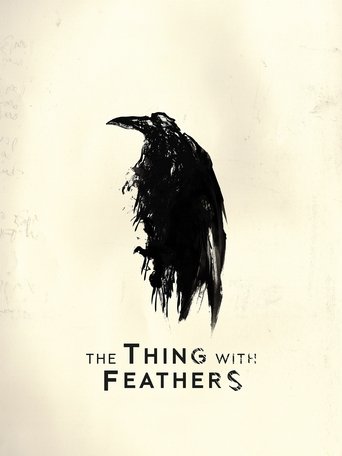
The Thing with Feathers adapts Max Porter’s novel Grief Is the Thing with Feathers, a critically acclaimed work known for its experimental structure and deep exploration of grief and healing. The story follows a widowed father and his two sons as they struggle to cope with the sudden loss of their mother. In the novel, their grief takes the form of a crow, a dark, haunting presence that embodies their pain. Dylan Southern’s film remains faithful to the book’s fragmented, poetic tone but adds that the father is now a graphic novel artist, and the crow emerges as a physical manifestation of his drawings, symbolizing his internal battle with grief.
Southern’s approach leans heavily into horror, evoking the atmospheric terror of psychological-supernatural hybrid films like Hereditary, The Witch, and It Follows. The film most closely echoes The Babadook in its thematic exploration of loss. However, unlike those films, the horror in The Thing with Feathers gradually takes a backseat, becoming less prominent as the narrative grows more abstract, a choice that ultimately undercuts the tension and loses its grip on viewers.
Technically, the horror elements are impressive. The sound design is evocative, and the visuals, especially the crow’s design and the editing choices, are striking. Yet Southern’s background in music videos is evident, as the horror sequences often feel like standalone, visually inventive moments rather than cohesive parts of a narrative. These scenes hit hard but don’t linger, relying more on flashy bursts than the creeping dread that would truly unsettle viewers.
The emotional core of the story, centered on the father and his two sons, also struggles to connect. While the book’s choice to leave the characters unnamed helped make the story feel universal, this same decision creates distance in the film. The two sons, though well-acted by their sibling performers, lack distinguishing traits, making them hard to engage with. If the actors had switched roles halfway through, it wouldn’t have made much difference. Similarly, the family’s limited interaction with the outside world makes the characters feel like placeholders for broader ideas rather than fully realized individuals.
Benedict Cumberbatch anchors the film with a committed performance as the father, diving headfirst into the physical demands of the role. His portrayal recalls Amy Adams in Nightbitch, as he fully embraces the premise without hesitation. However, the script doesn’t give him enough specificity or depth, leaving him to lean on familiar aspects of his screen presence. For a film, viewers need something to latch onto, whether it’s compelling characters or a gripping narrative. Southern’s decision to adapt the book’s poetic style literally leads to a series of intriguing, visually striking scenes that effectively depict grief’s stages but fail to come together as a cohesive narrative. While moments like the family sitting together on a couch in the third act are deeply moving and carry a meaningful message, the overall story remains emotionally distant and struggles to fully engage.
In the end, The Thing with Feathers is a visually inventive yet emotionally distant film. While its horror elements are technically impressive and its exploration of grief delivers a few powerful moments, the lack of character depth, an engaging narrative, and an overly abstract approach prevent it from leaving a lasting emotional impact. It’s a film that feels more like a series of intriguing ideas than a fully realized story.
- 1Sentimental Value
- 2Hamnet
- 3One Battle After Another
- 4Ne Zha 2
- 5Blue Moon
- 194The Thing with Feathers#194 of 256
- 1Kiss of the Spider Woman
- 2The Ballad of Wallis Island
- 3The Wedding Banquet
- 4Together
- 5Twinless
- 23The Thing with Feathers#23 of 27
- Where to watch
- Rent or buy at Apple TV Store, Amazon Video
- Where to watch
- Not available for streaming
 Play trailer


- Original title
- The Thing with Feathers
- Director
- Dylan Southern
- Genre
- Drama
- Cast
- Benedict Cumberbatch, David Thewlis, Sam Spruell, Vinette Robinson, Leo Bill, Garry Cooper, Jessie Cave, Adam Basil
- Rated
- R
- Screenwriter
- Dylan Southern
- Composer
- Zebedee Budworth
- Cinematography
- Ben Fordesman
- Editor
- George Cragg
- Country

- Language
- English
- Budget
- $6 million
- Box office
- 774063